
On the intervening night of July 22-23, 1999, Captain BM Cariappa of 5 PARA was tasked to capture a feature during Operation Vijay (military codename for the Kargil War) in the Batalik Sector in the Kargil district, Ladakh.
He called upon his supporting artillery unit to bring down fire upon his own position. He did so knowing fully well that the lack of safety distance of this fire assault could harm his own troops. The artillery unit brought down fire and destroyed the enemy position and, remarkably, without a scratch on Captain Cariappa or his men. He was awarded the Vir Chakra for his action.
This story illustrates how soldiers develop trust over years of training and operating together. They create a strong bond by understanding each other’s actions. It also reflects the confidence that a fellow soldier will undertake extraordinary risks to ensure the safety of his comrades, while remaining committed to the mission.
But with unmanned and AI-enabled systems, the challenges are entirely uncharted. Trust in these systems has to be engineered, tested, and validated. This is unlike the trust in human relations.
Trust in Data
AI systems are governed by data — if the data is weak, inaccurate or outdated, decisions will be compromised.
Modern warfare relies on attempts to corrupt the data to compromise the AI systems. So, what’s necessary, and should also be integral, is mechanisms for data assurance, authentication, and cybersecurity for military AI systems.
Trust in the Algorithm
Recent operational experiences have highlighted that algorithms can also be wrong. The issues range from model limitations to outdated training data, human oversight, and over-reliance on automation—commonly referred to as automation bias.
But this risk of placing unquestioning faith in automated systems is not unique to the age of artificial intelligence.
Let me illustrate this with an example.
On September 26, 1983, Soviet Air Defence officer Lt Col Stanislav Petrov was informed by an early-warning system that the United States had launched a nuclear missile attack. Every indicator on his console suggested the warning was genuine.
Yet, Petrov hesitated.
He felt that a real first strike would involve far more missiles than the handful being reported. Trusting his judgement, he chose not to report it as an actual attack. He was right. The satellite had mistaken sunlight reflecting off high-altitude clouds for missile launches. His decision is widely regarded as one that may have prevented a nuclear catastrophe.
The lesson remains relevant even today: technology can process information at breakneck speed, but speed does not guarantee correctness.
Trust in an algorithm should be through validation and human understanding and not merely because a machine produced an answer.
Project Maven is Pentagon’s flagship AI initiative, with Palantir Technologies serving as the primary software integrator through the Maven Smart System. During the recent US-Iran conflict, reports suggested that the system was processing 300–500 targets per day.
With such processing speeds, decision timelines are compressed, which leaves human operators with very little time for verification. The challenge therefore is not merely faster algorithms, but ensuring that they remain explainable, validated, and accountable.
Another issue related to AI models is training. They simply reflect the assumptions, doctrine, operational experiences, and military culture of the nation that developed it. So, the question to ask is if they can adapt to another country’s military rules, operational environment, and doctrine.
Trust Between Humans and Machines
Can a soldier be fully confident that the autonomous system fighting alongside him will carry out actions that will not endanger friendly troops and will operate within military ethos and established rules of engagement?
Unlike trust between soldiers, trust between humans and machines cannot be built through emotion or camaraderie. This trust is developed through repeated operational exposure, predictable behaviour, transparent decision-making, and confidence that the machine will perform reliably under combat conditions.
The objective is neither blind faith nor constant suspicion, but calibrated trust—where soldiers understand both the capabilities and the limitations of autonomous systems and know when to rely on them and when human intervention is necessary.
Trust Between Machines
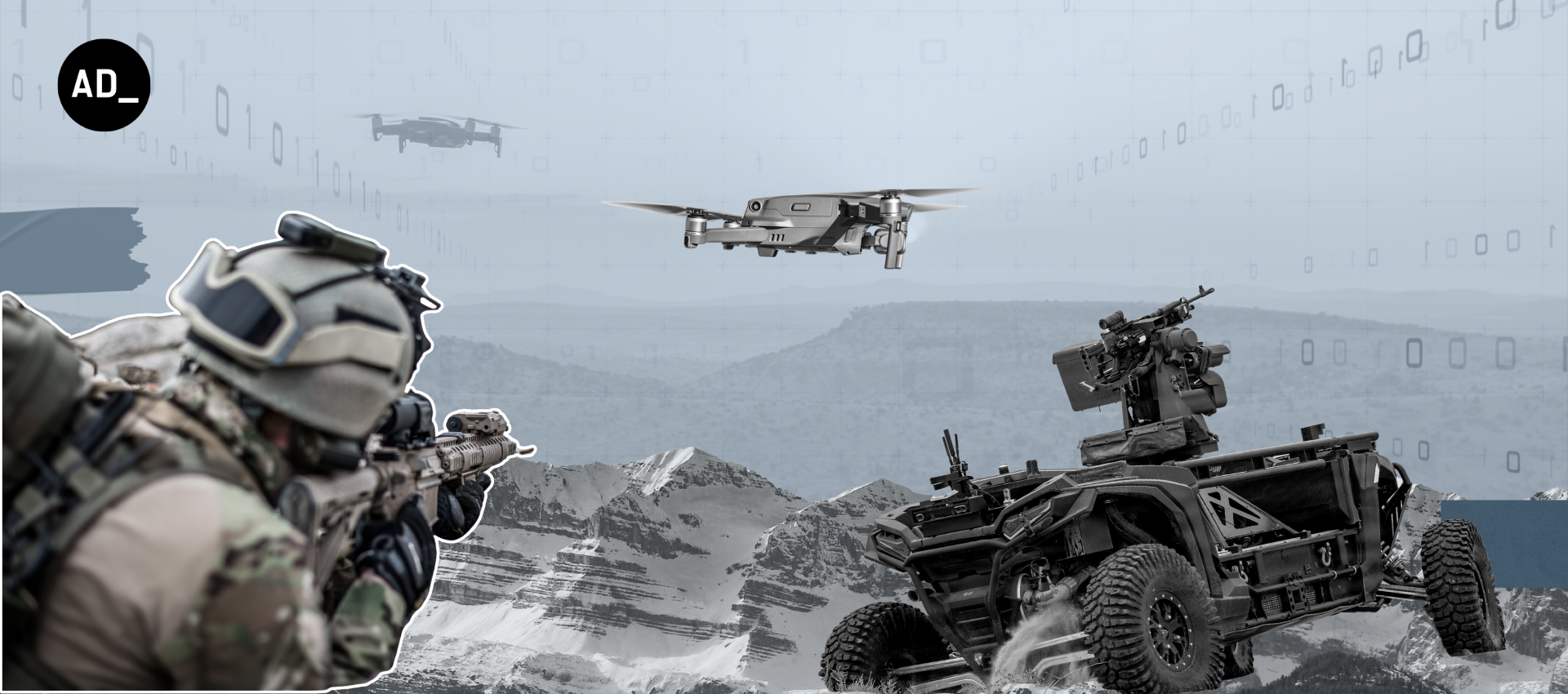
We may reach a stage where drones, unmanned ground vehicles, loitering munitions, and autonomous maritime systems cooperate, exchange information, and operate together with minimal human intervention.
But for such collaborations to be successful, every platform should be able to trust the information it is receiving from the other. This requires common standards, secure communications, robust mechanisms, and resilient networks. An error in one system should not spread across the entire network.
Trust in the System
A commander doesn’t just trust the drone or an AI model, they trust the complete operational chain comprising sensors, communications, data networks, AI algorithms, command-and-control systems, weapons, and battle damage assessment.
A failure at any stage can undermine confidence in the entire system. Consequently, trust is ultimately created through rigorous testing and evaluation, operational validation, cybersecurity assurance, resilient communication, clear accountability, and realistic training under operational conditions.
Conclusion
Trust has always been central to warfare — earlier it was trust between soldiers, in the future it will include trust in data, algorithms, machines, and the larger command-and-control ecosystem.
In the age of algorithmic warfare and autonomous systems, the military that succeeds will not necessarily be the one possessing the most advanced AI, but the one whose human-machine teams are trusted enough to fight, decide, and prevail under the extreme uncertainty of combat.