
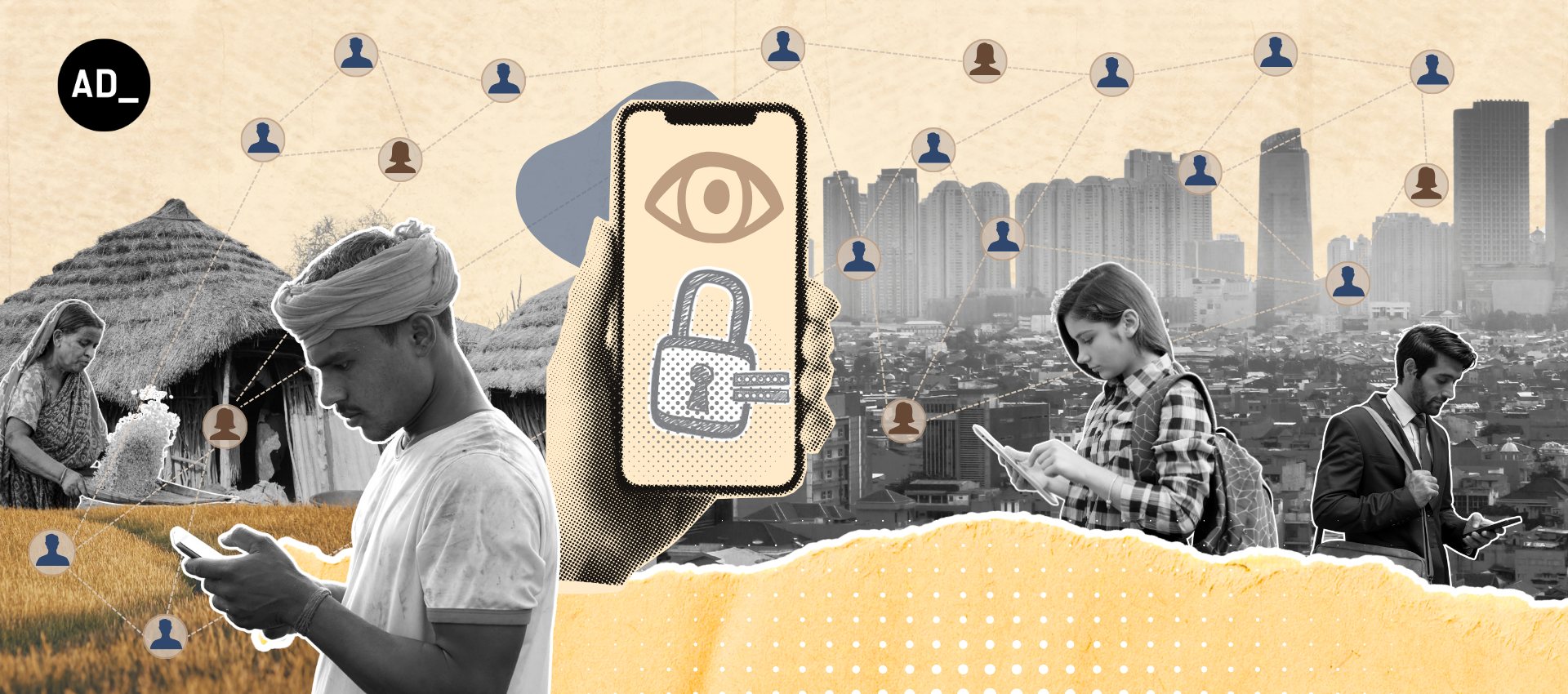
Asia is often celebrated as the world’s fastest growing digital region. Over the past two decades, hundreds of millions of people have come online, governments have adopted digital public infrastructure, and technology has become central to economic growth and public service delivery. These are significant achievements.
Yet they conceal an uncomfortable reality: access to the internet does not automatically translate into safety, privacy, or equal opportunity.
Across much of the region, the digital revolution has been uneven. National averages create an impression of widespread connectivity, but they often mask deep inequalities between urban and rural communities, affluent and poor households, and, most importantly, men and women. For instance: In Asia-Pacific, internet use reached 80 percent in urban areas in 2023, but was only 52 percent in rural areas.
As policymakers celebrate rising internet penetration, we must ask a more fundamental question: who is still excluded and who remains unprotected after coming online?
India illustrates this paradox clearly. Urban areas now enjoy near-universal internet access, while many rural communities continue to struggle with limited connectivity, weaker infrastructure, and lower digital literacy. This is despite the data showing rising internet penetration in rural areas. Similar patterns can be found across South and Southeast Asia. In countries such as Laos, Cambodia, parts of Indonesia, and the Philippines, digital access remains shaped by geography, income, and educational opportunity.
The story of Asia’s digital transformation is therefore not simply one of expansion; it is also one of persistent inequality.
In South Asia, the digital divide is fundamentally governed by rigid patriarchal structures. Device sharing is a collective household reality and a woman’s online entry is strictly monitored by domestic gatekeepers.
Southeast Asia boasts booming, mobile-first hyper-connectivity, yet its reliance on predatory, data-heavy “super-apps” exposes migrating women to massive tracking and corporate data harvesting. Meanwhile, in parts of Central and West Asia, women often face reduced access to devices, connectivity, and digital literacy which is furthered by rural disadvantage, socioeconomic inequality, and gendered social norms.
These disparities matter because digital rights are meaningful only when people can exercise them. Much of today’s debate on privacy assumes that individuals own a personal smartphone, understand the language in which privacy policies are written, and have the confidence and institutional support to challenge misuse of their personal data. For millions of people across Asia, particularly those living in rural areas, none of these assumptions hold true.
As someone who has spent more than four decades working on women’s rights and social justice, I have learned that development is meaningful only when it expands people’s agency and dignity. The same principle applies to digital transformation. Technology should strengthen people’s freedoms, not deepen existing inequalities.
This gap between law and lived reality deserves far greater attention. Across the region, governments have invested considerable effort in developing data protection frameworks. These are important advances, but legislation alone cannot guarantee privacy if it is designed around assumptions that exclude a large proportion of the population. Effective privacy protection requires an understanding of how technology is actually used in diverse social and cultural settings, particularly where access is shared.
The challenge becomes even more significant when viewed through the lens of gender. My work with women in rural and marginalised communities has consistently shown that digital exclusion is not merely a question of infrastructure. It reflects broader inequalities in education, mobility, economic resources, and decision-making within households.
Digital participation often depends on permission, not entitlement. This has profound implications for privacy, financial inclusion, access to government services, and personal security.
Lack of Awareness or Agency?
When policymakers describe low engagement with privacy tools or digital rights mechanisms as a lack of awareness, they risk misunderstanding the problem. In many cases, the issue is not that women fail to value privacy. Rather, they have limited ability to exercise it.
This is why conversations about digital inclusion must move beyond measuring connectivity alone. The success of Asia’s digital transformation should not be judged simply by the number of internet users or smartphones in circulation. It should also be measured by whether people—especially women and girls—can participate in the digital world safely, independently, and with confidence that their privacy will be respected.
The next phase of Asia’s digital journey must therefore focus not only on expanding access but also on building trust. Without that shift, digital inclusion risks becoming a promise that many of the region’s most vulnerable citizens can never fully experience.
Offline Inequalities Shape Online Realities
The consequences of unequal digital access extend far beyond the question of connectivity. They shape how people experience privacy, security, freedom of expression, and increasingly, their physical safety. The inequalities women and girls face offline are often reproduced, and sometimes intensified, in digital spaces.
Across South Asia, women are significantly less likely than men to own a mobile phone or use mobile internet independently. According to international estimates, South Asia continues to have the world’s largest gender gap in mobile internet use. Millions of women remain excluded from the digital economy not because technology is unavailable, but because social norms, affordability, literacy, and concerns about safety limit their access.
My work with women across India has consistently shown that the barriers are rarely technological alone. A young woman may have access to a smartphone, but it is often monitored by her family. Passwords may be shared, social media accounts scrutinised, and online interactions closely supervised. In many households, digital access remains a negotiated privilege rather than an individual right.
This reality fundamentally changes how we think about privacy, which is not just a legal issue. It is also a question of power.
These structural inequalities become even more serious when digital technologies are used to facilitate violence against women and girls. Over the past decade, technology-facilitated gender-based violence has emerged as one of the defining human rights challenges of the digital age. Online abuse is no longer limited to offensive messages or anonymous trolling. It includes stalking through location data, non-consensual sharing of intimate images, impersonation, doxxing, financial fraud, deepfakes, and coordinated harassment campaigns.
Research from across the Asia-Pacific region shows that women in positions of power and public eye are increasingly targeted because of their visibility. The objective is not merely to intimidate individuals but to discourage women from participating in public discourse altogether. Digital violence thus becomes an extension of longstanding gender inequalities..
For women in rural and marginalised communities, the situation is often even more difficult. Many lack access to effective reporting mechanisms, specialised cybercrime units, legal assistance, or psychological support. Harm frequently goes unreported because victims fear social stigma, family restrictions, or retaliation. As a result, official statistics almost certainly underestimate the scale of the problem.
The rapid expansion of artificial intelligence adds another layer of complexity. Generative AI has made it easier to create convincing deepfakes, manipulate images, automate harassment,and produce harmful content at unprecedented scale. These technologies offer enormous social and economic opportunities, but they also require stronger safeguards, clearer accountability, and greater investment in digital literacy.
Building Digital Trust
Asia stands at a defining moment in its digital journey. Over the next decade, the region will shape global conversations on artificial intelligence, digital public infrastructure, cross-border data governance, and platform regulation. The next phase of digital transformation must therefore be guided by a simple principle: every person who comes online should also come under the protection of rights, safety, and dignity.
For governments, this requires moving beyond legislative ambition to institutional implementation. Data protection laws must reflect the realities of shared devices, limited digital literacy, multiple languages, and unequal power relations within households. Privacy cannot remain a privilege enjoyed primarily by educated urban citizens. It must become a practical right that reaches the woman in the most remote village as effectively as the professional in a metropolitan city.
Technology companies have made important investments in trust and safety, including AI-based content moderation, improved reporting mechanisms, and collaboration with child protection organisations and law enforcement agencies. These efforts deserve recognition. Yet the pace at which harmful technologies evolve means that safety systems must evolve just as quickly. The challenge is not only to remove harmful content after it appears but to anticipate emerging risks before they become widespread.
This requires a shift from reactive moderation to proactive governance. Safety cannot be treated as an afterthought or a compliance exercise. It must become an integral part of product design, data governance, and platform accountability. The principles of “safety by design” and “privacy by design” should guide technological innovation from the earliest stages of development.
Civil society, academia, educators, and community institutions have an equally important role. Digital rights cannot be secured solely through legislation or technology. They must be understood, claimed, and exercised by citizens. Community-based organisations, women’s collectives, schools, and local governments can become the bridge between digital policy and everyday practice, ensuring that privacy, consent, and online safety are not abstract legal concepts but lived realities.
Perhaps most importantly, we must stop treating gender equality as an outcome of digital development and recognise it as a prerequisite for it. Digital ecosystems that exclude or expose women cannot be described as inclusive. When women participate safely and confidently online, societies benefit through stronger democratic participation, greater economic opportunity, richer public debate, and more resilient communities.
Asia has both the opportunity and the responsibility to lead the world in building a rights-based digital future. The region’s remarkable diversity, youthful population, technological capability, and growing regulatory experience position it uniquely to demonstrate that innovation and human rights are not competing priorities—they are mutually reinforcing.
The true promise of the digital revolution will not be realised when every citizen has a smartphone. It will be realised when every citizen—regardless of gender, geography, language, income, or social status—can participate in the digital world with confidence, autonomy, and trust. That is the digital future Asia should aspire to build.