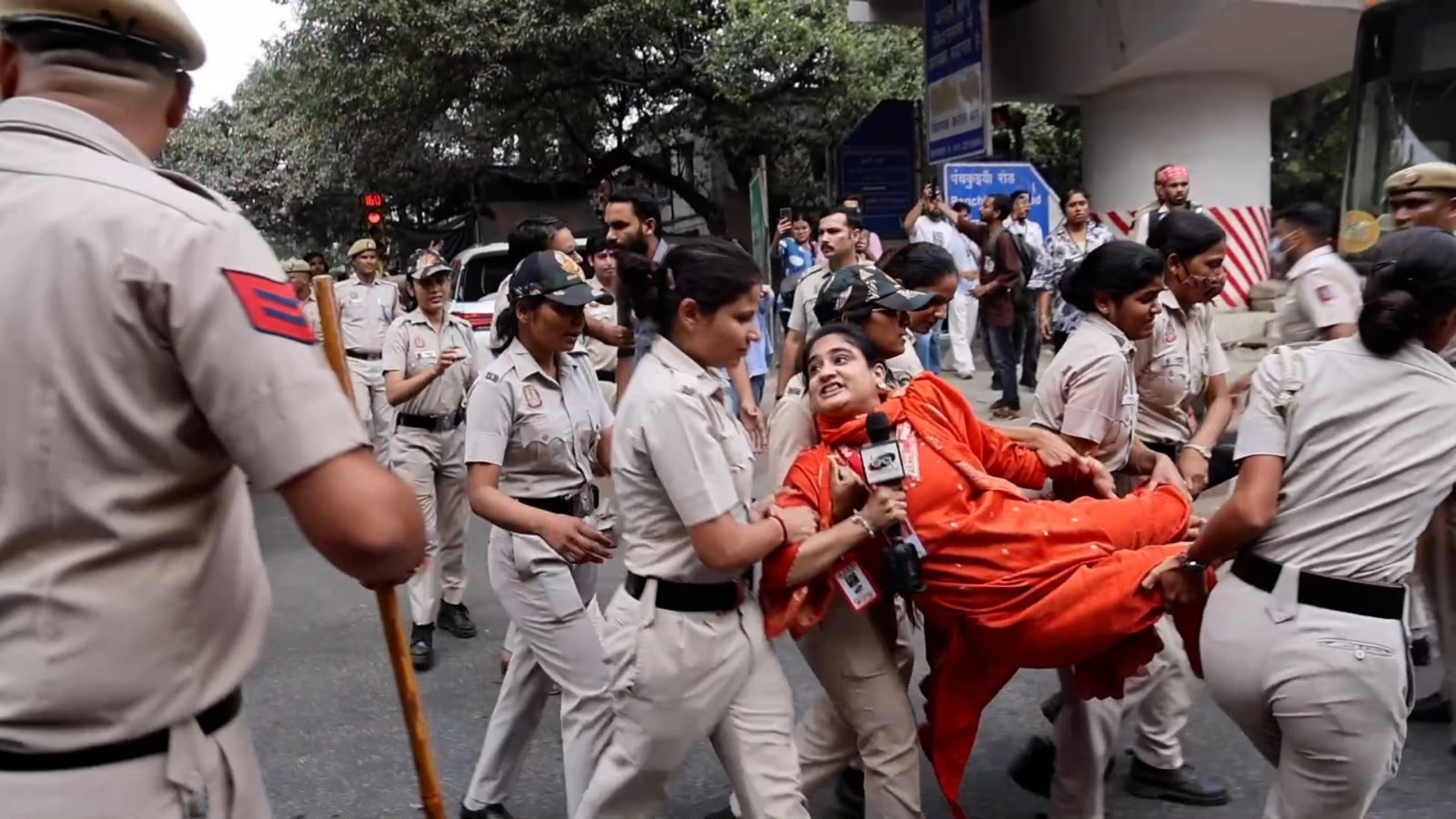
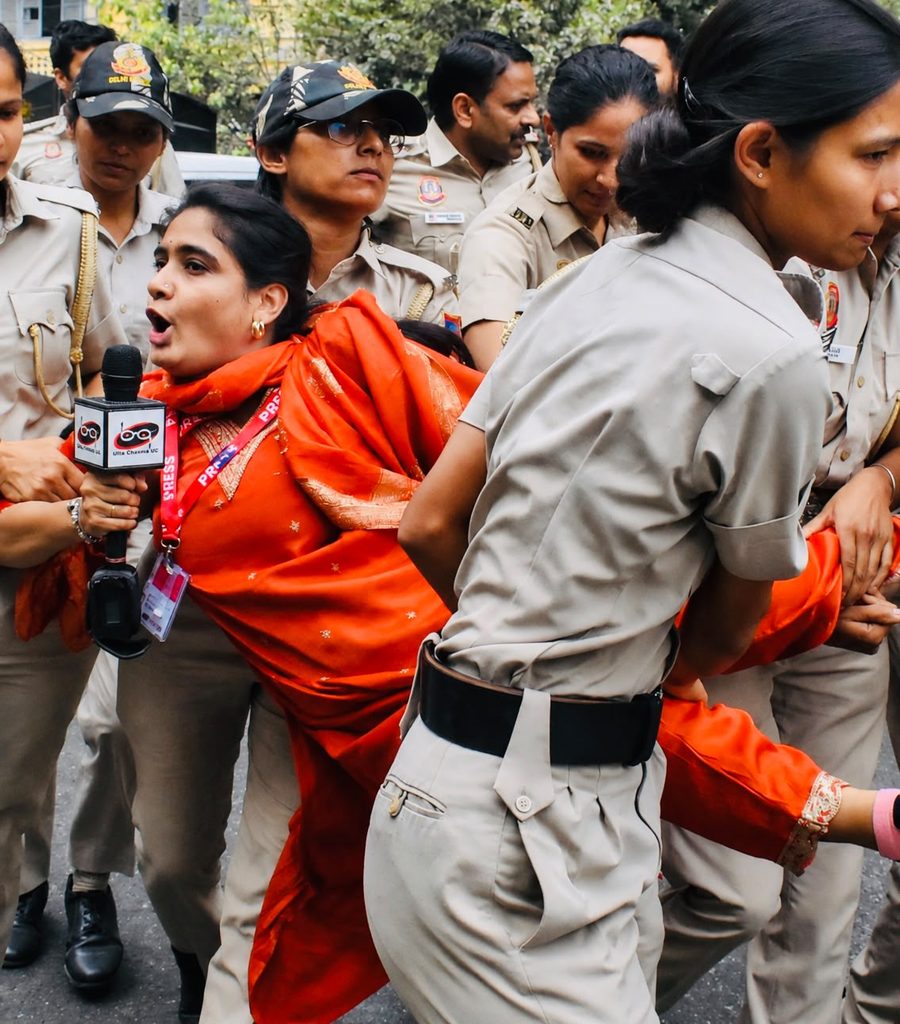
“I was put in a bus. I showed them that I have an ID card and a mic ID, and asked them why I was being detained. But they didn’t want us to show how protesters were being manhandled,” said 28-year-old Pragya Mishra, who runs a news outlet called Ulta Chasma uc.
On October 11, 2026, Mishra was covering the protests against Chief Election Commissioner (CEC) Gyanesh Kumar at RK Ashram in Delhi. While reporting, Mishra says her cameraperson Anuj Kumar (23) was pulled by his hair by police personnel. When she went to protect him and inform the police that they were from the media, she was also forcibly put inside a bus with a few other journalists.
She told Asian Dispatch that she was being taken to a detention center in Rajendra Nagar. The bus, however, was intercepted and stopped by other journalists. She says that the police eventually dropped them at Connaught Place.
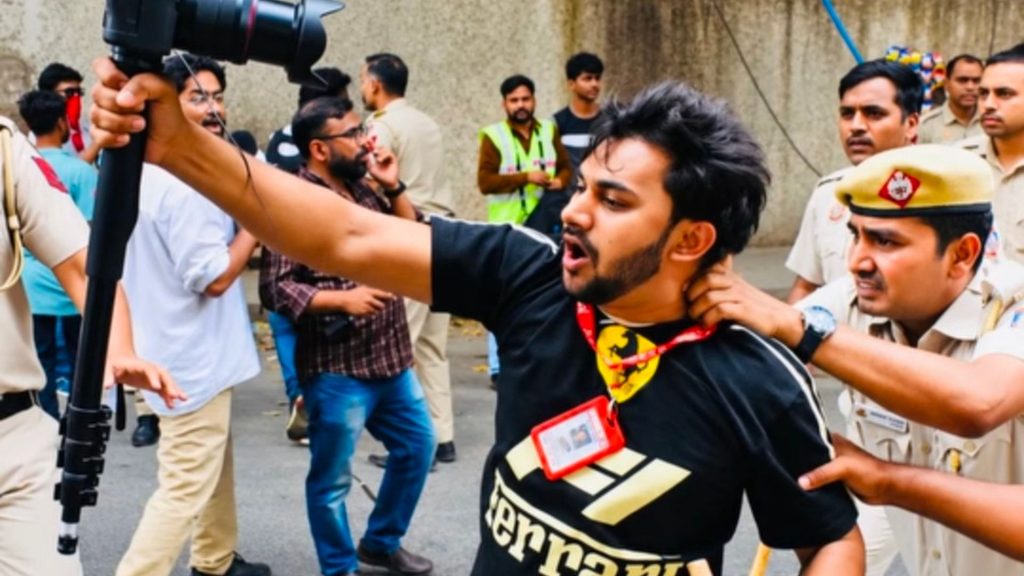
Mishra was not the only journalist who faced police action during the recent protests held across the country against Kumar over the alleged irregularities in the Special Intensive Revision (SIR) of the electoral rolls.
The protest against CEC Kumar is linked to the alleged irregularities in the ongoing SIR process, which has reportedly resulted in the deletion of around 13 crore names from electoral rolls.
It gained momentum after a report published by The Indian Express dated September 24 found that Election Commissioners Sukhir Singh Sandhu and Vivek Joshi had formally objected at least 14 times over a 10-month period. The objections were related to electoral rolls, changes to Form 6, and handling of the electoral-roll data.
The opposition parties, including the Indian National Congress (INC), have also levelled allegations of vote theft and demanded the resignation of CEC Kumar.
According to the Committee to Protect Journalists (CPJ), at least 43 instances of journalists being detained were recorded. Journalists from several news organisations such as The Wire, Scroll, The Quint, Newslaundry, as well as freelance journalists were detained — some were even heckled, assaulted, and forced to delete what they had documented on the ground.
The Press Club of India, along with other journalists’ associations, condemned the detentions and said that the police took the step even after journalists displayed their press cards. It further mentioned that the police seized the phones and reporting equipment of some of the journalists. The statement referred to the developments as a “blatant attack on the freedom of the press”.
Commenting on the situation, Reporters Without Borders (RSF) told us, “What we are witnessing is not simply excessive policing during demonstrations, it is part of a broader pattern of restrictions that undermines the ability of journalists to report freely on matters of public interest, particularly when their reporting exposes the conduct of the authorities.”
The repression that happened in Delhi reflects an increasingly hostile environment for journalism in India, where the authorities are using a combination of police repression, surveillance, judicial harassment, internet shutdowns and online censorship to obstruct the coverage of protests and restrict access to information.
Reporters Without Borders (RSF)
RSF is an international non-profit working towards protecting the rights of journalists/press. According to their 2026 World Press Freedom Index, India ranks 157 out of 180 countries in press freedom. The body also highlighted that press freedom remains a major concern across Asia, where the media faces restrictions in covering politically sensitive events and protests.
More Journalists in Jail in Asia Than Any Other Region
CPJ’s annual report on jailed journalists, released in January 2026, noted that 330 journalists were behind the bars globally as of December 1, 2025. Of these, one-third were in Asia — China and Myanmar were found to be the leading jailers in the region. It’s important to note that this number from Asia excludes jailed journalists from Central and West Asia (referred to as the Middle East in the graph). Those are marked separately in CPJ’s database.
Speaking to Asian Dispatch, Kunal Majumder, Asia-Pacific program coordinator, Committee to Project Journalists (CPJ), said that journalism is under attack across the region and added, “In South Asia, the focus is largely on over-regulation of the online space; apart from SLAPP [Strategic Lawsuits Against Public Participation] suits, physical violence remains a grave problem.”
Expressing concern about the situation in India, Majumder said that India has a responsibility to uphold press freedom and “serve as a role model for other countries in the Global South”.
For instance: the situation for journalists in Bangladesh during the 2024 July uprising was alarming. The International Federation of Journalists (IFJ) estimated that at least 160 journalists were reportedly injured while covering the nationwide protests as of July 31, 2024.
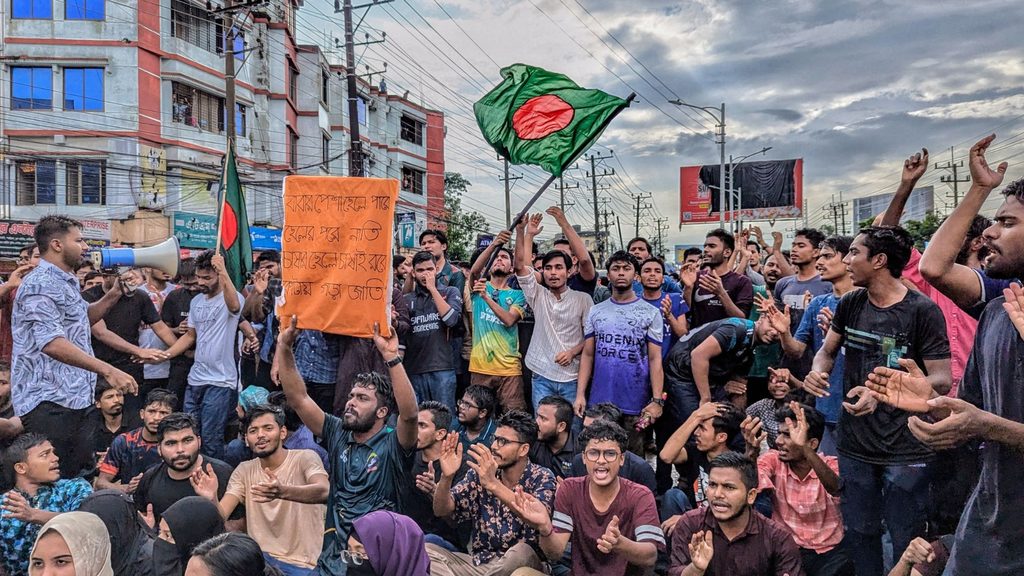

RSF noted that five journalists were allegedly killed by police bullets between July 15, 2024 and August 5, 2024, and one was killed during clashes between two factions.
CPJ, in a report published on July 26, 2024, detailed the reports of police attacks on journalists. It said that on July 16, 2024, police personnel fired metal pellets at journalists Mehedi Mamun, Abdur Rahman Khan Sarjil, Wajahatul Islam, and Jubayer Ahmed. This happened despite them identifying themselves as journalists.
The next day, July 17, 2024, Abdullah Al Mamum, a correspondent with Prothom Alo, was reportedly beaten with rifles and batons by police personnel while he was recording the police action against students. Mamum told CPJ that he showed them his press card but he was beaten and the police fired a rubber bullet at him while he was trying to flee.
A similar incident happened on September 21, 2025, when eight journalists covering the anti-government protests in Manila were harassed, assaulted, and obstructed. They alleged that police used shields to deliberately obstruct media coverage. The usage of tear gas and water cannons near to where journalists were also posed direct harm to their safety.
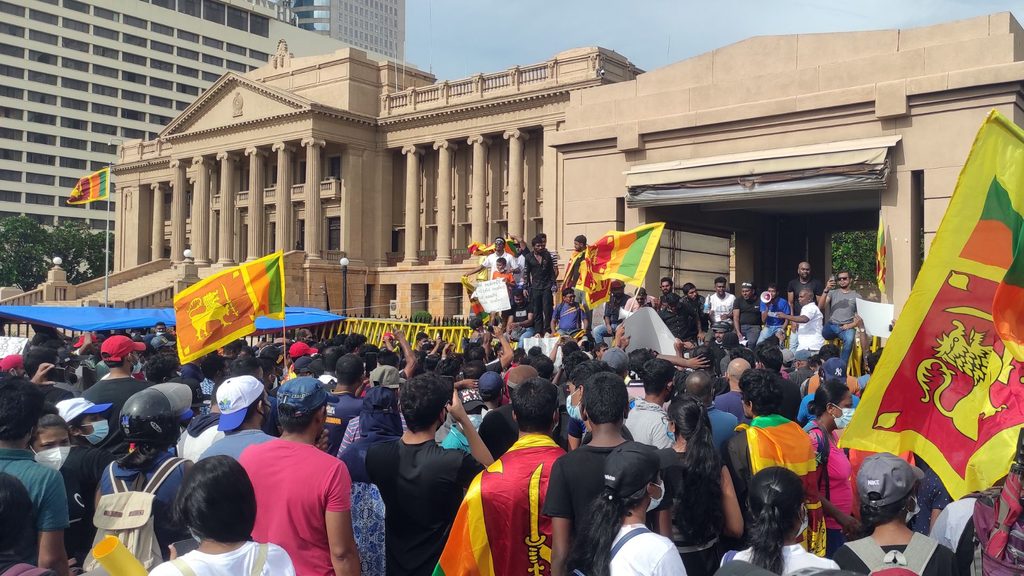
At least nine journalists in Sri Lanka were injured during the anti-government protests in 2022. A freelance journalist, Sumedha Sanjeewa Gallage, was reportedly attacked by the police while he was covering a demonstration outside the president’s residence. As per reports, he lost partial vision in his right eye following the attack.

The 2026 CPJ analysis also found that the greatest incidence of torture and beatings of journalists has occurred in Iran since 1992. Between 2022 and 2025, 71 journalists were imprisoned in Iran.
‘Journalists Deterred From Doing Their Jobs’
Mishra, who was bundled in a bus in New Delhi on October 11, highlighted that these detentions happened despite the Supreme Court clearly stating that lawyers and journalists should be allowed to work without hindrance.
“The Supreme Court had ordered that journalists, lawyers, and doctors should be allowed to continue their work…I pointed this out, but they [police] weren’t listening,” Mishra says. She also told us that she repeatedly asked the police personnel not to carry her and that she could walk to the bus, but nobody heard her.
Speaking about the detentions and the force with which journalists were met, RSF said, “The circumstances strongly suggest that journalists were targeted precisely because they were documenting what was happening on the ground: the police’s brutal treatment of protesters. Several journalists were detained while filming arrests or acts of police violence. Others had their phones seized, their cameras damaged or were pressured to delete their footage. This raises serious concerns that the objective was to prevent images of police operations from reaching the public.”
Several journalists, who were covering the protests, also highlighted on social media that the police was asking for government accredited press cards and not recognising cards issued by independent organisations.
“This raises fundamental concerns, press freedom cannot be conditional on government approval, and accreditation requirements must never become a tool for excluding independent or critical voices. The right to report does not depend on whether a journalist works for an established newspaper, an independent online outlet or a digital platform. All journalists must receive equal protection, regardless of their employer and professional status,” RSF said.
In Bangladesh, IFJ documented an expansion of gatekeeping intended to restrict the media’s ability to report. The Press Information Department had revoked the accreditation of around 167 journalists between October 29, 2024 and November 7, 2024.
These measures often lead to self-censorship.
‘Protect Press Freedom’
The United Nations’ Human Rights Committee, in 2020, adopted general comment number 37 that noted that the right to peaceful assembly should be recognised. It also highlighted the obligations of state parties regarding the same.
It said that law enforcement officials must respect and ensure the exercise of fundamental rights of organisers and participants, while also protecting journalists, observers, and others from harm.
The committee further said, “The role of journalists, human rights defenders, election monitors and others involved in monitoring or reporting on assemblies is of particular importance for the full enjoyment of the right of peaceful assembly.” It added that journalists and participants have the right to record law enforcement officials.
Majumder emphasised that every journalist has an equal right to report on public events without intimidation, obstruction, or discrimination.
The police must not decide who gets to do their job based on which media organisation they represent or what their reporting might reveal. Press freedom means protecting the right of all journalists to report, including those whose coverage may be critical of the authorities.
Kunal Majumder, Asia-Pacific program coordinator, Committee to Project Journalists
With respect to what happened in India, RSF recommended that courts should provide effective and timely remedies when journalists’ rights are violated, and newsrooms should strengthen safety protocols. It also said that the police must put an end to physical assaults, intimidation, and the confiscation of journalistic equipment.
“Let us do our jobs. We don’t want any special or VIP treatment. We already go through a lot when we are on the ground…If the fourth pillar of democracy, which is journalism, is weakened, then what will happen to democracy?,” said Mishra.