
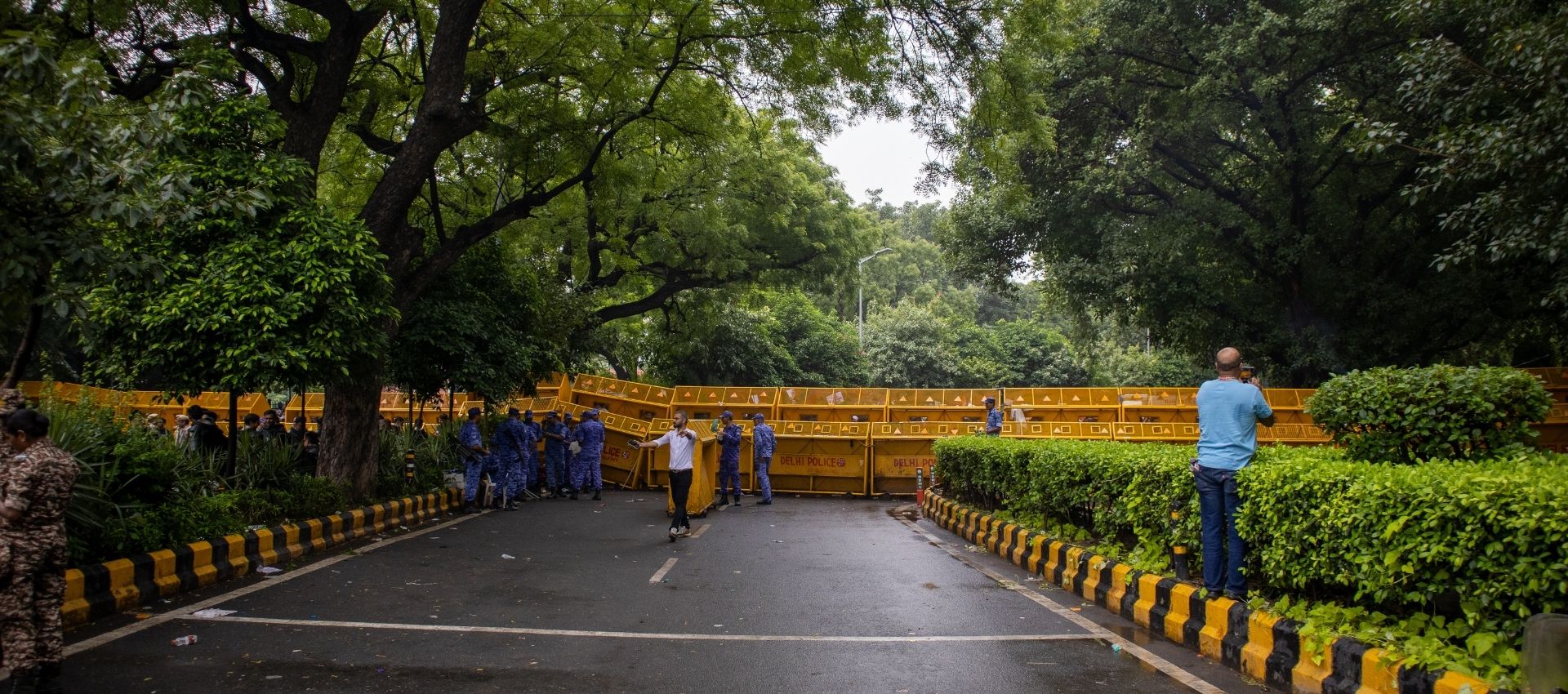
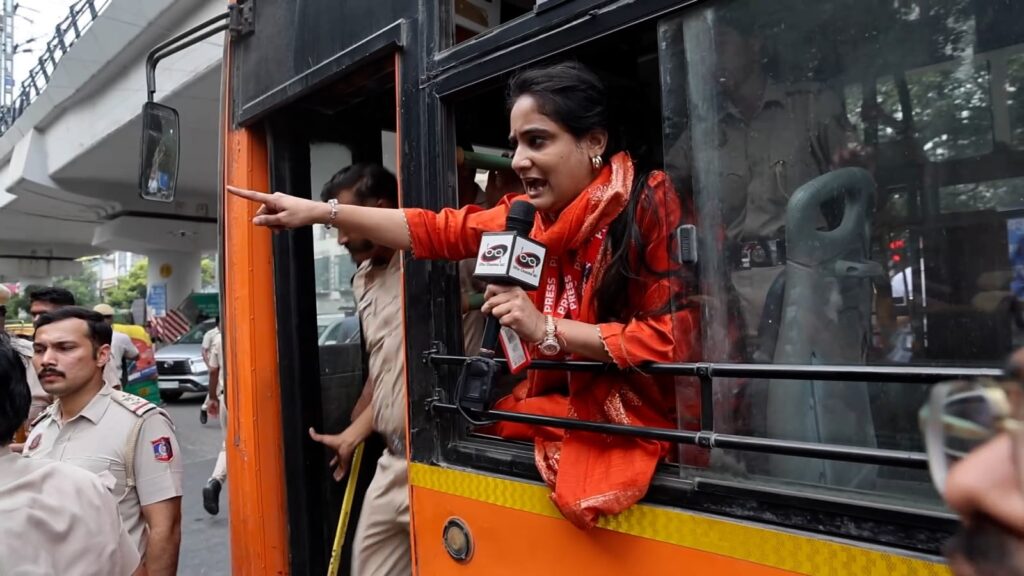
Thousands of protestors, student leaders, journalists, lawyers, leaders of political parties, and even those who were not protesting were detained by the Delhi Police on October 10-11 as security forces locked down parts of the national capital in an attempt to thwart a demonstration demanding Chief Election Commissioner (CEC) Gyanesh Kumar’s resignation over alleged irregularities in the Special Intensive Revision (SIR) of the electoral rolls.
Since then, the United Nations, lawyers, and journalist associations have criticised Delhi Police’s indiscriminate action. Rights groups such as Committee for the Protection of Journalists (CPJ) and Reporters Without Borders (RSF) have recorded close to 40 instances of journalists being detained, harassed, and stopped from reporting during the protests.
On October 11, the Supreme Court of India also held a special hearing as lawyer bodies sought contempt action against Delhi Police for flouting earlier court orders that directed the authorities against closure of metro stations, internet shutdown, and preventive mass detentions.
A bench comprising Justices Joymalya Bagchi and V Mohana reiterated in its interim order that the internet facilities should function unhindered, there shall be no illegal detention, and that lawyers and journalists should be allowed to work without hindrance.
Since the Sunday hearing, a bunch of petitions have been filed before the apex court in connection with the October 10 protests. The matter will be heard on October 15, when the court has also summoned senior Delhi police officials to appear personally.
The police may take preventive action when there is a genuine and reasonable basis to believe that a particular offence or disturbance may occur. But preventive powers do not give the police unlimited authority to detain people merely because they are activists, political opponents or suspected participants in a peaceful protest.
Vikas Pahwa, Senior Advocate
Legal experts have called these detentions “illegal” and have questioned Delhi Police’s refusal to allow anti-CEC protests. They also said “reasonable apprehension” to avoid violence can’t be used as a reason to stop demonstrations.
Prohibiting Protests: A Wrong Call
Former IPS officer Amodh Kanth said prohibitary orders can be issued only in limited circumstances and in limited high-security areas. Even then, this does not mean that a total prohibition on gathering of people can be imposed.
The Constitution and several Supreme Court judgments state that protests and dissent are fundamental rights subject to reasonable restrictions. “The government, any state, or the police cannot take away these fundamental rights,” Kanth told Asian Dispatch.
Commenting on the close proximity of Jantar Mantar (which has now been de-notified as a designated protest site) to the parliament, Kanth added, “Protests happen [close to the place of power] so the parliament knows what a citizen’s grievances are.”
As the CJP leaders announced a protest on October 2, the Delhi Police had imposed Section 163 (prohibitory orders) of the Bharatiya Nagarik Suraksha Sanhita (BNSS). This empowers them to issue orders to prevent potential disturbances where “there is sufficient ground for proceeding under this section and immediate prevention or speedy remedy is desirable.”
However, the police went to the extent of detaining individuals from their homes, hotels, even trains and flights.
Pahwa, who specialises in criminal defence, stressed that a person cannot be taken into custody simply because the authorities find the protest inconvenient or disagree with its message. He also referred to Section 172 (persons bound to conform to lawful directions of police) of the BNSS, and explained that the section allows the police to detain a person who resists, refuses, or disregards a lawful police direction issued to maintain public order.
The concern is that the provision does not clearly define what constitutes a “petty case” and it gives the police considerable initial discretion to decide when a person should be detained or removed. In the context of protests, this creates a real risk that people may be detained merely for refusing to comply with police directions, even where their conduct does not independently justify arrest under the ordinary criminal law.
Vikas Pahwa, Senior Advocate
While a petition has been filed in the Supreme Court challenging the constitutional validity of the section, Pahwa added that whether the police relied specifically on this section must be verified.
Regulation Different From Suppression
Governments have always regulated protests but experts emphasise that there is a difference between regulation and suppression.
Kanth recalled the 1988 Mahendra Tikait protest where the dissenters were prevented from gathering at the Boat Club near India Gate and instead diverted to Jantar Mantar, which was a more convenient space for all stakeholders.
Senior Supreme Court advocate Huzefa Ahmadi said that there should be an element of proportionality in any kind of action and added, “In a republic, every citizen has the right to protest. Authorities cannot stop them unless there is [an] incitement for violence. As far as public nuisance is concerned, even to stop that, there is an element of proportionality. One can’t say that a group of people gathered to protest are creating a nuisance and stop it. This is what distinguishes us from a banana republic. What Delhi Police has done is something that only happens in a banana republic.”
Pahwa, too, said that the State may impose restrictions to protect public safety and order but those restrictions must be “lawful, necessary and proportionate”. “They cannot be used as a blanket excuse to silence dissent or prevent people from exercising their constitutional rights,” he added.
Despite following guidelines shared by the Delhi Police, videos shared by journalists across social media platforms show that they were heckled and detained.
News magazine Caravan’s Editor-in-Chief Hartosh Singh Bal said, “The police were arbitrarily picking up people, including individuals, and bundling them in buses. Under what law were the journalists detained? The detentions were just to clamp down in a high-handed fashion in order to create fear to express one’s self.”
According to the news outlet, a journalist from their newsroom was also detained and brutally beaten up.
Ahmadi said we must redeem ourselves and the democratic republic. “In a democracy, it is healthy and necessary to let off steam. This is why most evolved democracies have designated sites for protest subject to the laws of defamation.”
Pahwa also focused on the need to maintain public order but also allow peaceful dissent. “Maintain public order, but do so lawfully. Prevent violence, but do not criminalise peaceful dissent; take preventive action where genuinely necessary, but do not use it as a tool of arbitrary detention; and obey the directions of the Supreme Court in both letter and spirit.”
“A democratic government must protect public safety while also protecting the liberty, dignity and constitutional rights of the people,” he added.