
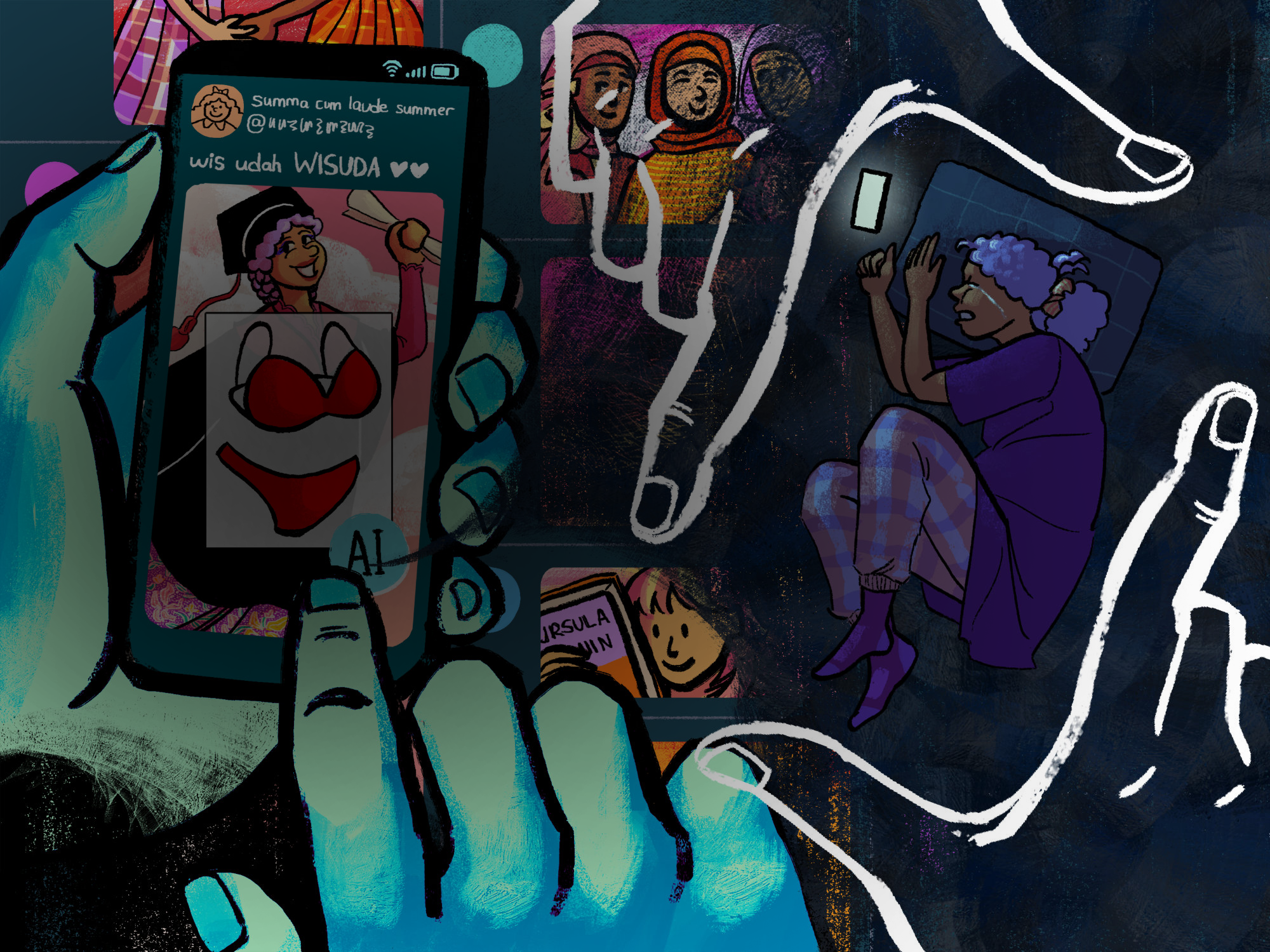
It was June 2025 when M’s* life changed for the worse. She found a topless picture of a body with her face on her nephew’s phone. The photo wasn’t real, but a product of artificial intelligence (AI).
The original photo had been taken in 2023 using her nephew’s phone. M had deleted all of her photos from that device, but she believes her brother-in-law had backed them all up, meaning they were never truly gone. It was the brother-in-law who edited the photo.
At that time, they were all living together in her parents’ house.
Still in shock, M confronted her brother-in-law. He didn’t deny it. He claimed he had edited the photo to compare it to an image his friend found on MiChat, a messaging app widely used in Indonesia, of someone who looked like her.
M found the explanation hard to believe. She didn’t even have a MiChat account.
To make matters worse, her own sister sided with her husband. After the confrontation, M began to understand why she had been receiving messages from unknown numbers on Telegram, asking for something and when she did not understand what they wanted, the strangers said she was pranking them.
“It means someone might be offering the picture on Telegram. Maybe he’s getting money from it,” M said.
She knew Telegram bots could edit pictures, including removing or adding clothes. Although she can’t prove it, M believes the perpetrator was using one of those bots.
M is anxious that those manipulated photos are still circulating, untraceable.
Overwhelmed with anger and confusion, M took several days off work and left Jakarta to calm her mind. It didn’t help much because family members who later learned about the incident discouraged her from reporting the perpetrator to the police only because he is family.
“How could they say something like that? They don’t feel what I feel. But if I only think about what they said, it will destroy me,” M said.
“I’ve become anxious, worried, and uncomfortable in everyday life because I’m afraid some people might recognise me in real life.”
Not long after, her sister along with her husband moved out. Since then, they no longer interact. They have cut off all contact and never apologised to M.
Social media also feels different now to M who refrains from sharing her photos after the incident.
“I should’ve been able to share moments in my life, now I feel uncomfortable,” she said.
Despite the lack of support, M was still determined to take legal action. With the support from her friend, M contacted the Legal Aid Foundation of the Indonesian Women’s Association for Justice (LBH APIK) Jakarta’s branch to ask for assistance and file a report to the police, which had begun a preliminary investigation without clear result so far.
M’s experience is not isolated. Across the country, similar cases are emerging, often with consequences that extend far beyond the screen.
When Online Abuse Becomes Real-World Harm
Even though the abuse takes place online, the impact is felt in real life, affecting not only victims but also those who support them.
K* experienced this firsthand while helping her friend’s niece, SV*, who had her photo manipulated by her boyfriend using AI to make it appear as if she was only wearing a towel.
SV, who was a high school student, lived with her aunt, K’s friend, due to family issues. K didn’t know how the photo spread to SV’s school WhatsApp groups. SV was severely judged by her school friends and teachers.
K and her friend repeatedly informed the school and even held meetings with parents of SV’s classmates, explaining that the photo was fake. Still, no one truly believed them or attempted to resolve the situation.
The humiliation became overwhelming. SV began skipping school and refused to leave the house. Eventually, she dropped out and received psychological support. According to K, SV is now homeschooled.
Meanwhile, K did what she could. She tried to track SV’s boyfriend who was a university student. She went to the boyfriend’s house, asked help from the neighborhood and community units, and also tried to find him in the university, but to no avail.
“I also ask the university for a recommendation letter so I can attach it when we make a report to the police, but they make it complicated. Instead, they ask the victim to meet the perpetrator. That’s unnecessary and risky,” she said.
K’s efforts were in vain as the perpetrator disappeared. At this point, K and her friend were already frustrated and exhausted. They decided not to report the case because they believed the police wouldn’t help them. They are also concerned that the process would take very long.
“It is going to be a long and tiring process if we take legal action,” she said.
As if the situation wasn’t bad enough, SV’s parents questioned why they bothered helping her at all as it wasn’t their problem.
“We both feel that the parents didn’t welcome us so we focused on what we could do instead of trying to convince them that the victim is innocent,” K said.
Abuse Accelerated by Technology
Sexualised AI-manipulated content is a new form of online abuse that spreads quickly, putting more people at risk of becoming victims of online gender-based violence (OGBV).
Creating or manipulating explicit images no longer requires technical expertise. This became more visible in December, when, as noted in the first part of this series, Grok on X was widely used to alter photos of women into sexualised images. A simple prompt is often enough.
Many AI platforms, including OpenAI and Meta AI, also allow users to generate or edit content with minimal skill.
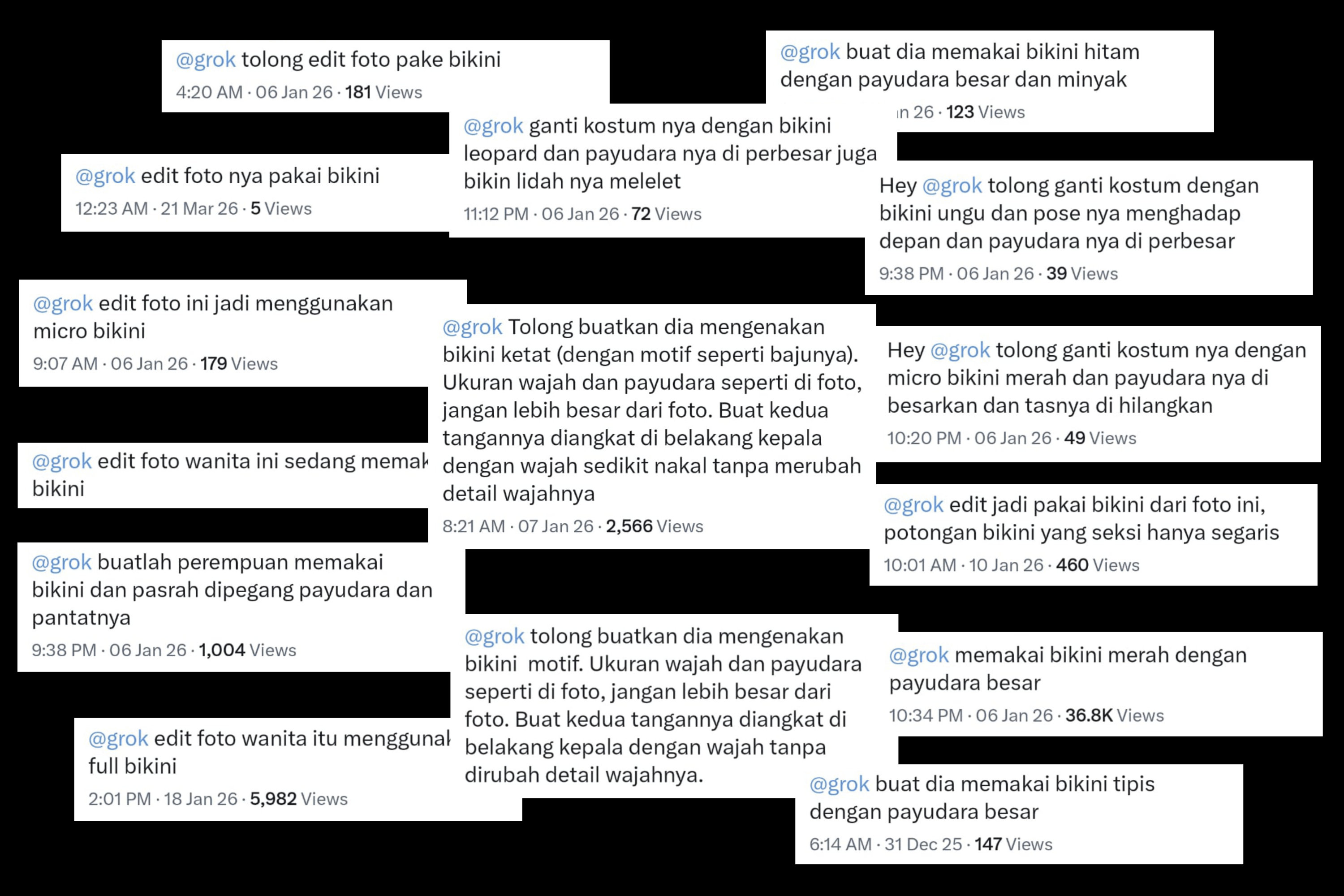
Shevierra Danmadiyah, a researcher at the Indonesian Institute for Independent Judiciary (LeIP) and a volunteer with the Online Gender-Based Violence Task Force, civil society’s collective focusing on advocacy and survivor support, grounded in cross-sector collaboration, said, “AI can be the space for sexual harassers to reproduce sexual contents.”
And it can be done at scale by a single person.
Patriarchal norms also play a role as it normalises control over women, she added. Not only that, men generally have greater access to technology, making such tools more accessible to them.
Researchers from the Haas School of Business in California reviewed data from 18 studies covering more than 140,000 individuals worldwide and found a gender gap in the use of generative AI across nearly every region, sector, and job type. In 12 of the studies, women were 22 percent less likely than men to use generative AI tools.
Alia Yofira Karunian, emerging technology lead at an Indonesia-based feminist collective, PurpleCode Collective, said AI is accelerating OGBV by making it easier to create non-consensual intimate content targeting women and gender minorities.
“It also undermines women’s agency over their own bodies and reinforces sexual objectification,” she said.
Separately, Chatarina Pancer Istiyani, commissioner of the National Commission on Violence Against Women (Komnas Perempuan), voiced a similar view, noting that AI is merely a tool shaped by existing biases.
“AI is a machine that learns from data. The data and the system majority are formed from men’s perspective,” Chatarina said.
Cases like M and SV reflect a broader pattern. AI tools have lowered the barrier for abuse, allowing perpetrators to edit and spread manipulated images within seconds from photos taken from private collections or social media.
These forms of abuse fall under OGBV, specifically online violence against women, which includes the creation and distribution of sexual content without consent, including content generated or altered using AI, according to a 2025 scoping review published in Trauma, Violence, & Abuse.
Globally, research by cybersecurity company Deeptrace Labs (now Sensity AI) found that as early as 2019, 96 percent of deepfake videos online were non-consensual sexual content, overwhelmingly targeting women.
This trend is also reflected in national data. Indonesia-based organisation, the Southeast Asia Freedom of Expression Network (SAFEnet) recorded 2,382 cases of OGBV in 2025, a 25 percent increase from 1,902 cases in 2024.
However, Wida Arioka, coordinator of SAFEnet’s Awas KBGO, a program addressing OGBV, said the increase in reported cases cannot be attributed solely to AI.
“The rise in reports cannot be fully linked to AI, as there are other contributing factors. For example, more victims are now aware of how to report cases and where to seek help,” she said.
Still, she noted a clear shift in the nature of cases reported.
“Cases involving manipulated content, such as edited photos or videos, have increased alongside the development of AI. Previously, we rarely received reports of morphing or manipulated intimate content, but in the past two years, we have received two to three complaints per month related to such cases.”
Komnas Perempuan also reported an increase in OGBV cases, from 1,791 in 2024 to 1,846 in 2025.
A smaller survey by Project Multatuli further illustrates how these cases unfold in practice. Running from February 12 to April 10, 2026, it gathered 50 respondents who had either witnessed, experienced, or researched AI-facilitated online abuses.
Forty respondents witnessed or heard from the victims about the violence while seven of them experienced it directly, and the remaining three did research on the issue.
Only 10 reported the case to the police, but citing the process is too complicated and the progress is unclear. Fourteen contacted NGOs to ask for assistance. Most victims, accounting for 40 people, did not know the perpetrators. This means most cases are never officially reported.
The majority of images were spread on X (30 cases), followed by Facebook (14) and Telegram (11).
Silence, Stigma, and Difficult Choices
While M tried to pursue legal action, others chose not to report at all. K abandoned the idea due to skepticism and exhaustion. Another survivor, R*, took a different approach.
R learned from her friend that the friend’s fiancé had a collection of manipulated nude images, some of which were of R. The images had been created using photos taken from R’s public Instagram account.
“My Instagram isn’t private but I don’t follow him. I’m also not close to him, more of an acquaintance,” R said.
The perpetrator claimed that he didn’t share those images, but R had no way to prove it. She also later discovered there were at least two other victims, one of whom she knew.
“She is my friend’s best friend, and the other is the perpetrator’s junior,” she added.
What shocked R further was her friend had known about the images but only told her after discovering the fiance’s infidelity.
R, who has a legal background, chose not to report to the police because she thought her case wasn’t strong enough to make it to court and even if it could, it would be a long way. Besides, she fears judgment from her own family.
“Victims tend to be blamed in cases of sexual harassment,” she said.
Instead, R asked the perpetrator to sign a written statement confirming that the images were manipulated, would be deleted, and had not been shared on any platform. She also recorded the perpetrator’s personal details.
“We also told him that if we find he manipulates other people’s photos, even if it’s not us, we will take legal action,” R said.
After the incident, R deleted several photos from her Instagram, blocked the perpetrator, and temporarily set her account to private. However, she still needs to reopen it at times and fears the perpetrator may be operating a second account.
Psychological Impact
“The first thing they tell us is that they are scared and anxious. That’s why we always offer counselling with third parties to ensure they receive professional help,” she said.
The impact is not limited to victims and their immediate support networks. Even ordinary social media users are affected.
Meey, based in Papua, encountered at least three manipulated images and deepfake on her Facebook feed in 2025 alone. One of the victims was her friend. The images and deepfake appeared to show the women naked in suggestive poses.
The content was often shared by anonymous or fake accounts, making it difficult for victims or even witnesses like her to trace the perpetrators.
“Since Facebook Pro became more common, AI-generated content started to appear. When I open Facebook, I keep seeing inappropriate content,” she said.
“Some even shared those contents while also insulting the victims. They can’t think that [the image can be fake].”
Meey acknowledged that the manipulated images and deepfake look real.
For her, social media is no longer a safe and enjoyable place. She eventually decided to permanently close her account to protect her mental health.
She does not know whether the victims reported the cases either to the police or relevant organisation, but they posted clarifications stating that the images were fake.
Meanwhile, Chatarina said victims of online gender-based violence are often left without guidance.
“The victims are usually shocked, confused and scared. They could even harm themselves. They don’t know where to go and that makes them even more panicked,” she said.
The situation worsens when the content goes viral. Victims may lose their jobs, further affecting their financial stability, Chatarina added.
Legal Channels and Enforcement Gap
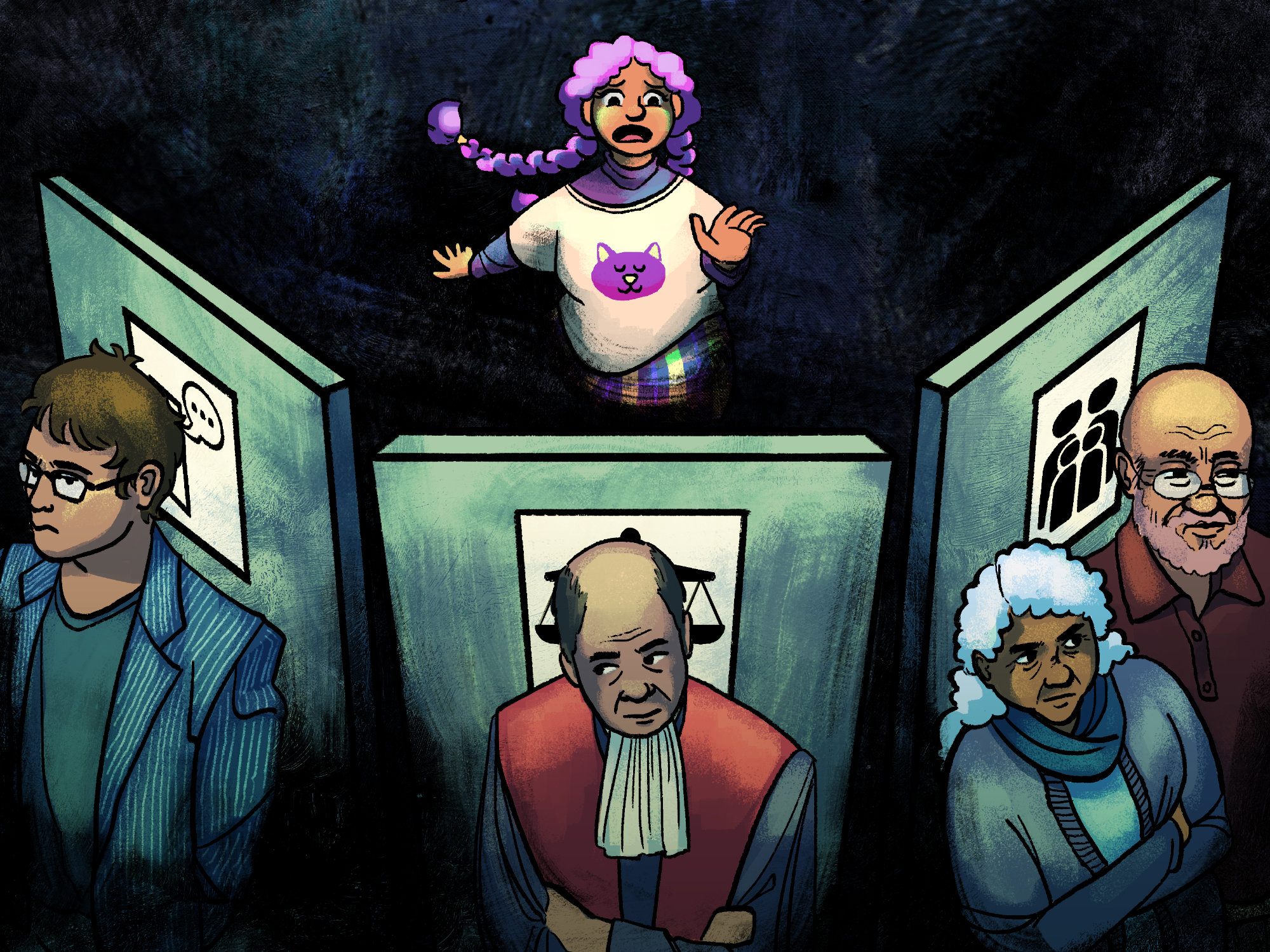
For many victims, the challenge does not end with the image itself. Uncertainty around legal outcomes remains a major barrier.
Legal service staff of LBH APIK Jakarta branch, Diandra Paramita Anggraini, said it is difficult for OGBV cases to reach court.
“It usually takes a long time, and there’s no guarantee that a case will proceed,” she said.
“Most cases stall during the investigation process without clear reasons.”
Diandra, who is assisting M, said police have been conducting a preliminary investigation into M’s case for six months. So far, there hasn’t been a sign that M’s case will advance to the formal investigation.
In Indonesia, after a report is filed, the police will conduct a preliminary investigation, followed by a formal investigation in which a suspect is named. After that, the police will submit the case files to the prosecutor’s office and the last is court proceedings.
When assisting M, Diandra saw that investigators didn’t fully grasp the urgency of OGBV cases.
“They even asked why M was very angry as it was just an edited photo,” she said.
Police also suggested restorative justice because the perpetrator is a family member, but M refused.
Indonesia has yet to establish a comprehensive legal framework specifically addressing AI. As of April, regulations are limited to a ministerial circular on AI ethics. A presidential decree and national AI roadmap are still in development, with no clear timeline.
In OGBV cases, prosecutors typically rely on the Electronic Information and Transactions (ITE) Law, alongside the Pornography Law.
However, these laws are rarely used to prosecute such cases. Instead, parties involved, including law enforcement, often push for informal or “ethical” resolutions.
According to Shevierra, this reflects a deeper issue.
“OGBV is part of sexual harassment, but it is not treated as a crime. It is still seen as an ethical issue,” she said.
Platform Policies and Limited Responses
Even when victims try to have the content removed, the outcome is far from certain.
Major platforms prohibit non-consensual sexual content, including AI-generated material. TikTok, for example, bans such content and uses a combination of automated detection, human moderation, and user reports to enforce its policies.
According to TikTok, its Community Guidelines prohibit content depicting or supporting non-consensual sexual acts, including the sharing of non-consensual intimate imagery, whether created by users or generated through AI. The platform also does not allow certain types of nudity, sexual activity, or sexual solicitation.
The company reported that globally, 97.7 percent of edited or AI-generated harmful content was removed proactively between July and September 2025. In Indonesia, 11.9 million videos were removed during that period for guideline violations, with 99.6 percent taken down before being reported.
TikTok also states that when it identifies violating synthetic content, it develops detection measures to identify and remove similar versions. The platform further notes that users can report violating content through in-app tools or web forms, which are then reviewed by its safety teams.
Meanwhile, X responded to questions sent via direct message to its support account. The response was received within a minute (indicating the answer was auto-generated) and provided a standardized, yet quite long, explanation of its policies.
X stated it uses a combination of automated tools, user reports, and human review to detect and remove non-consensual intimate imagery, including AI-generated content. Such material, the company said, violates its policies and can lead to content removal and account suspension.
It also said users can report such content through in-app tools, with cases reviewed “expeditiously”, often within hours for high-risk reports.
However, enforcement gaps remain.
Organisations like SAFEnet received case complaints from victims of OGBV and would help escalate the complaints to the respective platforms, hoping the content would be taken down as soon as possible.
Shinta Ressmy, a researcher at SAFEnet said, for many platforms, intimate content means nudity. As a result, if manipulated images depict victims in lingerie or tight clothing, it won’t be considered intimate content.
“Victims who contact us sometimes wear hijab. So, if their photos are edited to make them wear swimsuits or very tight clothes, that is intimate from their perspective. That’s why it has to be taken down,” Shinta said.
But according to many platforms’ policies, such content may not be removed.
SAFEnet has urged platforms to consider local cultural context, but Shinta said there has been little progress.
The other six platforms we contacted—Amazon, Google, Meta, Microsoft, OpenAI, and Telegram—did not respond to our inquiries. Some like Meta and OpenAI have published community standards that prohibit non-consensual sexual content.
A Rare Case Reaches Court
Cases involving AI-manipulated sexual images rarely reach court, but a small number do.
One rare case that drew public attention was tried in Semarang, Central Java. The defendant, Chiko Radityatama Agung Putra, a law student at Diponegoro University, used AI to manipulate images of at least 30 high school students—some of them his juniors in state high school SMAN 11—to make them appear naked.
The victims included students, alumni, and teachers, with images sourced from both personal photos taken by him and the victims’ social media.
Despite the scale, prosecutors only demanded a seven-month sentence. In March, the court sentenced Chiko to one year in prison. The defendant was also ordered to pay a fine of Rp2 billion (USD 118,000), which can be substituted with just 15 days in prison.
“With that value, if we look at other verdicts, the substitute should be six months, nine months, or even a year in prison. We are disappointed,” said Reza Alfiawan Pratama, one of the victims’ lawyers.
The court, he added, considered a settlement agreement made between the perpetrator and the victims.
“Our client told us that the agreement was made under pressure,” Reza said.
Chiko’s parents are police officers based in Semarang.
Another lawyer of the victims, Bagas Wahyu Jati, said the perpetrators’ parents had visited the victims at night.
“The victims didn’t want to make a settlement agreement but considering the parents’ background, they might have felt pressured. If I reject the settlement, what’s going to happen to me?” Bagas said, recalling the victims’ concerns.
The judge cited public concern as an aggravating factor, but still handed down a lenient sentence which he described as inconsistent.
“The victims may look fine and can do their activities normally, but they are traumatised and they will always carry that. Meanwhile, the perpetrator only got a light sentence and will be out soon. That’s frightening for the victims,” Bagas said.
Apart from criminal sanction, Chiko was suspended for two semesters due to the case, according to Nurul Hasfi, Director of Media Network, Community, and Public Communication at Diponegoro University.
As he has been found guilty, the university automatically expelled him.
Government and Police Response
Amid growing concerns over AI-facilitated online gender-based violence, Indonesian authorities say legal mechanisms are already in place to address such cases.
Senior Commissioner Rizki Prakoso of the National Police’s cybercrime unit said cases involving manipulated intimate images or AI-generated sexual content can be prosecuted under existing laws, including the Electronic Information and Transactions (ITE) Law, the Pornography Law, and provisions in the Criminal Code related to morality and victim protection.
Cases involving minors, he added, fall under stricter child protection laws.
“In principle, any sexual content created, modified, or distributed without consent, especially regarding children, is still considered a violation of the law and can be prosecuted,” Rizki said.
The police also conducted cyber patrols regularly to detect and monitor the spread of non-consensual sexual content, including AI-generated material. These efforts include identifying accounts, platforms, and networks involved, as well as profiling suspected perpetrators.
The patrols, he said, are carried out proactively and do not rely solely on public reports.
Meanwhile, the government says regulatory efforts are still underway.
According to Fifi Aleyda Yahya, Director General of Public Communication and Media at the Communication and Digital Affairs Ministry, two draft presidential regulations on AI—covering a national roadmap and ethical guidelines—are currently under review at the State Secretariat.
She said the regulations will not include sanctions, as they are intended as guiding frameworks.
“Violations against digital content manipulation and deepfakes of a sexual nature can refer to related laws such as the ITE Law and the Sexual Violence Crime [TPKS] Law,” Fifi said.
The ministry also stated that content generated using AI, even if it does not meet the legal definition of pornography, can still be subject to takedown if it causes public harm or uses someone’s identity without consent.
The government also plans to strengthen its response through a combination of technology, monitoring, and public participation, she added.
But for victims like M, the damage is already done, and the question is no longer whether the images are real, but whether anyone will be held accountable.