
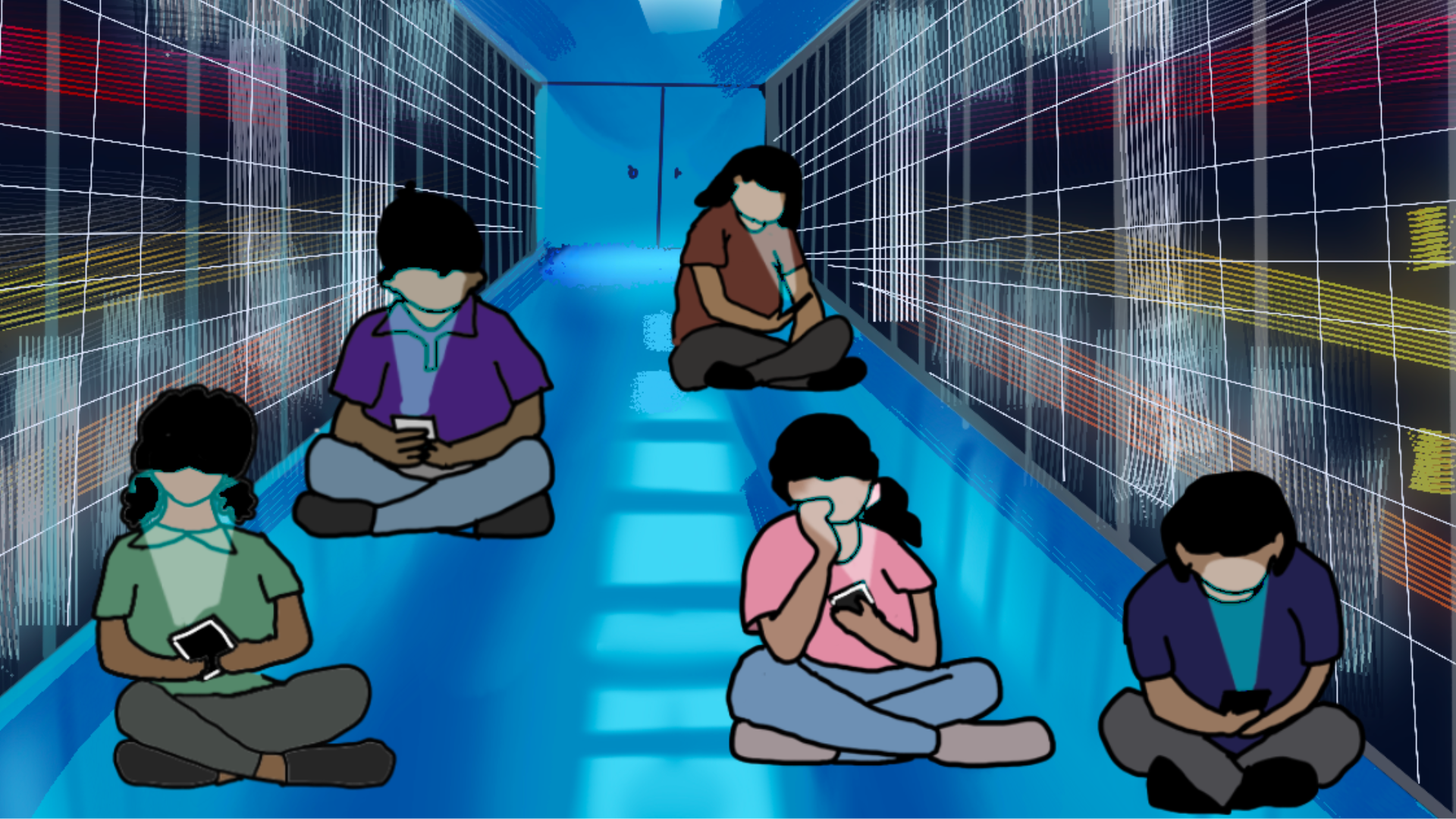
“I talk to it [AI] about everything — my career, emotional issues, anxiety, everything in my life. I just open my heart in front of ChatGPT,” said Diksha Vijay, a 21-year-old student in Delhi, India.
Vijay started using AI chatbots nearly six months ago. She would discuss every minor detail with the chatbot, which in turn would agree with her. She initially found solace in these responses but slowly started recognising that the tool was merely saying things that made her happy. Despite acknowledging this, she continues to rely on these chatbots for support.
“I had a fight with my friend and I talked to ChatGPT about it. ChatGPT agreed with me and said I wasn’t wrong anywhere. But when I reached out to my other friends, they pointed out my faults. So there was a difference there,” said Vijay, adding, “I sometimes feel that ChatGPT just agrees with what you say. Sometimes it lacks in giving real advice which is actually important for you at the moment.”
Like Vijay, there are many young adults and children across South Asia who recognise these pitfalls of AI but continue to use it for emotional, academic, and professional support.
Experts and parents worry about this overdependence and highlight how this trend is reducing human interaction and curtailing critical thinking.
Speaking to Asian Dispatch, Dr. Mariya Stoilova, manager, Digital Futures for Children centre, London School of Economics said, “Children are often the users of a technology that is not created for them. It’s almost like AI is coming to them, it’s messaging them, and it’s prompting them to have a relationship with it.”
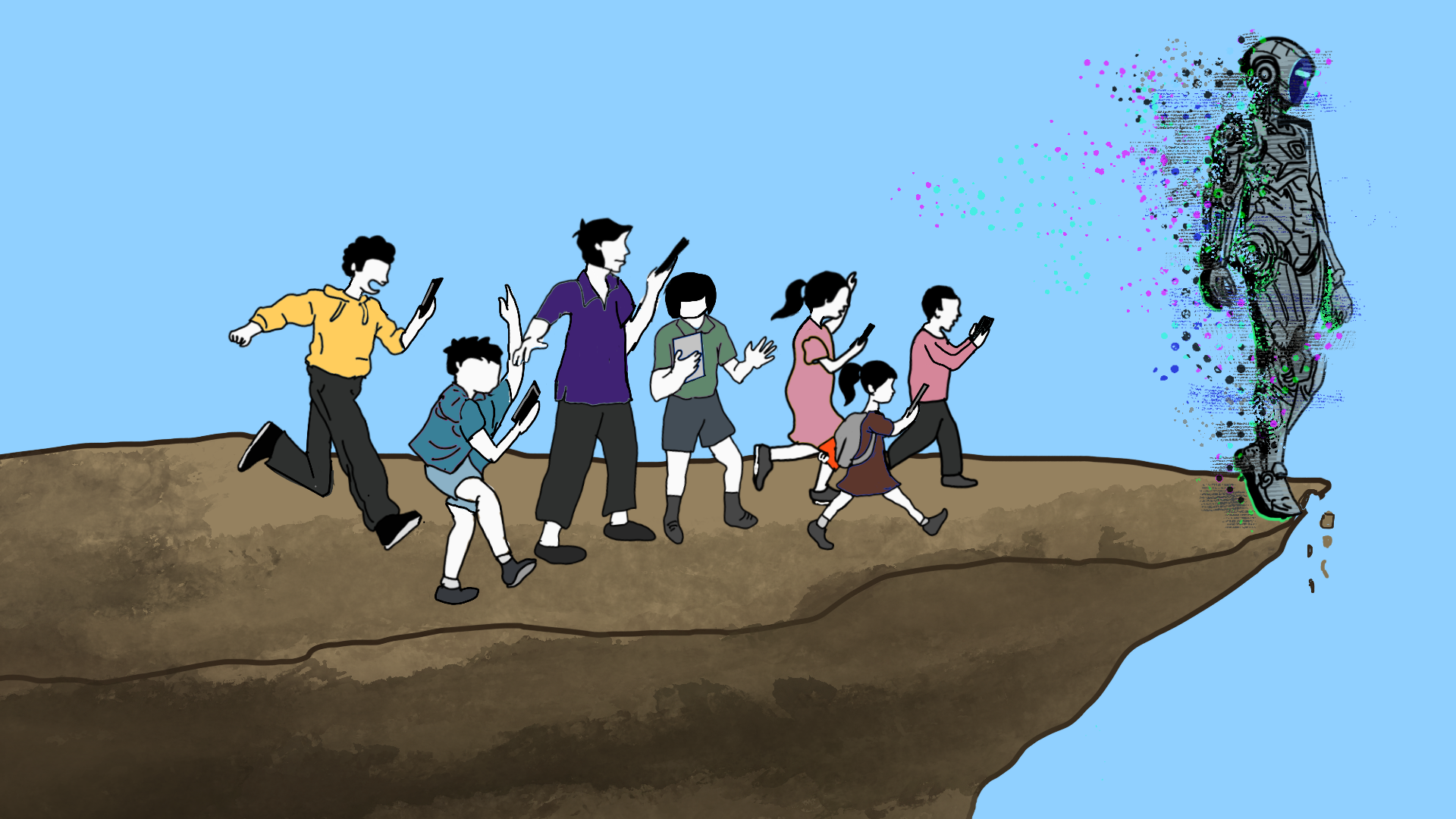
A study of 18 children across three cities in India, which was conducted as a part of a larger cross-border research led by Dr. Stoilova, notes that children use generative AI tools for educational purposes—to ask questions about new concepts, get help with school work, to fix grammatical errors—to have fun with friends, or explore creative talents.
Published in September 2025, it mentions that while children are beginning to recognise the harm of AI, they say that there is little to no conversation about it in schools. It also points towards limited understanding of privacy-related harms and the quality of output.
A thirteen-year-old who studies in a private school in Gurugram echoed this.
I see so many people use AI for it [homework]. You’re not even using your own mind for the answers, so what’s the point of doing the task? – A thirteen-year-old student
She fears growing up in a world where nobody is going to use their mind and only rely on machines.
However, this trend is not specific to any one country. With high internet penetration, cheap data, and easy access to mobile phones, children across South Asia are heavily relying on technology for personal interactions.
Adoption Without Adaptation
In developing nations such as India, Sri Lanka, and Pakistan, technology is often viewed as a shortcut to advancement, a quick path to achieve the coveted status of a “developed” nation. AI in the region is also being swiftly introduced into every aspect of our lives.
But without sufficient guardrails, these sweeping changes have the potential of severely impacting the quality of education and the socio-cultural development of children and young adults alike.
Kriti Bhattarai, program manager, Voice of Children, Nepal, pointed towards one such impact. She highlighted that while schools are advertising and boasting about their AI-powered educational facilities, anecdotes from teachers show a different reality.
“A school teacher [at a private school in Nepal] shared that children in primary classes are using AI for simple subtraction,” she said.
Bhattarai works on cybersecurity for children, with a focus on sexual violence against boys from marginalised families. Another major concern for her is the wide knowledge gap between parents and children in these families. In her experience, it’s the children who own smartphones and are able to use them.
In such situations, how are parents expected to provide informed consent about AI to schools and their children, she questions.
Anil Raghuvanshi, founder of ChildSafeNet, a non-governmental organisation in Nepal, raised similar concerns and underscored that these tools are embedded in our daily lives so seamlessly that children don’t often realise that they are using any technology.
Raghuvanshi stressed that children now talk to AI through voice features and rely on these machines for answers they might once have sought from family or peers. “This might affect human-to-human relationships, trust, and social connection especially for children and young people.”
Another immediate concern with AI usage is the representative bias.
The study conducted by Dr. Stoilova in the Global South (India, Kenya, Thailand, and Brazil) noted that children shared their experiences of racial, linguistic, and cultural biases as “as GenAI frequently failed to recognise or respect their circumstances and needs.”
Raghuvanshi, too, mentioned that these biases that AI systems carry could perpetuate stereotypes and cause distress among children.
These biases may seem par for the course to some; afterall, large language models (LLMs) are still being fine-tuned. But when you see AI as your friend, these seemingly small gaps in development can be hurtful.
For young adults, who better understand that there is no one on the other end, it’s a frenemy.
“There’s this feeling of inequality, that opportunities are disappearing for them,” said Stoilova. “They are worrying about over reliance on AI themselves, saying ‘I’m going to lose my skills. I [have] stop[ped] thinking, I rely on it’.”
But the use of chatbots doesn’t stop at work and studies.
A Shortcut to Intimacy
A unifying facet across South Asia is that strict taboos around intimacy, especially among young people, continue to flourish.
“Lots of younger teenagers don’t even know how to talk to people of the opposite genders in India; it’s a larger social problem,” said Srinivas Kodali, independent researcher and hacktivist.
Without options for socially acceptable companionship, children are more susceptible to emotional dependence on unsafe alternatives.
Character.ai, a chatbot to talk to personalised fictional characters, gained notoriety after multiple users of the platform reportedly died by suicide. The California-based company is embroiled in lawsuits with families over causing harm to minors. They announced an end to its open-ended chats policy for users under 18 in October 2025.
“We will limit chat time for our under-18 users. The limit will start at two hours per day and ramp down over the coming weeks,” the policy update read.
Three of the 18 participants of the study conducted in India reported using Character.ai, although Professor Chinar Mehta, one of the Indian researchers, believes that the actual number could be higher.
“It didn’t come up too often, but it is clear that children are using this space as a way to talk about their bad feelings or intimate relationships, about problems with their friends, family, and so on,” said Mehta.
Zaib Samraz, a clinical psychologist and research associate, Institute of Omics and Health Research and visiting lecturer, The Islamia University of Bahawalpur, Pakistan, shared a similar experience with us.
She said, “A 14-year-old girl uses Al as a “friend.” She shares her secrets with it, and says it “understands” her more than her mother. She’s becoming withdrawn at home.”
A research conducted by RATI Foundation, a Mumbai-based organisation that focuses on addressing violence against women and children in online and offline spaces, asked children to anonymously write the questions they ask Google. The topics they collected ranged from skin care to sexual advice, relationships, and aspirations.

As ChatGPT essentially replaces Google search for the younger generation, Siddharth Pillai, co-founder, RATI Foundation, thinks it’s natural that these conversations are migrating to AI platforms.
In 2025, India was a big market for ChatGPT and their focus on the region is evidenced by the announcement of IndQA, an AI assessment project for 12 “Indian” languages, at least three of which are also commonly spoken in Pakistan, Sri Lanka, and Bangladesh.
Alongside the U.S., India is a top user for other AI-based applications as well. However, liability cases against these companies are piling up in the U.S, many stating that these chatbots are driving their loved ones to suicide.
High profile wrongful death lawsuits against both OpenAI and Character.ai have been making headlines all through 2025. Seven new suicide cases against ChatGPT were filed in November, which allege that the chatbot provided encouragement and instructions to vulnerable users.
With a large user base in South Asia, do these platforms not have similar negative impact here or are there other factors keeping it under the radar?
“It is certainly probable that there are similar cases happening here,” said Prateek Waghre, programs and partnerships head, Tech Global Institute. “But the social context around self harm is so different here. It’s very unlikely that someone is going to take it up in court, with the way the legal system operates here.”
After the first few cases gained public attention, both ChatGPT and Character.ai introduced new restrictions for users under 18. But how these platforms will implement age verification is still unclear.
A Character.ai spokesperson told Asian Dispatch, “We have developed our own age estimation model in-house and are partnering with third-party services like Persona. Combined, we’re using different age assurance techniques to get better and better at ensuring that users are in the correct age bucket.”
Whether it’s identification card based verification, or photographic verification, the reliability of these methods is unknown in the larger geographical context. Waghre said that they might be reasonably accurate for North America or Europe, but that doesn’t guarantee it will be effective in Asia.
OpenAI also updated ChatGPT’s model to improve its reactions to people in distress, but this improvement is only measured against its previous models. Essentially, there is no guarantee that the platform is safe for children.
So Why This Dependence?
AI has become ubiquitous, and there seems to be no way to keep children away from it without depriving them of digital connectivity entirely.
40-year-old Shweta Khasgiwala, a dentist and a mother of two young kids in Madhya Pradesh’s Indore, believes that to keep up with the fast paced world, her children will have to use these tools. She says a speech written using Perplexity, an AI tool, is comparably better than a speech written by a child on their own.
“What concerns me is that if they have to compete, they have to use the tools,” opined Khasgiwala. “So you have to make it a part of your child’s life. But then you have to train your child as to where the usage has to stop.”
But here’s another question: hasn’t reliance on the internet been a cause of concern for parents ever since the internet was invented? Are AI tools impacting children’s education more than Wikipedia, their social behaviour more than Instagram?
We don’t know yet but the answer will be complicated, experts say.
“Your human friends are not always there for you but AI is always there. It’s going to keep replying and it replies immediately,” said Dr. Stoilova.
“It sets some expectations that are definitely not realistic for a human being. Sometimes it tells you what you want to hear, when a human friend might be more sincere or preoccupied with something else and might not give you this kind of support. It’s persuasive, it’s hyper-personalised, and children are bound to trust it quickly.” –Dr. Stoilova
Samraz says that children using AI feel heard when adults shut them down, it has helped them learn faster, and also helped boost their confidence and creativity.
But these chatbots have been deployed at an unprecedented rate—with little scope to understand their impact on our lives. Further, Waghre said that AI’s non-deterministic nature “makes pattern recognition and prediction almost impossible, so no one really knows what goes on between a chatbot and its user.”
He also questioned if the reason behind minors and teens turning to chatbots for these conversations is lack of safe social spaces in their daily lives and relationships?
“It will be oversimplifying to say that conversations with chatbots shouldn’t be happening. What are the social support systems they need so they don’t feel the need to go to ChatGPT to ask those questions? What kind of structures do we need to put in place?” said Waghre. “Those questions need to be understood and the answers to that will not come from technology policy.”
The scale of AI’s impact, and the consideration of these support mechanisms is all going undetected in South Asia, said Waghre.
Where Do We Go From Here?
Experts highlight positive use cases of AI and concur that AI can’t entirely be eliminated from anybody’s life.
Pillai argues that AI could be beneficial for education and accessibility among children in marginalised groups but it’ll always be the urban affluent child who first interacts with it. He emphasises that when such a child falls into trouble then we suddenly ban AI for all kids, we deprive people of the positive impacts.
He highlights that RATI Foundation runs a helpline, Meri (my) Trustline, for online safety of children and they have received AI-written emails from children seeking help about online safety. He says children have also used AI-generated emails to successfully take down [harmful] content online.
An in-depth understanding of AI’s impact on children will take a few years, but parents and tech experts agree that the use of AI should be regulated and there should be focus on children-centered AI policy and regulation.
Millennial parents, Smita Misra and Neena Wilson, focus on effective communication and a healthy balance of exposure to technology and reality.
Misra, an advertising professional and a mother of a seven-year-old said, “We have to be as technologically nimble as possible. As long as you give your kids a firm connection to reality with a healthy balance of technology, I think that’s all right because today it’s AI, tomorrow it will be something else.”
And discussing terms such as regulation and policy aren’t enough.
“AI should be approached from a child rights lens, which means building digital literacy, ensuring safeguarding measures, and involving families and schools in guiding ethical use of AI, rather than banning or ignoring these tools,” said Narendra Dangol, executive director, Loo Niva Child Concern Group, a child rights organisation in Nepal.
Raghuvanshi is also careful about positioning Al as an “enemy”. He argues that if it is used well, AI can support learning and even encourage critical thinking. However, he says that the problem is that “many children don’t know how to ask the right questions, how to verify answers, how to check sources.”
The question, he suggests, is not whether children will grow up with Al, but whether adults will catch up fast enough to guide them.