
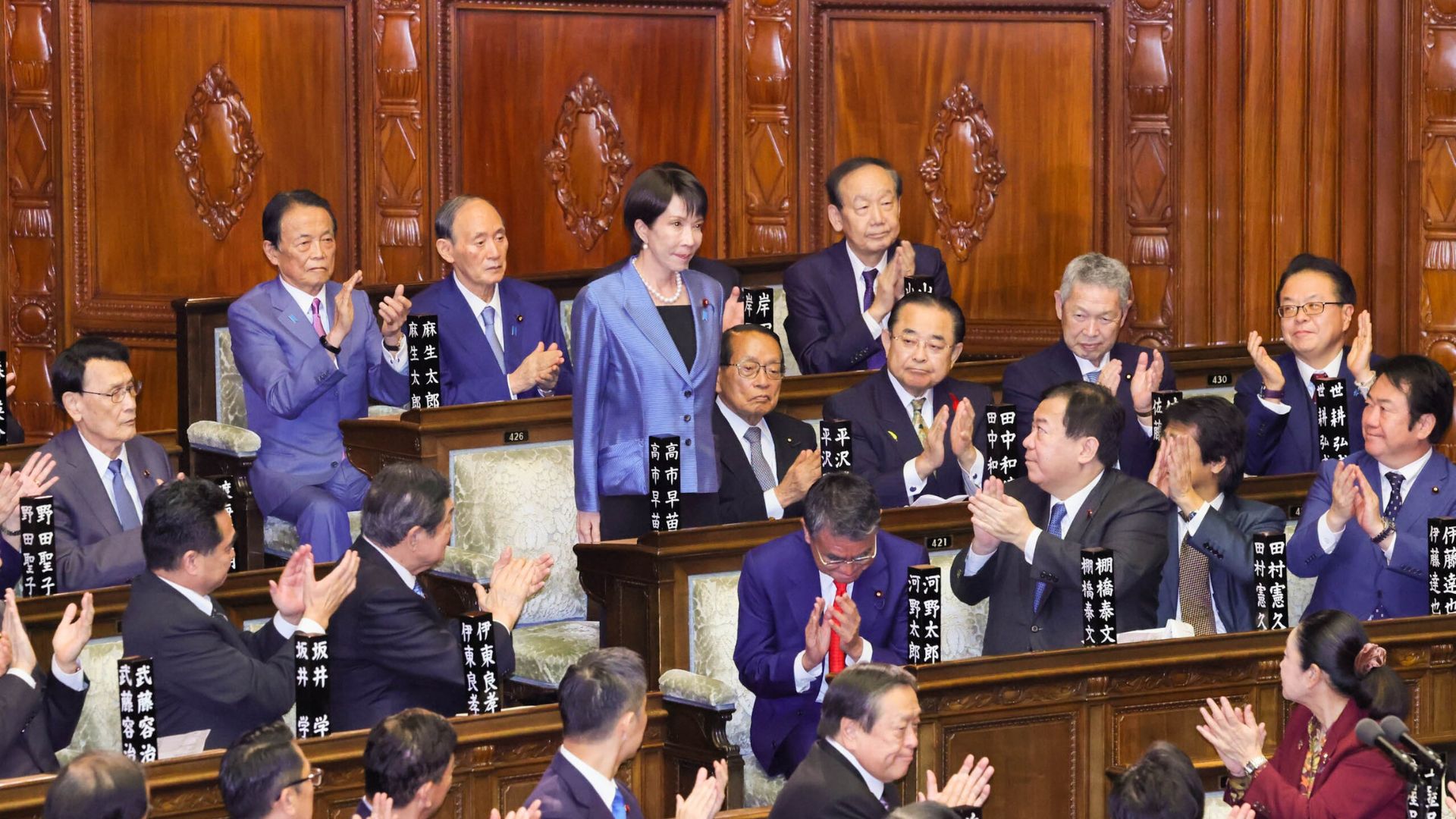
Sanae Takaichi was elected as the first female prime minister of Japan, a country that has been long criticised for its gender gap, in October 2025. Takaichi brings a hard-line, conservative approach that points to an assertive defence and energy policy. She is socially conservative and her tenure begins as the country enters a period of political uncertainty with geopolitical and economic challenges, internal party factionalism, and mounting opposition.
On the geopolitical front, Japan is sandwiched between the United States and China. Tokyo identifies China as a security threat and commits to the U.S. security umbrella but relies on both the countries economically. Takaichi recently met Chinese President Xi Jinping on the sidelines of the Asia-Pacific Economic Cooperation (APEC) Summit in South Korea and focused on building “constructive and stable Japan-China relations”.
However, Takaichi’s meeting with Taiwanese officials drew China’s ire, with the latter calling it “egregious”. While China is Japan’s largest trade partner, there are persistent issues such as China’s increased military activity around disputed islands and the status of Taiwan.
Tokuko Shironitta, managing director for Japan at strategic advisory firm the Asia Group, told TIME that the challenge for Takaichi would be to maintain “strategic clarity and significance with the U.S., while promoting economic relationship with China.”
Takaichi’s visits to Yasukuni Shrine (before taking office) in Tokyo, a shrine for Japan’s war dead, have also been seen as an act of provocation by countries that Japan attacked during the Second World War.
Takaichi’s rise has also been seen with concern in South Korea, who was warming up to Japan under former Prime Minister Ishiba Shigeru. Japan also faces nuclear powers North Korea and Russia across the sea. The relationship between Japan and Russia is at an all-time low and since 2022, Takaichi has criticised Russia’s invasion of Ukraine. Her position on Moscow is completely different from her mentor and former Prime Minister Shinzo Abe.
Experts point out that Russia’s strategic partnership with North Korea also adds to the mix as from Japan’s perspective, Moscow is an “accomplice to a regime that openly threatens Japan with ballistic missiles and nuclear weapons, and which is known to have abducted Japanese citizens.”
READ: Do U.S. Trade Tariffs Present an Opportunity for Asia to Emerge Stronger?
Women’s Rights on the Agenda?
Takaichi’s rise is symbolic in a society where women remain underrepresented at senior political levels, but gender advocates and commentators have been quick to warn that the symbolism may not translate into progressive policy.
Momoko Nojo, founder of No Youth No Japan, a youth advocacy group, told The New York Times that “the situation for women will not improve” and highlighted that “she [Takaichi] came to this position by discouraging gender equality in society.”
Soon after assuming office, Takaichi announced her cabinet with just two female ministers. Alluding to this appointment, Tohko Tanaka, a media and gender studies professor at the University of Tokyo, told Reuters, “This is extremely disappointing and offers no hope for women’s empowerment.”
Takaichi’s has publicly opposed gender reforms such as allowing married couples to keep separate family names, opposing same-sex marriage legalisation, and supporting preservation of male-only rules in the imperial succession, which means her premiership is unlikely to produce a liberalisation of family and gender laws.
Takaichi is a former economic security and interior minister and has repeatedly referred to the conservative Margaret Thatcher as a source of inspiration.
She is, however, not the first female head of state with conservative views or whose leadership rests on high expectations for women in her position and power. Asia has seen several female heads of government; many have risen to power while advancing conservative positions on gender and social norms.
Leaders such as Park Geun-hye in South Korea avoided feminist agenda despite her election being a symbolic milestone. Yingluck Shinawatra in Thailand, too, rose to power but shied away from the feminist agenda.
In South Asia, figures like Sheikh Hasina in Bangladesh and the late Indira Gandhi in India governed with strong centralist instincts rather than gender-progressive platforms. Sri Lanka’s Sirimavo Bandaranaike, the world’s first female prime minister, similarly led a traditional, patronage-driven political culture rather than a reformist gender lens.
Defence: Speed and Scale
One of the clearest and most immediately consequential elements of Takaichi’s agenda is defence. She has signalled that Japan will accelerate plans to bring defence spending to two percent of GDP within the current fiscal year, sooner than the earlier target of fiscal year 2027.
Bart Gaens, Japan Chair at the International Centre for Defence and Security (ICDS), argues that relations with the United States remain a top priority. “Takaichi’s strong stance on a more autonomous defence, increased deterrence, eased restrictions on the export of defence equipment, and tough stance on immigration will likely appeal to Trump,” he wrote.
He also pointed out that it is equally important to maintain relationships with China and South Korea. “In China, the reaction to Takaichi’s election was wary, cautioning her about historical sensitivities, Taiwan commitments and regional stability. With China Takaichi will likely follow in the footsteps of Abe and play her cards very pragmatically, engaging China economically in the region wherever possible, while competing strategically at the global level,” he added.
The current defence plan should be seen in the context of Japan’s postwar legacy. In 1947, after the Second World War, Japan adopted a pacifist constitution under the U.S., with Article 9 explicitly renouncing war and the maintenance of traditional armed forces. But as the regional threats (China, Russia, and North Korea) grew, there was a growing call to amend Article 9. Abe was instrumental in this shift: expanded Japan’s defence budget and pushed through legislation allowing collective self-defence. Takaichi’s policies build directly on Abe’s foundation, focusing more on an assertive, self-reliant military strategy.
Earlier this year, Takaichi also proposed creating a “quasi-security alliance” with Japan, Taiwan, Australia, India, and other European partners.
Energy and the Return of Nuclear
Economically, Takaichi has moved to make nuclear power central to Japan’s energy and inflation strategy. After shocks to energy markets and the political fallout from the 2011 Fukushima reactor disaster, she is pushing for accelerated reactor restarts and a re-emphasis on nuclear power. However, there is scepticism over large solar deployments, especially projects contracted or financed with strong Chinese components.
The stated rationale: restart reactors to reduce costly fossil-fuel imports, stabilise prices, and buttress industrial competitiveness.
Takaichi’s economic plan combines pro-growth spending with a readiness to approve extra budgets and stimulus packages to boost household incomes and domestic demand, rather than rushing to cut government spending. However, some economists warn that if this approach continues for too long, it could make it harder for Japan to fix its already high public debt which stands at more than 250 percent of GDP, the highest among developed nations.
Another immediate constraint on Takaichi’s power is also the political arithmetic and reputational damage within Japan’s ruling bloc.
Kristi Govella, senior adviser and Japan chair at the Centre for Strategic and International Studies (CSIS), told Asian Dispatch that Takaichi is “inheriting a difficult domestic political situation.”
“At the moment, her support ratings are around 74 percent, among the highest of all Japanese prime ministers after their election, and she has just completed a very successful summit with President Trump, so she may have a bit of a honeymoon period to push forward with the difficult next steps.”
Govella says that Takaichi is facing multiple challenges: bridging divisions within her own party, finding ways to work with her new coalition partner and other parties to make policy, and trying to show the Japanese voters that she is taking their concerns seriously.