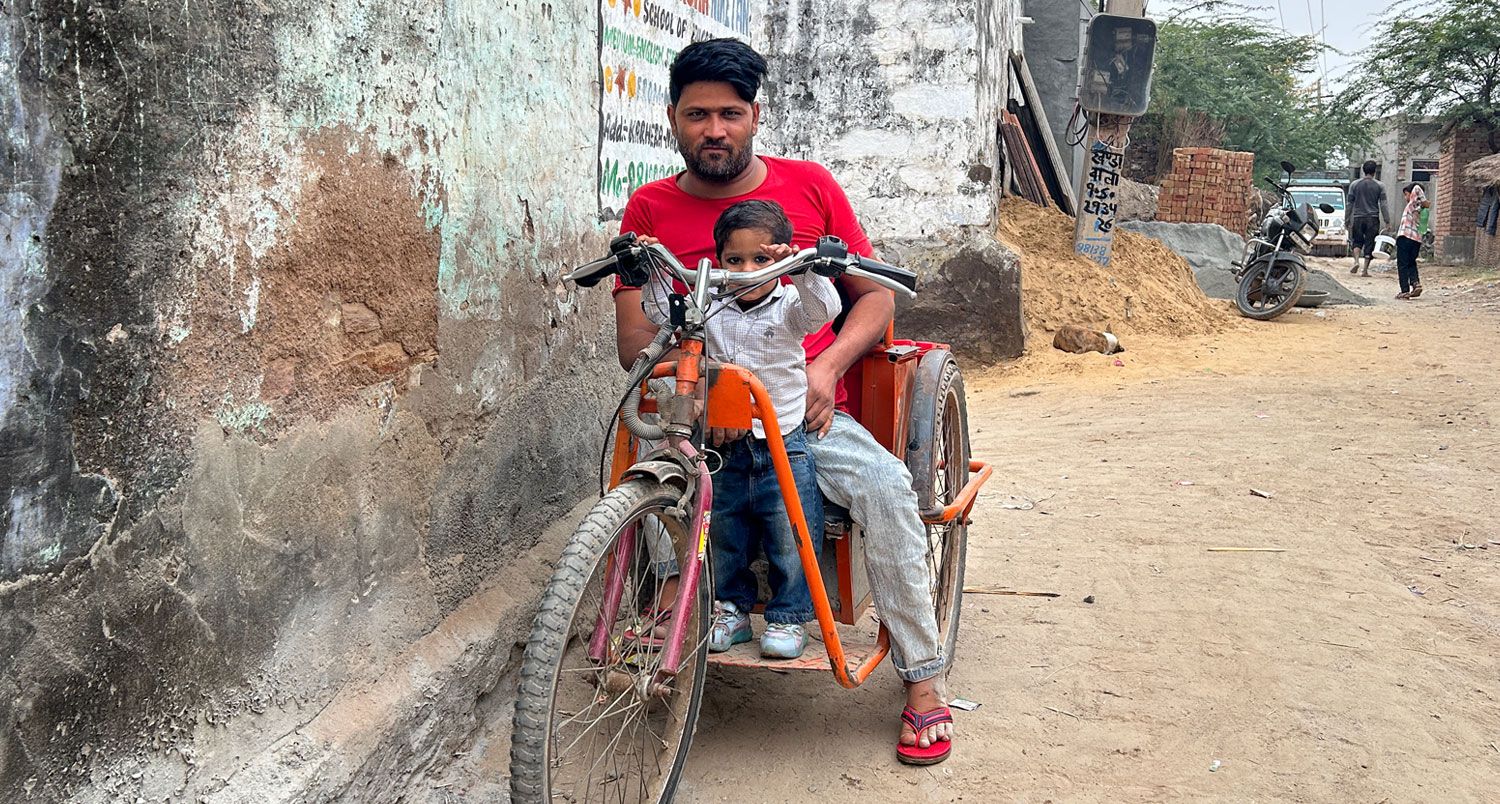
“Its maximum speed is 30 kilometres an hour, but it doesn’t go over 27.”
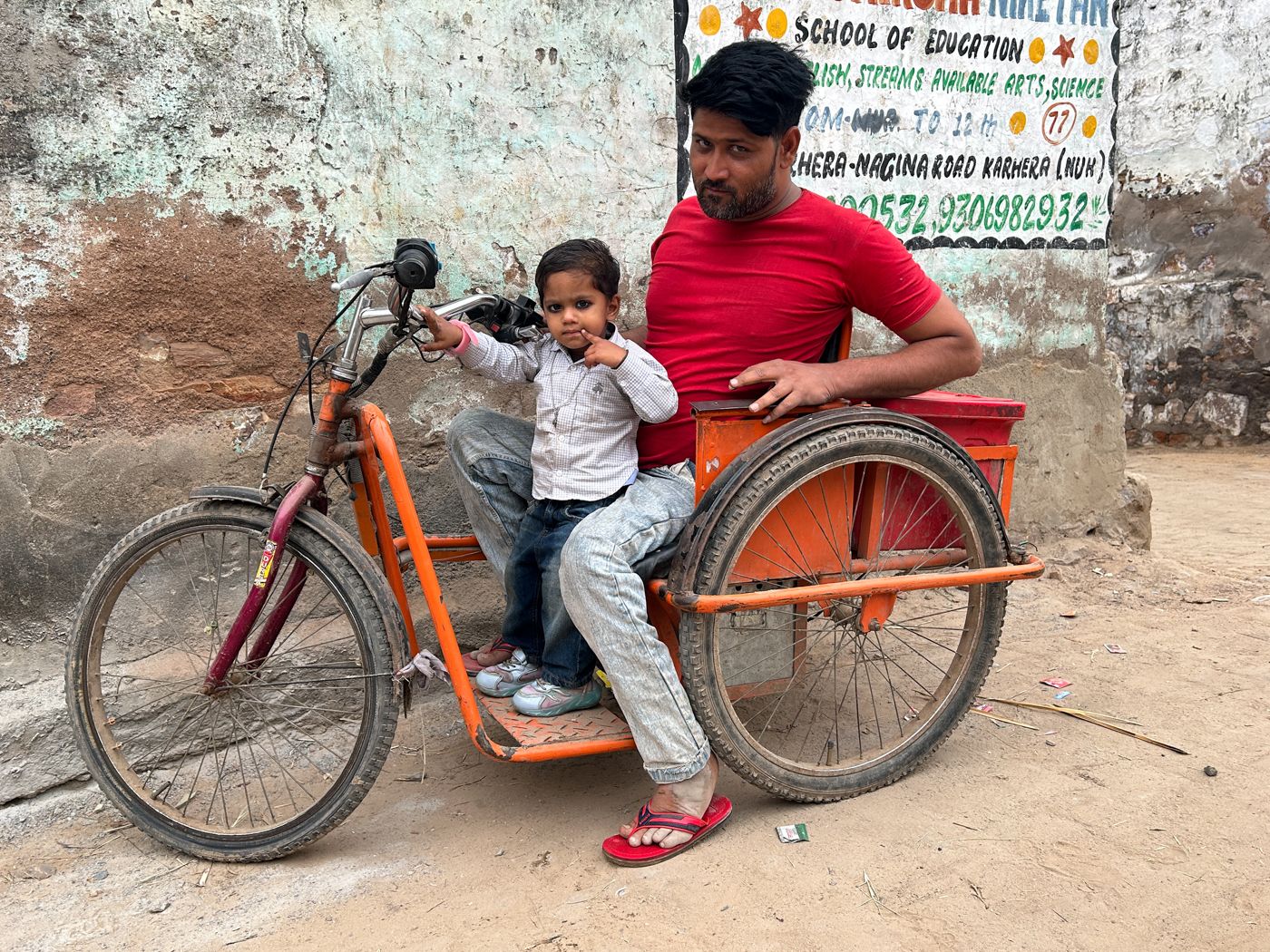
Even so, Waseem Qureshi is pleased to have his vehicle working once again. The 34-year-old uses this motorised tricycle to get to work and back.
As he mounts the bike, he tells me the wiring is still a bit tricky and he must be careful while using the brakes. Seated comfortably in the chair fitted onto the tricycle, he leans down to show me the battery underneath the seat, and a small storage compartment behind.
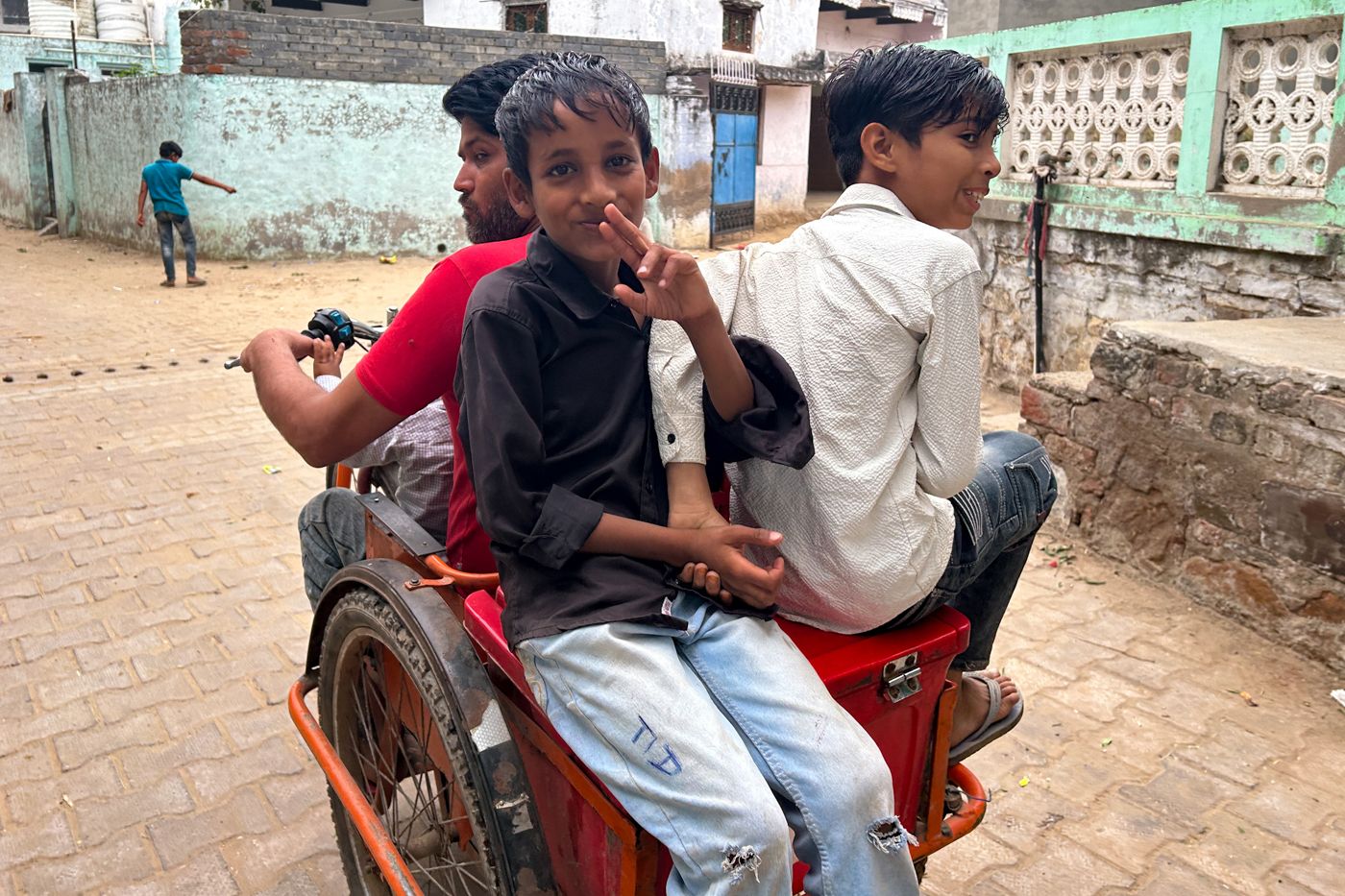
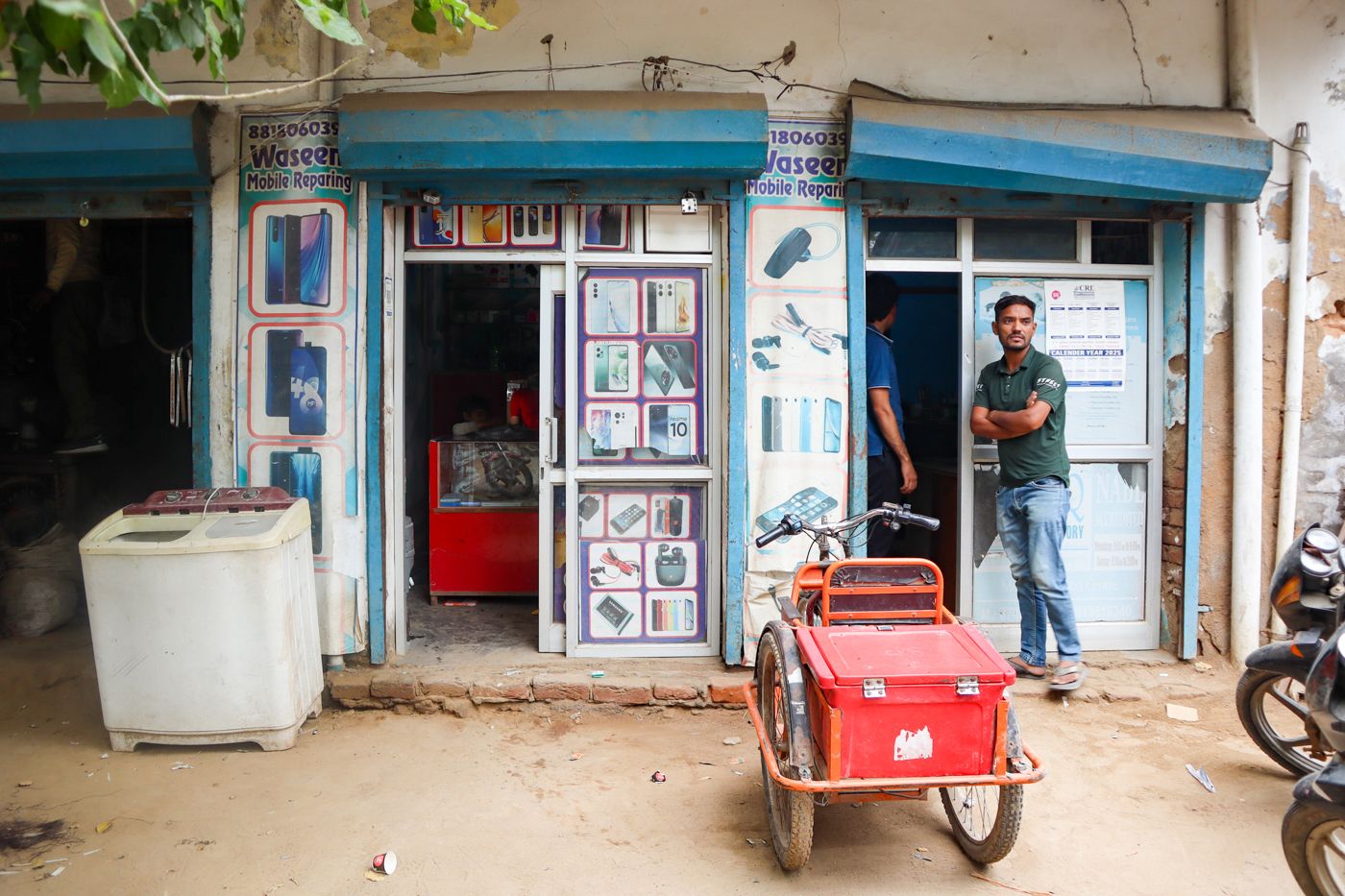
Waseem starts the bike, and he’s off to his small mobile repair shop tucked behind the trees along the Delhi–Alwar national highway, less than a kilometre from his village in Haryana’s Mandikhera. I watch as children from his neighbourhood run behind, laughing and hopping onto the small compartment at the back of his tricycle. He doesn’t seem to mind, joining in their laughter.
There was a time when he did mind.
Waseem was five years old when a severe fever left him unable to walk. “He collapsed in the courtyard. He couldn’t get up,” his 55-year-old mother, Anwari, remembers. “Jaise koi hawa lag gayi ho [as if some ill wind had struck him],” she says.
“Polio mara tha [I had contracted polio],” Waseem says.
His father took him to school on a scooter. On the way back, his older brother carried him on his back, “piddi karke,” he says. The few afternoons he walked home alone, he overheard, “See that bechara, how he walks.” Those remarks hurt even today.
Polio (poliomyelitis) is a highly infectious viral disease that affects children under five, spreads mainly through the faecal and oral route, and can cause paralysis by invading the nervous system. India was declared polio-free in 2014, following a nationwide oral vaccination campaign that began in 1995.
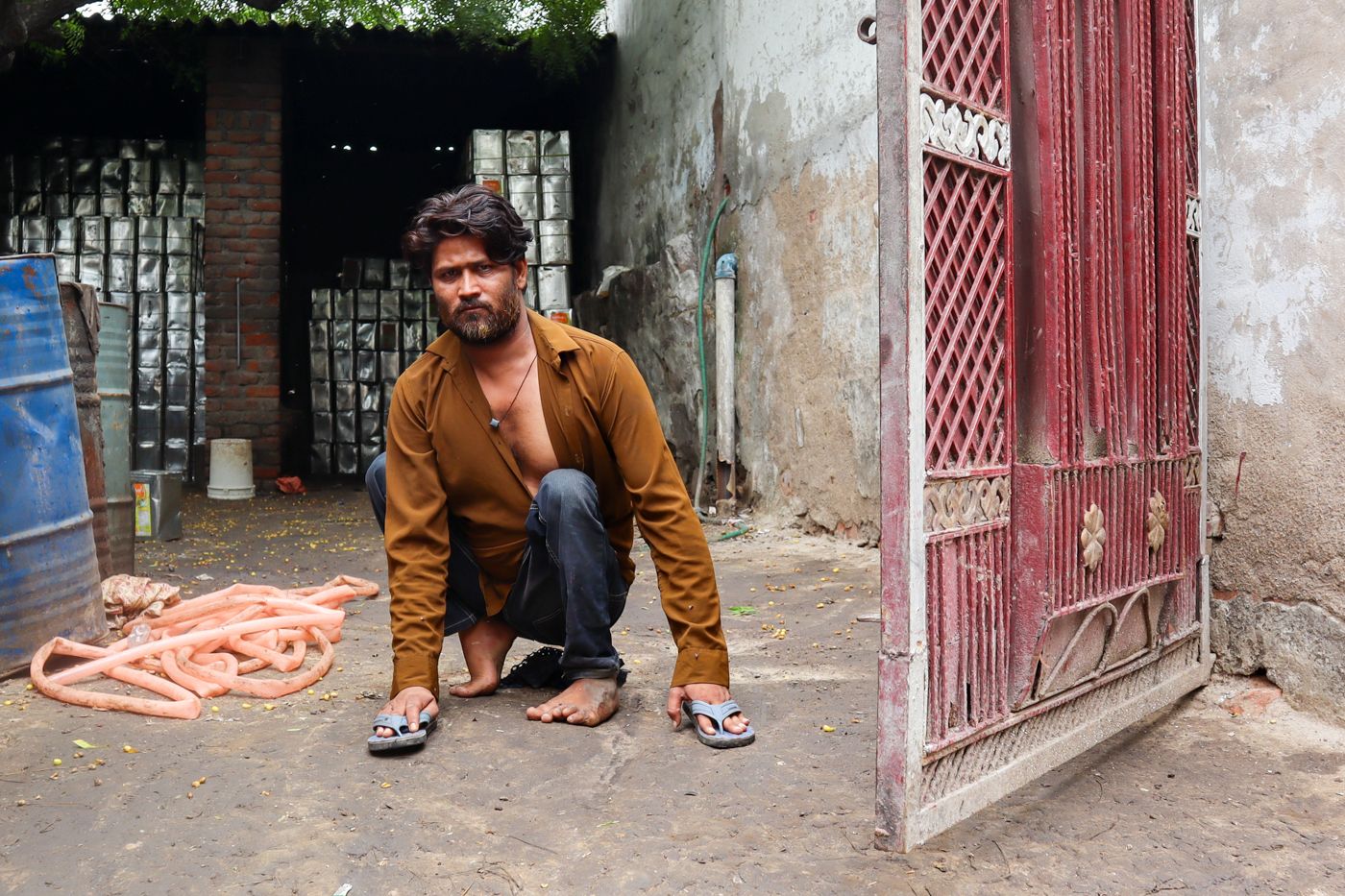
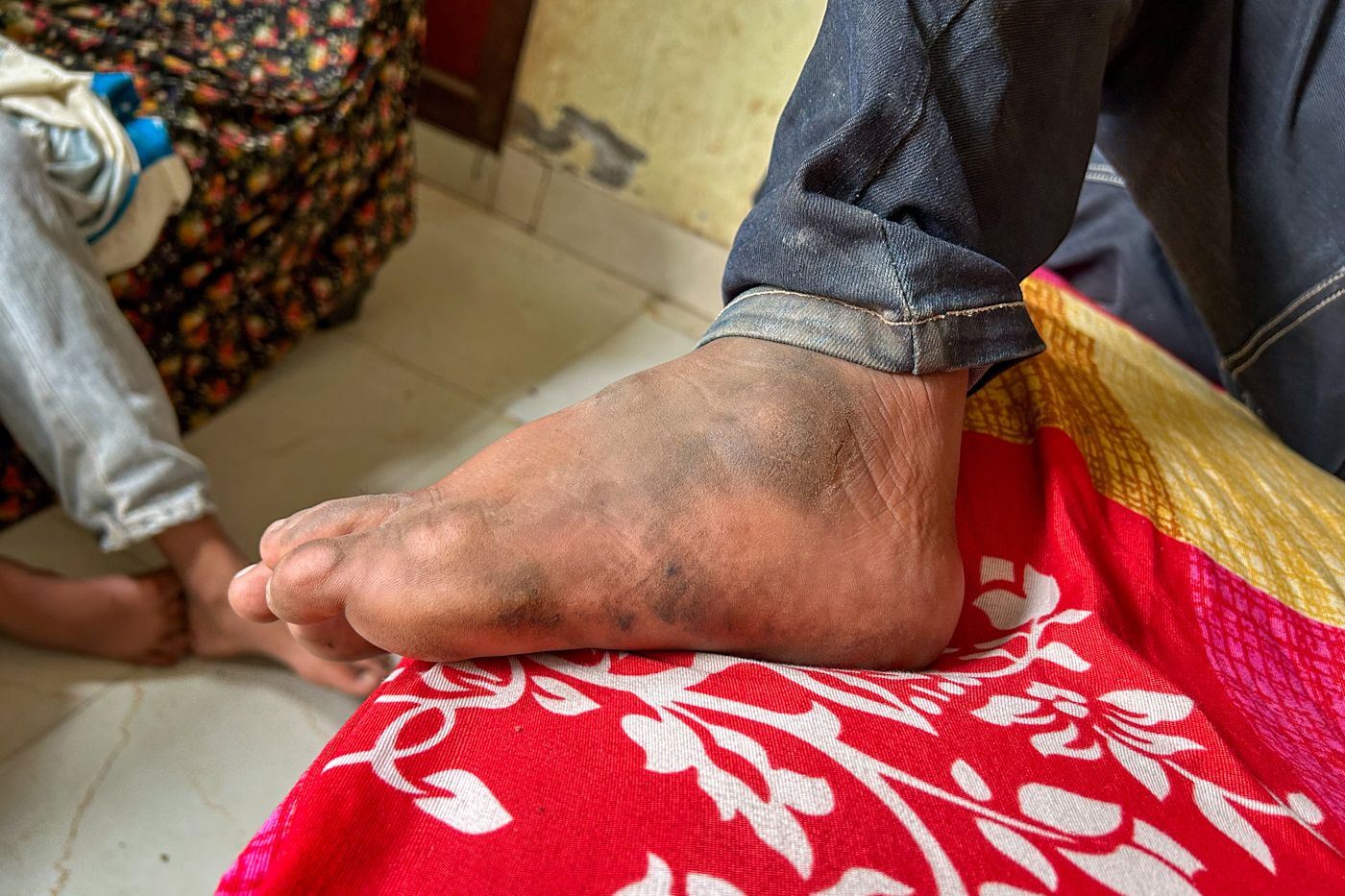
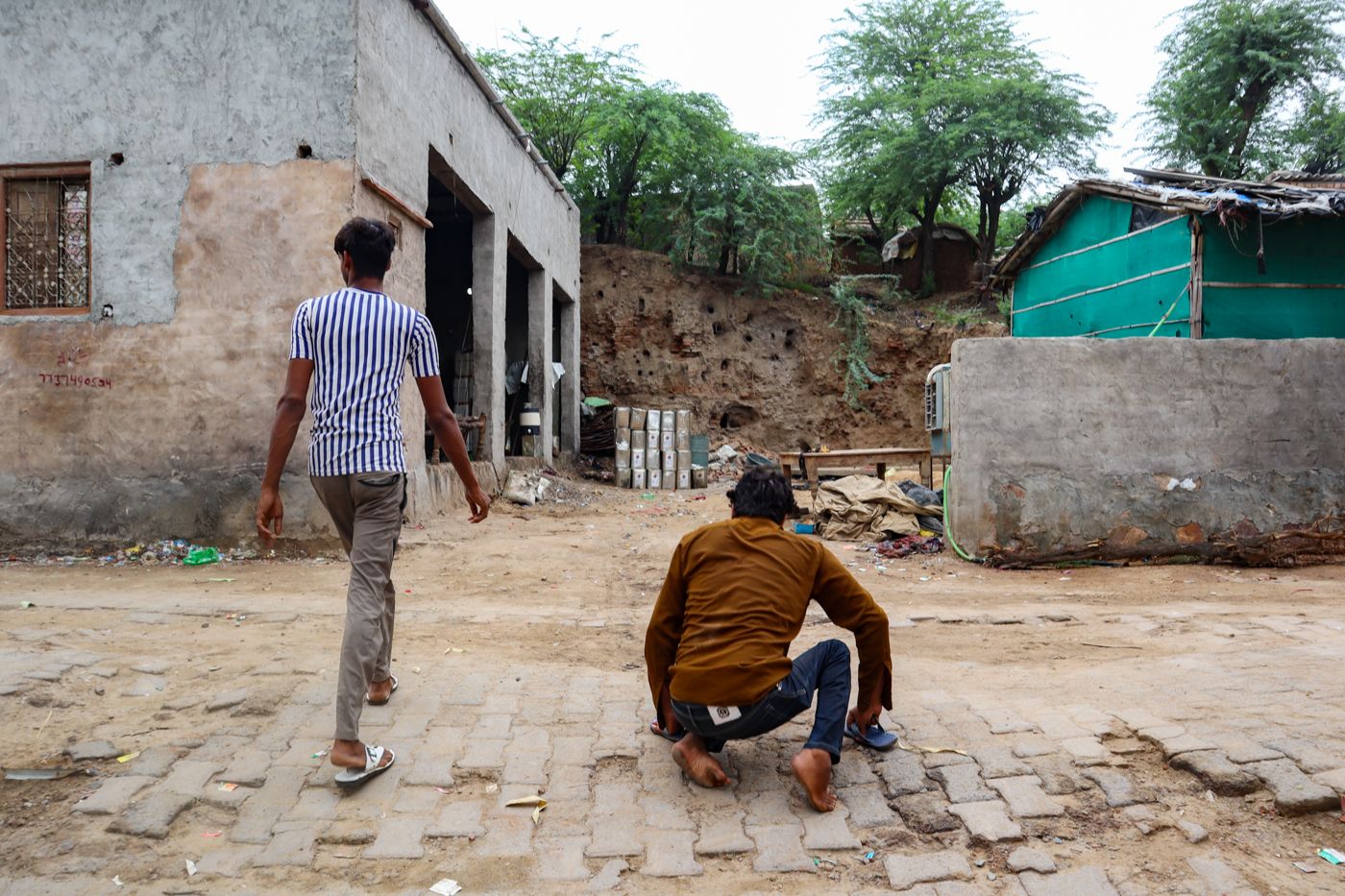
But not before Waseem, born in 1991, had succumbed to the deadly virus that left him with permanent deformities in his lower body and arms, and unable to walk and stand without help. All of four-five years old when it happened, he has since relied on his loving family for daily activities. For short distances, Waseem pulls slippers onto his hands, and balancing his weight on his hands moves forward.
“My father [Waheed Qureshi] never made me feel different from my brothers,” Waseem says. He was the only one amongst his 11 siblings to have contracted polio. Once, when his brothers went ahead without him to watch the Ramlila in Nagina, he cried so much that his father took him there on his scooter.
During the monsoon season, his father would often take him to have ghewar at a sweetshop nearby. “He’d tell the halwai to feed me as many sweets as I want. On days when I sat silently at the entrance of our home, he’d come and ask, ‘What’s wrong? Do you need money?’ and slip a hundred-rupee note into my hand,” Waseem recalls.
“Allah ka shukar hai [By God’s grace] I was born in such a family where everyone treats me well,” he adds.
*****
The Qureshi family belongs to the butcher community, and at one time earned a living by salting buffalo and sheep hides in Nuh city (formerly in Mewat district) and selling them in the leather market at Hapur, Uttar Pradesh.
When Waseem contracted polio, their lives were upended. Doctors around said it was untreatable, but his parents refused to give up. In search of a remedy, the family left their ancestral home in Nuh city and moved 35 kilometres away to Gujar Nagal village; they stayed with his maternal uncle. In the neighbouring village of Kherli Nuh, a desi haqeem (traditional healer) began treating the young boy, now unable to walk.
While he worked on Waseem, the family began piecing together a new life. His father, Waheed Qureshi, started refurbishing and selling burlap sacks and later built a home in nearby Mandikhera.
The family held on waiting, praying, and believing.
“I used to give him medicine nine times a day, bathe him with neem water, and massage him with the oil the haqeem [traditional healer] gave,” his mother Anwari recalls, as she cracks open a betel nut to chew.
“My ammi [mother] tried everything. It’s because of her that today my arms got better and I can sit,” Waseem says, remembering how along with the oil she would also massage him with sheep’s milk as it is considered nourishing in their Muslim kasai (butcher) community.
According to the 2011 Census, around 26.8 million people in India, or 2.21 percent of the population, live with a disability. Of these, nearly one in five suffer from movement-related disabilities such as cerebral palsy or paralysis. In Haryana, the numbers mirror the national average. Roughly 546,000 people, or 2.2 percent of the state’s population, live with a disability, with movement disabilities making up nearly a quarter of all cases.
*****
In 2022, Waseem married his sweetheart Sitara. The two met through family connections and soon got engaged, but suddenly the engagement was called off.
“My brother thought his family lived too far from us,” Sitara says, referring to her parental home in Loni in Uttar Pradesh’s Ghaziabad district, over 100 kilometres away, where her father and four brothers are fruit sellers.
But the two did not stop talking to each other, “Chori se [on the sly],” Waseem says about their secret calls to each other.
“I would call him from my abbu’s [father’s] phone,” the 26-year-old Sitara, says blushing as she speaks, sitting on the bed. Sitara has a deformity in her legs caused by polio when she was two years old, and finds it difficult to walk.
When her mother eventually found out, the families agreed to the marriage. The couple have a two-year-old son Mohommad Azhar, and three-month-old daughter Iqra.
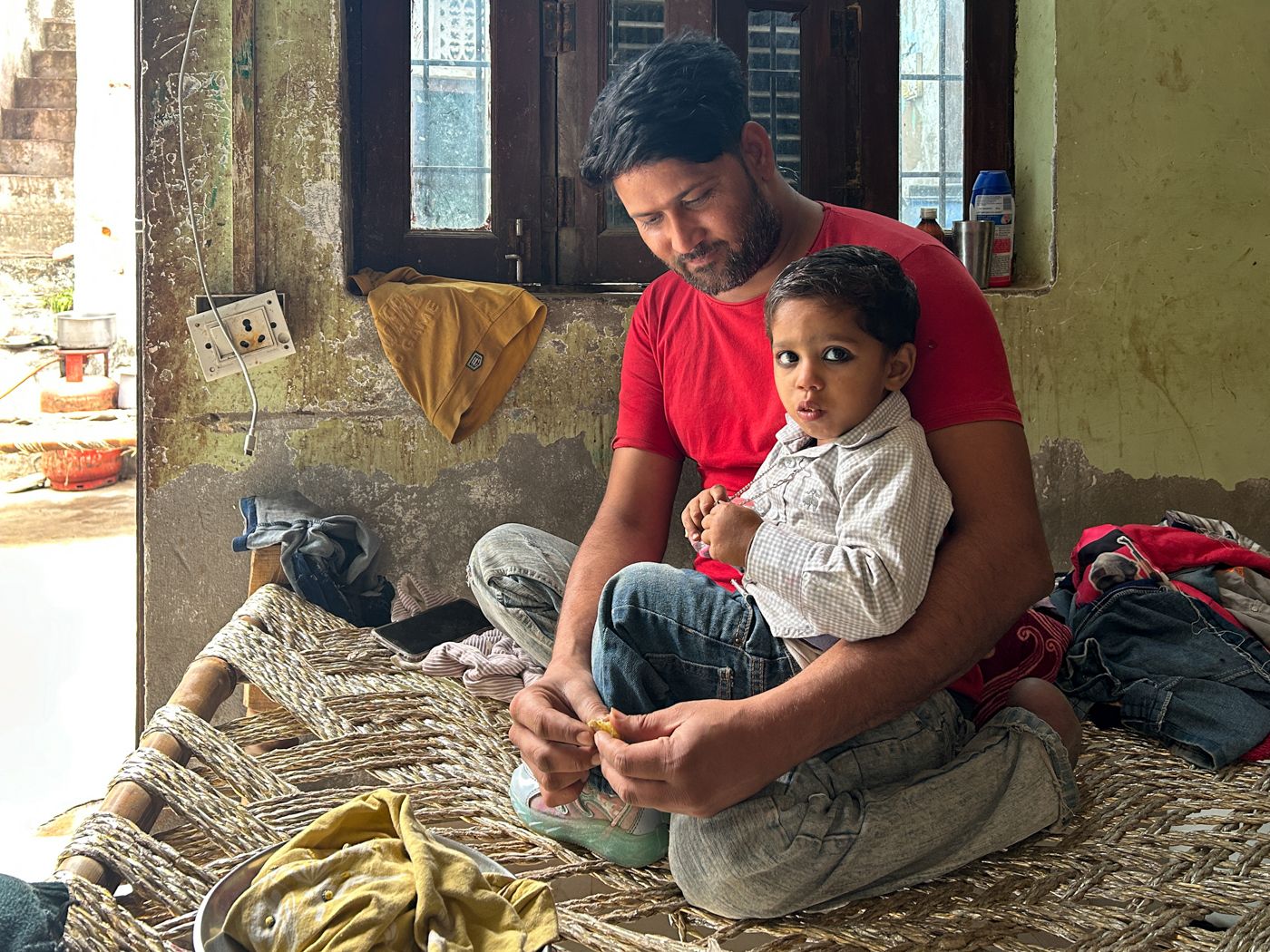
“None of the children look like me,” Waseem teases her.
“My son looks more like his mama [maternal uncle]” he tells me.
“I know, you’re just too handsome,” Sitara says, smiling.
*****
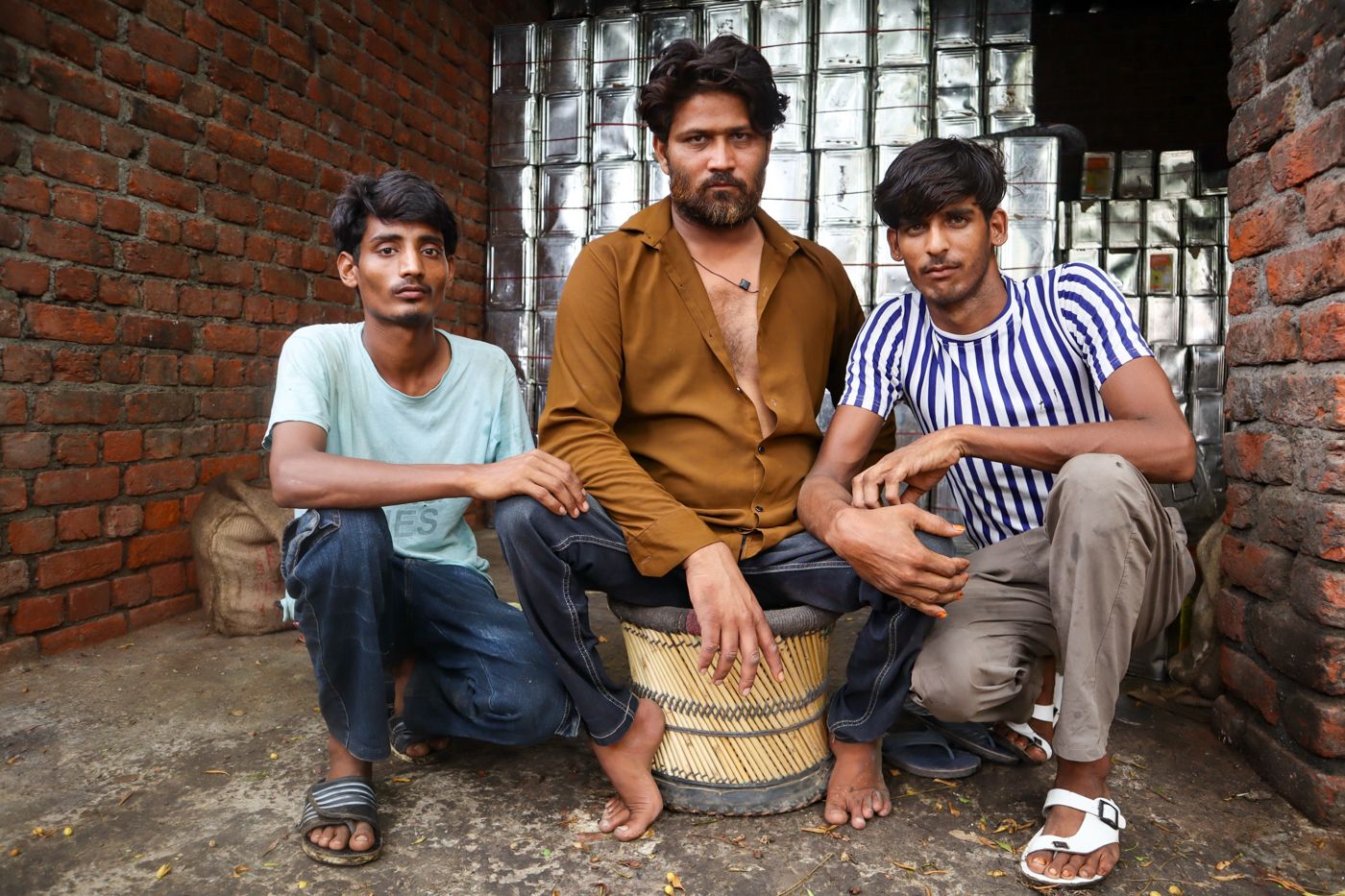
Mandikhera village lies at the foot of the Aravalli hills. Seven siblings of the family live here alongside each other. Each married brother has his own room, and lives there with his wife and children. In all, this is a joint family of 19 members.
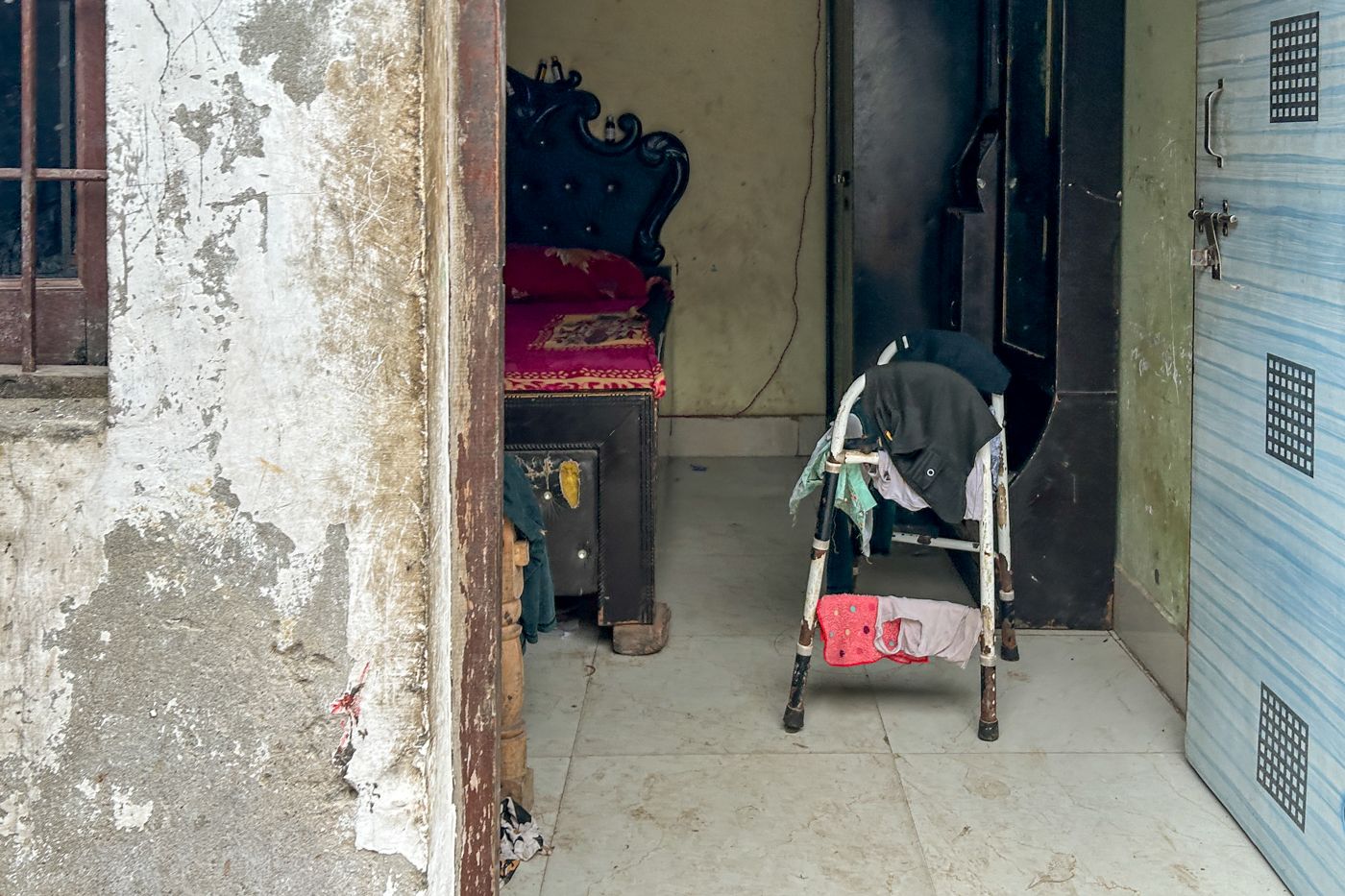
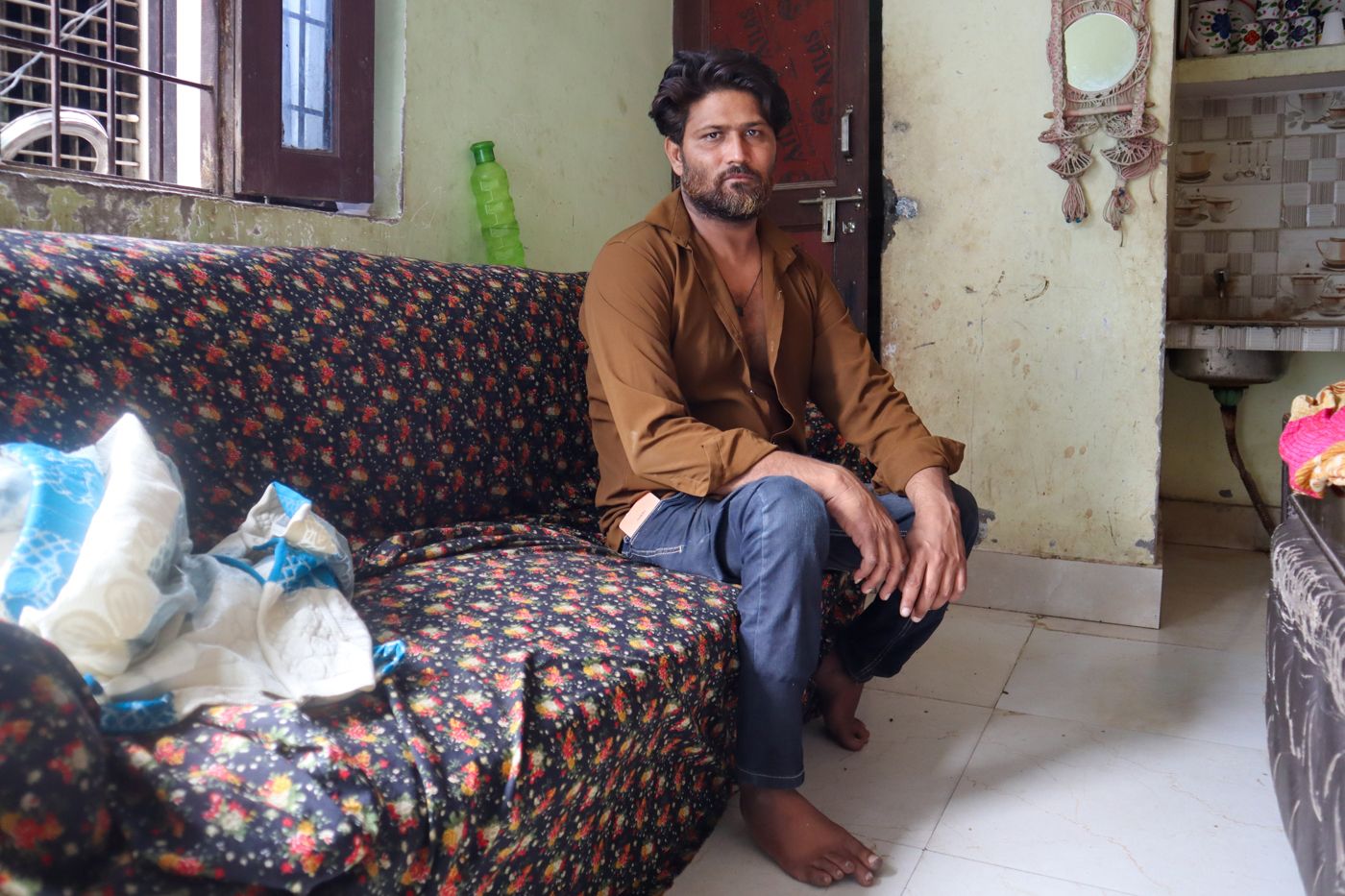
With both Waseem and Sitara unable to walk unassisted, the furniture in their room, and the toilet is placed in a way that allows them to be independent. The sofa and cot are placed near each other, so that they can lift themselves up with their arms. Sitara has a walker but both times PARI visited, it was not being used.
Waseem initially worked with his three brothers who refurbish and resell metal canisters (pipa). A few years ago, he set up a mobile shop which he runs independently. Starting every morning at 8 a.m., and closing at 4 p.m., with an hour’s break for lunch, he manages to earn between Rs. 300 to 500 a day, but he says it’s barely enough to cover daily expenses. Nearly Rs. 5,000 goes towards monthly expenses of rent, electricity, and water.
The only money that comes in regularly is his disability pension of Rs. 3,000 a month from the state government. For months now, Waseem has been trying to get a similar pension started for his wife Sitara. But there’s a hitch. Her name is still listed under the category of persons with disabilities in her home state, Uttar Pradesh. “To get it started here, her name has to be removed from there first. Someone has to go to a nearby government hospital there and get it done,” Waseem says.
The couple has been asking Sitara’s family to handle the process, but “no one has the time,” Sitara says and adds laughing, “I’ve been asking for so long… I’ve become a mother of two since then!”
*****
Waseem is keen to educate both his children. His own schooling was patchy – he dropped out multiple times before completing Class 10 through the National Institute of Open Schooling (NIOS). Showing a photo of his father who passed away in 2021 he says fondly, “Out of love Papa never scolded me for dropping out.”
According to Census 2011, nearly three in 10 children with disabilities in India have never been to school, and 12 percent drop out. Article 21A of the Constitution guarantees education as a fundamental right. The Disabilities Act, 2016 says education and opportunities for sports and recreation should be given equally with others, and the building, campus and various facilities should be accessible to those with disabilities.
Waseem’s school had a ramp to enter the building, but no ramps to access classrooms — one had to use the stairs. There were no wheelchairs available in this state institution. He went to the toilet by himself, and there was no staff designated to support children with disabilities.
“Dikkat to hoti thi [It was difficult],” Waseem tells me, and adds that he didn’t enjoy school.
Even later in life, Waseem has had to manage his movements with the help of family.
Nobody has ever offered him a wheelchair, not at the bank and not in a hospital.
*****
In summer this year (2025), Waseem began to stay home more and more, rarely stepping out of his room. His older brother, Mohommad Taushiq, who lives in a room across from him, could tell Waseem was slipping into “depression.”
“I didn’t feel like meeting anyone or going out. I don’t know what happened in my mind. I didn’t feel like talking to friends. It all started when I got sick,” Waseem recalls. In March 2025, a bout of stomach flu laid him low for a while. Shortly after, his motorised tricycle broke down, and he found himself stranded, unable to reach his shop.
When nothing helped, he got a naksh (talisman) from a haqeem to wear around his neck. It gave him just enough courage to step outside again, though he still couldn’t bring himself to go to the shop without his vehicle.
Waseem finally managed to get the tricycle fixed in October by a mechanic in Nagina. A new battery cost him Rs. 5,000, and another couple of thousand rupees went into the wiring.
The motorised tricycle was given to him about four years ago at a distribution camp held at the Nuh District Collector’s office. He isn’t sure how he got it. Assistive devices are typically provided under the Assistance to Disabled Persons for Purchase/Fitting of Aids and Appliances scheme (ADIP) which offers grants-in-aid to implementing agencies such as NGOs and District Disability Rehabilitation Centres for the purchase and distribution of aids to persons with disabilities.
Under the scheme, since 2014, nearly 29 lakh people with disabilities have been provided aids and assistive devices (ADIP 2025). Of these, 65,000 were motorised tricycles.
Waseem is eligible for a loan of upto Rs. 50 lakh under the central government scheme Divyangjan Swavalamban Yojana. Implemented by the National Handicapped Finance and Development Corporation (NHFDC) under the Department of Empowerment of Persons with Disabilities, the loan is meant for persons with disabilities to buy vehicles or start small ventures. But Waseem is unsure how to apply and will require physical assistance to chase it.
“I want to turn my mobile business into a wholesale one, supplying local shops nearby,” Waseem says. Or he wants to use the money to turn his shop into a men’s clothing store.
“Would you like to come home and meet the family?” he asks, as he gets back on his tricycle and accelerates away.