
It was August 2021. The sun was on the horizon, ready to set. Jatin* was relieved to have arrived in the northern Indian state of Punjab after crossing multiple police checkpoints deployed as part of India’s COVID-19 protocol.
The 32-year-old was in his newly-registered Hyundai i10 that he had bought from an auto-rental service he started just a month ago to make a living. This was a dream he had along with his childhood friend Sukhbir*. But this was Plan B. Plan A was to start the same business in the US. So when Sukhbir went to the US in July 2017, Jatin thought they’d be closer to the so-called “American Dream.” In August 2018, Sukhbir got deported. A year later, in August 2019, he died by suicide.
“He was extremely depressed after being deported from the US-Mexico border, and embarrassed due to the deportation case against him,” Jatin tells Asian Dispatch. “The Punjabi travel agent also didn’t disclose that he was going to be taken through the dunki route. He refused to speak or meet with anyone, including me.” Dunki, a localised term for illegal routes immigrants are forced to take to reach their destination, has become a recurring term in light of hundreds of Indians who have been deported since February this year.
The International Organisation for Migration (IOM) defines an irregular migrant as someone whose movement “takes place outside the laws, regulations, or international agreements governing the entry into or exit from the state of origin, transit, or destination.”
Source: Definition via IOM
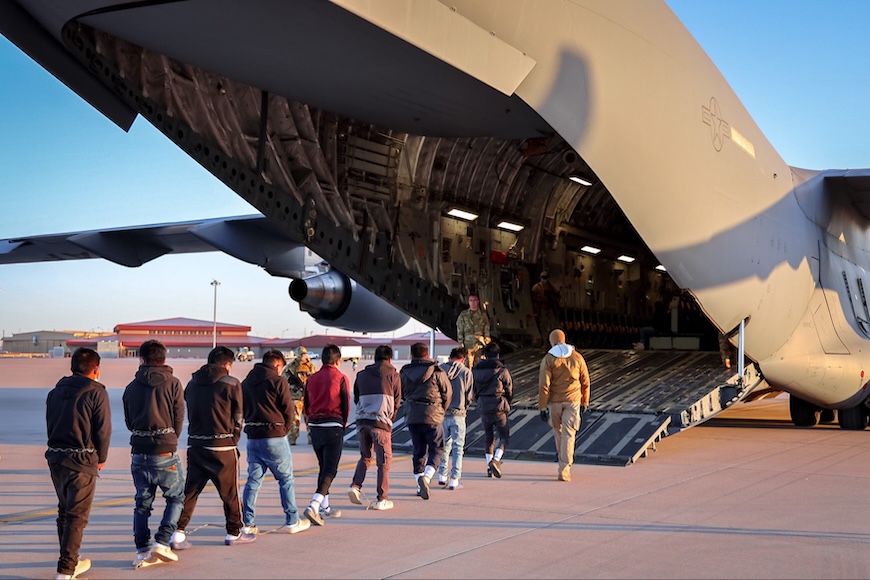
Between February 5 and 16 this year, US President Donald Trump’s administration deported 333 Indian immigrants. Out of that, 126 belonged to Punjab, 110 from Haryana, 74 from Gujarat, and 23 were from other Indian states.
The deportation drew unprecedented attention to the issues of irregular migration, human trafficking and the nexus of travel agents in India. As US officials orchestrated highly publicised and humiliating optics around the deportation of Indians – who were in shackles throughout the flight – global media fixated on the “illegality” of their entry. Conversations on the psychological and emotional toll of the ordeal that the deportees experienced were missing.
During the course of this reporting in the states of Punjab and Haryana, Asian Dispatch met deported persons and their families who experienced acute mental distress such as depression, suicide ideation, Post-Traumatic Stress Disorder (PTSD) and isolation. This piece digs deeper into the socio-cultural fissures that contribute to high rates of out-migration, and the subsequent mental health crisis that arise out of deportations. To protect their safety and privacy, Asian Dispatch has granted anonymity to all deportees quoted in this story.
Sukhbir would have turned 32 this year. Jatin says that when his friend came back, he faced constant shaming, mocking and social stigma. This was compounded by the pressures to repay his lenders over INR 42,00,000 ($48,806).
Jatin has now abandoned his dreams of moving to the US. “It was not [Sukhbir’s] fault [that he got deported],” he says. “Once you are deported, your neighbours and relatives see you as a failure. They make you feel like you’ve dishonoured the entire village.”
He then implores: “Will you help tell my friend’s story?”
The ripple effect
In Punjab’s city of Sangrur, where Jatin and Sukhbir are from, Sukhbir’s family has not yet come to terms with the death of their eldest son. After his passing, Sukhbir’s younger brother “successfully” migrated to Canada in 2023. His family now sees hope through him.
Asian Dispatch tried to contact Sukhbir’s family for an interview but they turned down the request. “They fear that talking about Sukhbir will jinx the situation for their younger son,” Jatin says.
Suneel Kumar, a professor at the Department of Political Science, University of Jammu, and a subject expert from Punjab on international migration, says that the families often experience the same mental stress as the deportees. “Even the family is a victim here,” Kumar tells Asian Dispatch. “A victim’s family is also involved in arranging the finances, either through loans or borrowing from others,” he adds. “Any loss to the victim — in the form of money, reputation and mental peace — is a loss to the family involved.”
In rural societies, Kumar adds, people don’t see deportation from the lens of mental health due to age-old beliefs in social status and hierarchy. “In rural Punjab and Haryana, while a car loan is seen as a positive investment, a loan for overseas travel – and then being deported – implies a negative message, downgrading the deportees to a low social status,” says Kumar.
A victim’s family is also involved in arranging the finances, either through loans or borrowing from others. Any loss to the victim — in the form of money, reputation and mental peace — is a loss to the family involved. — Suneel Kumar, Department of Political Science, University of Jammu, India
Satnam Singh Chahal, Executive Director of North American Punjabi Association (NAPA), a US-based organisation for the Punjabi diaspora, says that one of the reasons why people don’t come out about being deported is societal shame and fear. “I urge everyone — irregular Indians, their families and society — to come out in public to talk about [mental health] and seek help openly,” he says.
Sunil Jaglan, a Haryana-based social activist who campaigns for gender rights in India, recommends mechanisms to protect deported people from societal bullying.
“Some of the common comments most deported people face in villages are: ‘Kya ukhar liya waha jake?…Sharam ki baat hai galat raste se gaye tha…chori se gaye tha…ghar aur izzat barbad kardiya [What great things did you achieve by going abroad?’ It’s a shame you went through illegal routes. You went like a thief. You ruined our honour and reputation],’” Jaglan says. “Such acts must be avoided to protect their mental health.”
A bitter homecoming
On February 5, 2025, Satish* and Amar*, both from different districts of Haryana state, were among the first batch of Indians to be deported by the US this year. Since their return, they’ve both been visiting government hospitals to seek treatment for “depressive symptoms” after the family feared they might take “aggressive steps” if they didn’t seek help.
Mohit*, Satish’s cousin, told Asian Dispatch that when the Haryana Police escorted 30-year-old Satish home, they took a written declaration from his parents that stated that “no harm should come to Satish.” This came in the light of news reports of recent deaths by suicide, or attempts, by deportees.
“This news made the families, as well as the police, panic and fearful,” says Mohit. “After all, they sold everything to pay the travel agents for their overseas dreams, and as a consequence, incurred heavy monetary loss. But local people would not readily admit to such information out of fear.” Mohit adds Satish hasn’t spoken much since his return. “He is concerned about his future, wondering what he will do now,” Mohit says. Satish had sold off everything after his agent coerced INR 39,00,000 ($44,910) out of him. “The government has not offered him any assurance or support so far,” says Mohit.
Kuldeep Singh, a village head from Amar’s village, which is undisclosed to protect his identity, told Asian Dispatch that the 27-year-old’s mental health isn’t better either. “The family has been taking him to the government hospital to help him with his condition,” Singh says. “They’re affected financially, too. No government or NGO body has visited him.”
The recent cases are more challenging than ever for mental health experts such as Jaglan, who’s currently counselling four recent deportees from Haryana’s Jind and Kurukshetra districts. “When I met them, their mental health was failing, and two of them had attempted suicide,” says Jaglan, who has also served as a village head in a village called Bibipur in Haryana. “The deportation made them feel like their entire world had ended. After the counselling, we observed at least 20–25 percent improvement, if not 100 percent.”
Jaglan adds that at a time like this, the state and central government must step up and work towards the welfare of the deportees. “Just because there aren’t many people impacted doesn’t mean that they should take no or less action,” he says.
The deportation made them feel like their entire world had ended. After the counselling, we observed at least 20–25 percent improvement, if not 100 percent. – Kuldeep Singh, village head in Haryana, India
While India expressed concerns over the US’s treatment of their citizens’ deportations, on domestic frontiers, local leaders reinforced the stigma around deportees. Manohar Lal Khattar, the Union Power minister from the city of Karnal, Haryana, and a member of the ruling Bharatiya Janata Party, said that there should be “no sympathy for the deportees” while also deploying police buses to bring back deportees.
The perilous route of – and after – dunki
In Punjab, Manjit* struggles with insomnia. The 35-year-old was among the hundreds who were brought back on February 15. He had left his village just six months before that, on August 13, 2024. His first tryst with sleep disorder came when he had to spend 27 days in a California’s ICE camp. There, he’d receive a packet of chips, an apple and a small tetra pack of juice every day for all meals. A foil blanket was given to keep them warm. The Sikh deportees were not allowed to wear turbans.
“I cried the moment I deboarded the plane,” Manjit tells Asian Dispatch. “I didn’t take a bath for a month, and stayed in my room. My wife lost a lot of weight. We’re all feeling hopeless now.”
The trauma, however, didn’t start with the deportation. His sleeplessness started when he was forced to embark on the dunki route.
Manjit and his co-travellers were completely unaware of their travel agents’ “nefarious plans” until they were in the Netherlands. “The agent ordered us to hide in the airport’s restroom for up to nine hours,” he says. “That’s when we understood that he was bringing us illegally. He only asked us to come out when our next flight to Suriname was scheduled to depart.”
What was supposed to be a two-month journey turned into a six-month nightmare.
Between August 2024 and January 2025, the agents took the Indians across three Indian states and 18 countries. Manjit lost INR 39 lakh ($44,910) in the process.
This is what the route looked like:Amritsar → Delhi → Mumbai → Nairobi → Dakar → Amsterdam → Suriname → Guyana → Bolivia → Venezuela → Perú → Brazil → Ecuador → Colombia → the jungles of Panama → Costa Rica → Nicaragua → Honduras → Guatemala → Mexico → California.
When Manjit finally crossed the Mexico-US border into California on January 22, he felt like all the risk was worth it. The same day, Manjit and six others were apprehended by the US Border Patrol. “Aisa laga jaise muh se kisi ne niwala chin liya hai (It felt as if someone had taken away a morsel from my mouth),” says Manjit.
A key driver of irregular immigration is better opportunities, Kuldeep Singh Dhaliwal, Punjab’s NRI Affairs Minister, told Asian Dispatch. “People in India believe that foreign countries have higher wages. Therefore, they should go there, work hard, earn a lot of money, and bring it home. When people return (from overseas), the first thing they do is construct massive houses,” he says. “I also constructed my house when I first went to the US. Earlier, I had a small house. Once someone gets on the plane, they do not intend to return.”
The mental health issues, Dhaliwal adds, aren’t widespread and that those who were “disturbed” upon their return are recovering. “It was mostly the shock, disappointment and guilt over the money and trust they had lost for their parents and families,” Dhaliwal says.
Once someone gets on the plane, they do not intend to return. – NRI Affairs Minister, Punjab, India
Chahal, from NAPA, says that there’s more to irregular immigration than just aspirations of wealth. “If the state [of Punjab] gave them jobs or financial security, locals won’t risk their lives to move overseas,” he says. “Instead, farmers’ land is being forcibly taken by the government, while they’re not receiving full compensation for it. The state is focusing on high-rise apartments, buildings and offices at the expense of farmers’ land.” Chahal is referring to Aam Aadmi Party-led Punjab government’s “land pooling scheme”, which allows the state to acquire 24,311 acres of land from 57 villages in Punjab to build an urban development project.
Dhaliwal reassures that the government is supporting all deportees. “Most deportees want their money back from travel agents,” Dhaliwal says. “Some have received refunds too. We’ve told them that the state will help in case any travel agent refuses to cooperate.”
Around 200 travel agents have been arrested in the last three years in the state, the minister adds, but the menace is far from over. “We take action against one agent, people find another one,” he says. “I’ve told Chief Minister Bhagwant Mann that licensed travel agencies that engage in unlawful activities should face repercussions such as having their premises and property seized. They should feel scared that if they break the law, they will lose everything.”
For Manjit, recovering the money would help him get back on his feet, financially and mentally. However, in India’s backlogged courts, a legal case can take years. “This means it’ll take longer to recover the money,” Manjit says. “Poor people don’t have the time due to debts, loans and financial constraints. That is why, in most cases, deported people do not testify against their agents.”
In Haryana, Satish’s cousin Mohit says his travel agent is out on bail even though the police have evidence of the agent’s role in the alleged trafficking. “We’ve not received any money from the travel agent, nor is the government assisting us. Instead, out of all perpetrators named in the police complaint, only one was arrested. Today, he, too, is roaming free,” says Mohit.
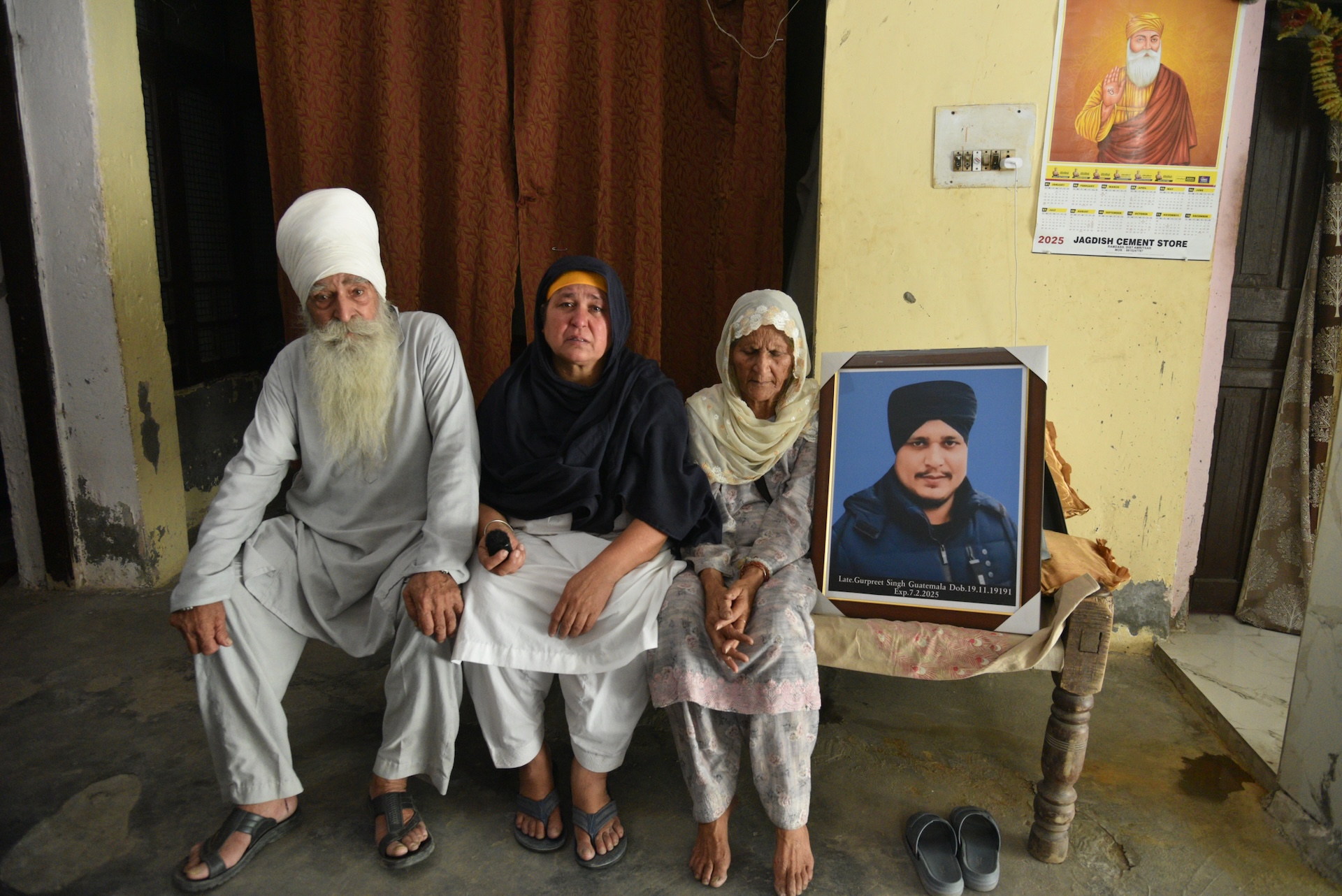
On February 8, a man called Gurpreet Singh, 33, from Punjab, died of a heart attack while walking through the Panama jungles of Guatemala after “being prodded by a donker [travel agent] who took INR 20,00,000 ($23,100) for air travel,” his family told Asian Dispatch. His death is a grim reminder of the high cost of the dunki route.
In his unfinished home, which Gurpreet was building for his family, Asian Dispatch met his 75-year-old mother, 85-year-old father and elder sister, 50. The mother and sister say they’re unable to sleep and eat, and often find themselves crying.
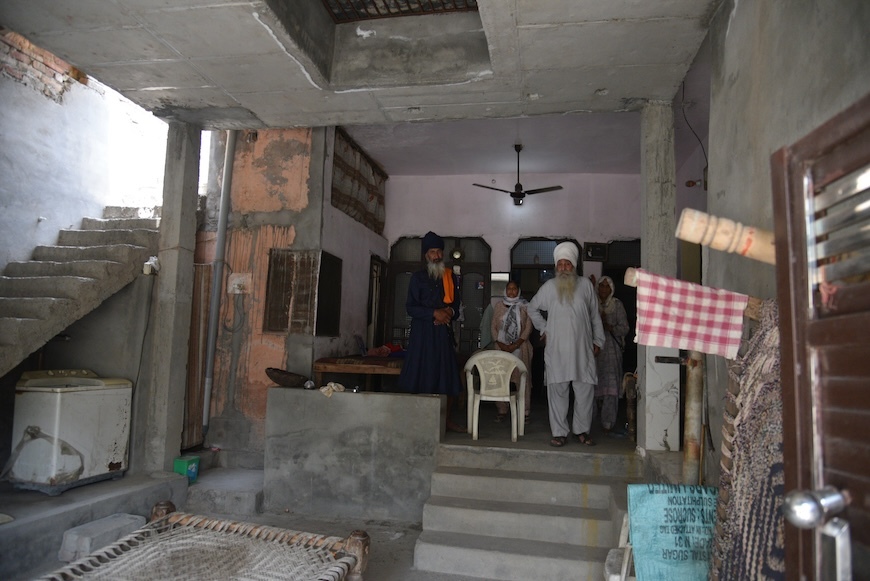
“Gurpreet sent me a voice note on February 7, in which he informed me of his arrival in Guatemala,” says Harjeet Kaur, his elder sister. “He told me the place is really cold, but he is fine and we should not worry. But the next day, we received a call from his phone saying he was struggling to breathe and was being taken to the hospital. We soon received the news that he is no more.”
Kaur says that she can’t stop listening to his voice messages, and calls his number often with the hope that he will pick up. Their unfinished house is now a painful reminder of Gurpreet. “Once the house was built, we were planning to get him married,” his mother says. “He was working hard for us.”
The family has a total debt of INR 36,00,000 ($41,580), including travel agent fees. They managed to pay back most of it but INR 15,00,000 ($17,325) remains to be paid. “If the government will help us with some financial support, we will be able to pay off our remaining debt,” the mother pleads.
The gendered side of trafficking
Preeti*, 35, has been on a lookout for work since 2023 but she has one condition: She doesn’t want to leave her home district. She is a survivor of human trafficking from Punjab’s Jalandhar city. In April 2023, a trafficker called “Mamta” – as mentioned in Preeti’s police complaint document – lured Preeti with a fake employment offer of INR 35,000 ($403) per month as a cook in Muscat, Oman. Preeti comes from an economically challenged family, where her husband’s wages were insufficient to support the family. She travelled to Oman on a tourist visa, excited about the opportunity. However, when she landed, her passport was confiscated by her Omani employer, and she was forced into sexual slavery.
Two months later, she managed to escape after seeking assistance from the Indian Embassy and taking shelter at a Gurudwara. The embassy provided a return ticket to India and a Punjab-based NGO called Sun Foundation, chaired by Member of Parliament Vikramjit Singh Sahney, assisted her with repatriation. But the psychological and physical torture she experienced continues to haunt her.
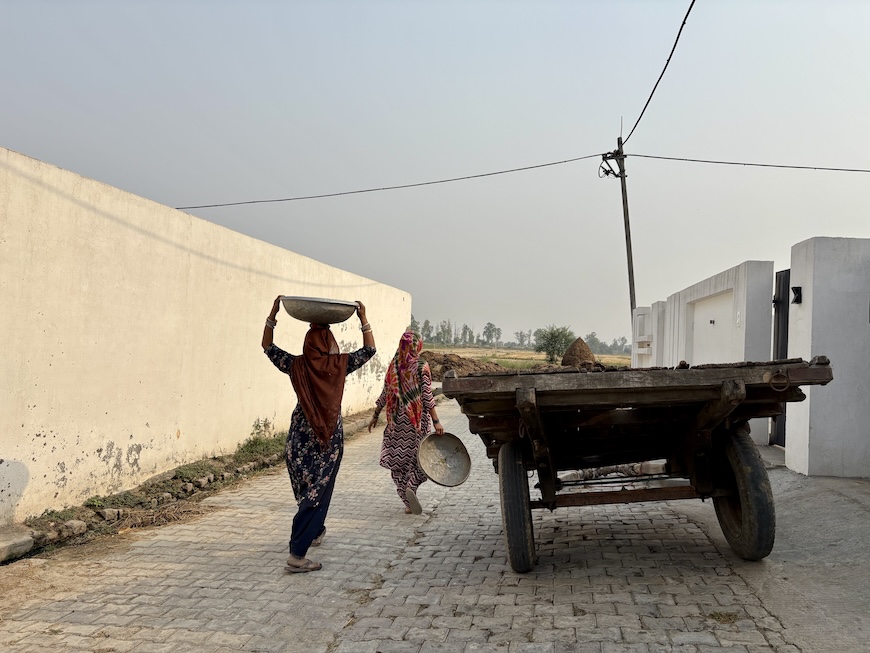
“When I was rescued from Muscat in 2023, the Punjab government offered me a job as part of the rehabilitation process, but I didn’t accept it because it was in Amritsar,” she told Asian Dispatch. “I didn’t wish to move away from my family after the incident.”
She is currently pursuing a legal case (pro-bono) against her trafficker but it has yielded no outcomes. The trafficker is on bail, and is pressuring Preeti to settle the case outside of court for INR 75,000 ($863).
“Finding work in Jalandhar is important to me because the trafficker has added to my stress,” says Preeti. “Would you ask the government to provide me with a job with a minimum salary of INR 10,000 to 15,000 ($115 to $172)?” Preeti has studied only up to the eighth grade.
The gendered aspect of deportation and trafficking is challenging to investigate because of the higher chances of stigma that women face. “People don’t want to talk about the women’s cases,” Kumar, the expert on international migration, says. “It is already difficult to persuade male members to disclose their encounters with trafficking, deportation, or mental health. Women may have endured additional circumstances on top of this, such as trafficking, slavery and harassment.”
A way forward
Dr Parag Sharma, a psychiatrist and founder of mental wellness clinic ‘Betterway’ in Punjab, says that severe depression and insomnia are the most common symptoms among deportees.
“Upon arrival, each deportee should undergo a clinical interview at the airport, guided by psychiatric, social workers, or psychologists for an initial assessment to determine who needs immediate medical assistance,” says Sharma. “Individuals who have anxiety, sleeping issues, depression, or are more vulnerable should be screened and treated further thoroughly. This is the bare minimum we should do.”
He suggests that at the airports, the deportees should be given a checklist in their native languages to inform them of what harms stress can bring upon return. “They should also be informed about the centres (clinics) where they can find help,” Sharma adds.
NRI minister Dhaliwal looks at the “Kerala Model” of migration as a way forward for states like Punjab that see high out-migration. “The Kerala government operates their own travel agencies,” he says. “So if a labour is required in Dubai, this government-run agency will select the candidate based on their qualification and skills, and send them. We will also do the same for Punjab, first at the district level, and then subdivisional.”
The Punjab government also has schemes worth INR 10,00,000 to INR 20,00,000 ($11,515 to $23,030) through which deportees can avail a loan with a low to zero interest rate in order to start a small business. However, when Asian Dispatch enquired about any mental health programs or services in the state, or any plans to establish a rehabilitation fund, Dhaliwal did not respond.
Following the February deportations, NAPA urged the Punjab government to establish a rehabilitation fund for skill development programmes, employment and counselling for deportees. But so far, he’s not seen much progress.
“We can only put pressure on the government,” he says. “And, the government will reassure us by saying ‘We can/will do something.’ To us, these are vague words. In reality, no one will do anything.”
Kumar adds that concrete steps can only be taken if Punjab inserts “human trafficking” into the title of the Punjab Prevention of Human Smuggling Act of 2013. “It should be the Punjab Prevention of Human Smuggling and Human Trafficking Act,” says Kumar, adding that the Punjab Human Trafficking Act of 2008 has been diluted so many times that it now lacks clarity. “The trafficking act changed into a Smuggling Act. Not every incident involves human smuggling, or vice versa. However, most smuggling incidents result in trafficking,” he says. “We need different provisions for each issue separately. The Smuggling Act has detailed provisions for prevention and travel agent regulations. However, victims’ relief, compensation, and rehabilitation are hardly addressed.”
Jaglan adds that gram panchayats – the governing body in Indian villages – should work closely with psychologists and psychiatrists to arrange counselling for everyone. The idea, he adds, is to make everyone, especially deportees, feel included.
In 2024, Jatin moved to Dubai through legal pathways after his unsuccessful stint working in Punjab. From there, he currently tracks Indians involved in incidents of human smuggling, trafficking, migration, deportation, asylum, and dunki cases. He believes the time is right for “many Sukhbirs to be saved.”
“We all miss Sukhbir even today. [His family] lost their son, and I lost a close friend,” he says. “Sukhbir’s life could have been saved had there been some kind of mental support or assurance from the state.”