
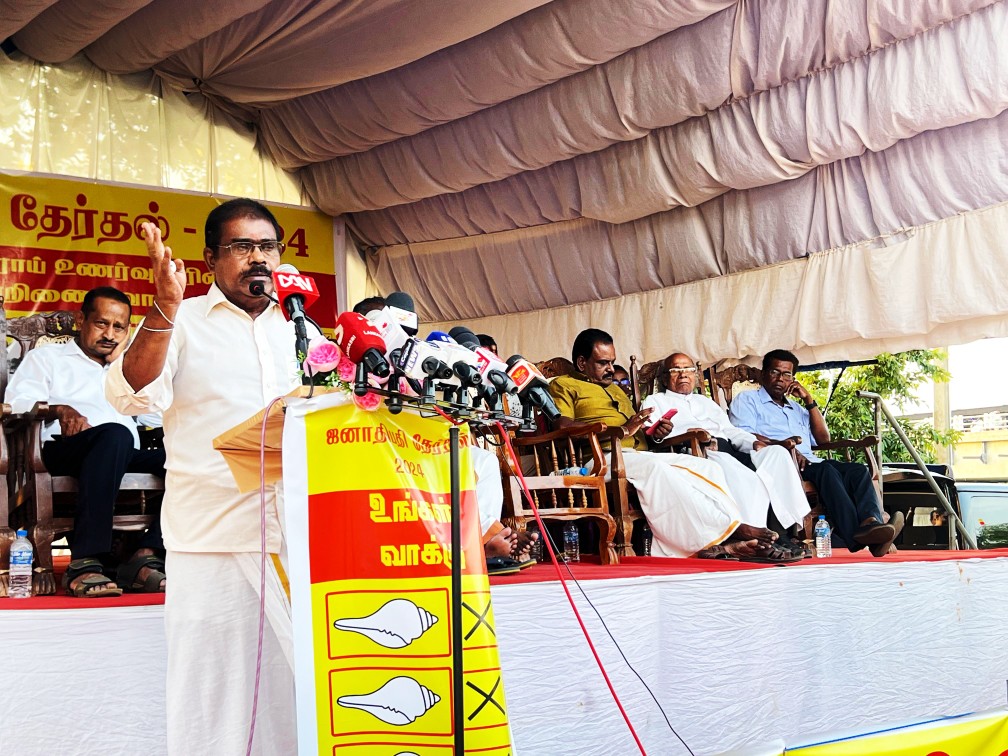
Had it been any other time in Sri Lanka’s history — outside of an election — a leader from the country’s ethnic minority, Tamil, calling for a referendum on self-determination and constitutional changes to establish a separate homeland would have likely faced imprisonment. It’s also possible the leader would never have been seen again.
But it is not so for Pakkiyaselvam Ariyanethran, Sri Lanka’s first Tamil common candidate – meaning one endorsed by several Tamil civil society and political parties – standing for the 9th presidential elections in the island nation on September 21.
“This should have happened in 2010,” Ariyanethran tells Asian Dispatch, referring to the year after the Sri Lankan state put a brutal end to an armed conflict between them and a separatist Tamil movement.
Since the end of the Mullivaikkal massacre, we’ve seen three presidents come and go. Each one secured our vote but lost our trust. We no longer have faith in them. —Ariyanethran
Ariyanethran is referring to the last phase of Sri Lanka’s 25-year civil war between the Sri Lankan state and the separatist Tamil government called the Liberation Tigers of Tamil Eelam (LTTE). LTTE’s separatist government arose out of decades of discriminatory laws and policies in the Sinhalese-majority island nation. The Sinhalese people constitute 75 percent of the country’s 23 million population, while the Tamil are 11.2 percent of it.
The incidents Ariyanethran speaks of took place in a northern village called Mullivaikkal, where thousands of Tamil civilians taking shelter in government-assigned “safe zones” were bombed.
The civil war may have ended in 2009, but the wounds from its violent end are palpable even now. For Sri Lanka’s government – which is dominated by Sinhalese leaders – any mention or memorialization of Tamil separatism or nationalistic expressions leads to crackdowns and state repression.
This is why, Ariyanethran’s candidature is a significant moment in Sri Lankan politics. He isn’t the first candidate to have been fielded in a presidential election. Ariyanethran recalls Kumar Ponnambalam, who ran in 1982, and Sivajilingam, who ran in 2019.
But there was one difference between past candidates and him.
[The previous candidates] ran independently. For the first time, 83 civil organisations and seven Tamil national political parties have united to make this collective decision on behalf of the Tamil people. —Ariyanethran
Ariyanethran’s candidacy marks a new chapter in challenging long-standing political norms in the country.
Ariyanethran stands against 37 other candidates across the country – including frontrunners Ranil Wickremesinghe, Sajith Premadasa and Anura Kumara Dissanayake. At the moment, Sri Lanka is still emerging from the shocks of a crippling economic crisis and foreign debt. It is coping with a crisis of governance of 2022, when anti-government protesters drove then president Gotabaya Rajapaksa – who played a key role in the Civil War – out of power. Economy has been at the forefront of most people’s demands but for Tamils, the economic and social strife go decades back.
“We Tamils have endured hardships that have tested us to our very core: Death threats, bombings, kidnappings, murders, extortion,” says Ariyanenthiran. “But I’m not scared.”
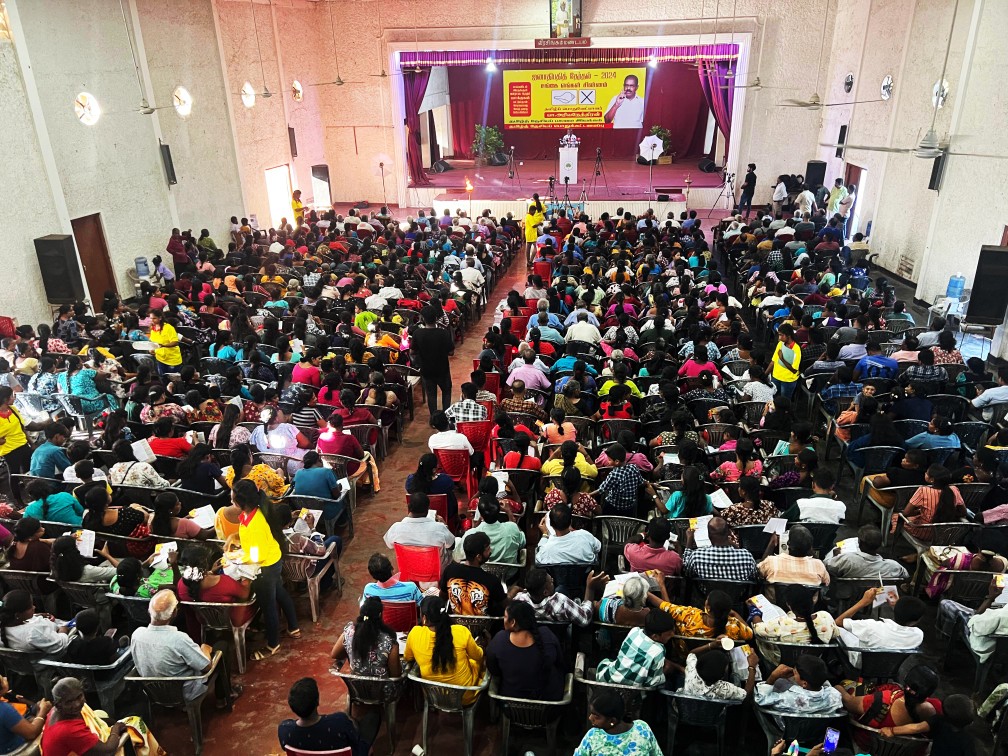
Ariyanethran’s own journey started in the early 2000s, when LTTE governed parts of northern Sri Lanka. The politician was an editor of an LTTE newspaper called Thamil Alai (Tamil Wave), after which he was inducted into the Tamil National Alliance, an alliance of Tamil-led parties that support Tamil self-determination. In its initial years, the TNA supported LTTE’s negotiations during the war. Ariyanethran’s first entry into the parliament was in 2004 with TNA and was re-elected in the 2010 parliamentary elections.
This year, the Ilankai Tamil Arasu Kachchi, Sri Lanka’s oldest and the most prominent political party representing the Tamils, announced Ariyanethran’s ticket under their political party.
In modern-day Sri Lanka, ITAK’s manifesto is bold. It calls for a new constitution recognising Tamils as a sovereign people with the right to self-determination. It also calls for the establishment of Sri Lanka as a plurinational state, the return of Tamil land confiscated during the war, and the right for Tamils to seek international assistance in determining their political future. Additionally, the manifesto addresses the protection of Upcountry Tamils and demands the perpetrators of crimes committed during the war be brought before the International Criminal Court.
For Ariyanethran, his candidacy is deeply personal too. He says it honours the legacy of ITAK’s founder, SJV Chelvanayakam, affectionately known as “Thanthai Chelva” (‘thantai’ translating to ‘father’). Chelvanayakam is regarded as the father of Tamil nationalism and with ITAK, he advocated federalism as a means to share power between Sri Lanka’s majority Sinhalese and minority Tamils. In 1977, his resolution for an independent Tamil state received overwhelming support in the parliamentary elections. But decades after that saw only unfulfilled promises and failed negotiations with successive governments.
“It is time for the Sri Lankan government and the international community to recognise [the Tamil right to self-determination],” Ariyanethran says.
Despite the enormity of the challenge, Ariyanethran has been actively campaigning in the Tamil-majority North-East, urging Tamils to cast their votes for liberation.
“There is overwhelming support,” he says. “People tell me it’s a good decision. They hope that the 9th president will deliver a political solution for the Tamils and recognise that we should not be deceived again. Tamil votes matter.”
Interestingly, running for presidency was Ariyanethran’s original plan. “The party has been discussing this for over six months, even before the elections were announced,” he reveals. “I am a member of ITAK and the deputy chairman for the Batticaloa district. I joined the party in 2004, but I had no intention of running for office.”
However, after attending several party meetings and voicing the concerns of Tamils, Ariyanethran found himself among 45 potential candidates. “I was chosen,” he says simply, “And I accepted.”