Singapore, October 15, 2025 – Policymakers, industry leaders, and digital safety experts at the Singapore Townhall on Cyber Frauds, Deepfakes, and Financial Safety have issued an urgent call for stronger regional collaboration to tackle the explosive rise of AI-driven scams and online fraud across Asia, now the epicentre of nearly half of all global digital scam cases, with annual losses surpassing USD 40 billion. Despite tougher laws and advanced detection tools, scammers continue to outpace defences with transnational crime networks across East and Southeast Asia expanding their lucrative scam operations worldwide.
Organised by DataLEADS Global in partnership with the Konrad Adenauer Stiftung (KAS) and Asian Dispatch, the townhall was held at the KAS Media Programme Asia office as an official Pre-Summit Event of the upcoming IndiaAI Impact Summit 2026, a flagship initiative led by Government of India’s Ministry of Electronics and Information Technology (MeitY) and the IndiaAI Mission to advance safe, responsible, and inclusive AI innovation.
The Singapore townhall served as an international dialogue within this framework, focused on strengthening regional collaboration, digital safety, and public resilience against fast-evolving online threats. The townhall brought together policymakers, technology leaders, academics, platforms, and civil-society innovators from Google, Microsoft, Kroll, TiE Bangalore, ASEAN Foundation, Deepmark, Tech for Good Institute , Data Security Council of India (DSCI), and The Straits Times to examine the fast-evolving digital-risk landscape and propose collaborative strategies for citizen protection.
Opening the event, Fabian Wagener, Director, Media Programme Asia at KAS, welcomed the partnership and said that the rise of transnational scam hubs has now become one of Southeast Asia’s most urgent and complex security challenges. “The cost of online frauds is enormous and the losses are already running into millions and they are still increasing. Fortunately, government regulators and the private sector are taking steps to address it. The key priority is to raise public awareness about this form of crime. While these efforts are important, there’s still much to be done when it comes to the protection of people and businesses against these criminal activities. On one hand online fraudsters are exploiting AI, while on the other hand, the same technology offers great promise in helping us detect and prevent such crimes and improving digital security,” he said.
Syed Nazakat, Founder & CEO of DataLEADS Global, emphasised the strategic imperative of aligning technology design with societal well-being. He said, “Scammers today operate like highly organised global enterprises—scaling their networks, innovating their tactics, and exploiting every new technology to deceive. To defeat them, we must be equally agile, data-driven, and collaborative—building powerful, sustained partnerships across governments, tech platforms, and civil society. We cannot make victims responsible for online scams; the real responsibility lies with service providers, institutions, and platforms to build safer digital ecosystems.”
He noted that global scam losses now exceed USD one trillion annually, with Asia among the hardest-hit regions, accounting for a substantial share of global cyber fraud. “The Cyber Asia series by DataLEADS Global aims to build a strong regional pan-Asia movement—driving dialogue, collaboration, and innovation to protect people and systems from the fast-evolving threat of scams, cybercrime and deepfakes,” he said.
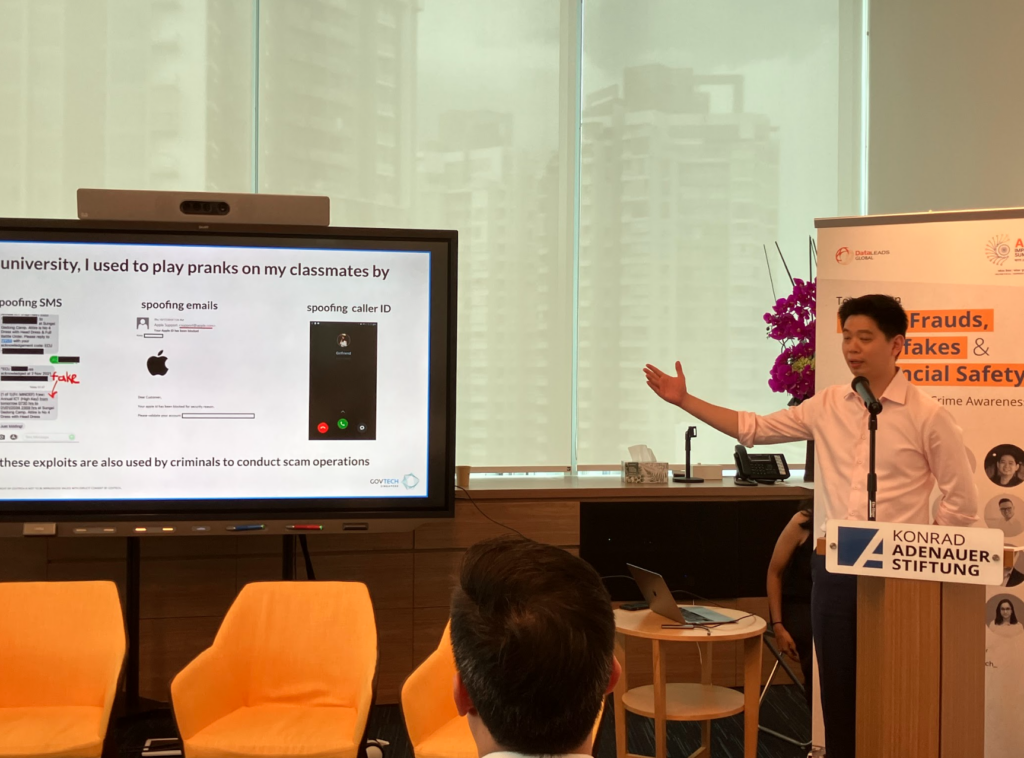
Andre Ng, Assistant Director, GovTech Singapore, showcased Singapore’s multi-layered AI-driven defence strategy against scams, illustrating the integration of public education, inter-agency coordination, and technical safeguards. Speaking about leveraging AI, Andre said that Singapore has seen a 50 percent decrease in scam typologies, where scammers rely on malicious websites (URLs) to exploit their victims. He elaborated that they use recursive Machine-Learning Site Evaluator (rMSE) to detect and report scam websites. The system evaluates more than 400,000 URLs everyday, which according to Andre has prevented more than 10 million attempts each month.
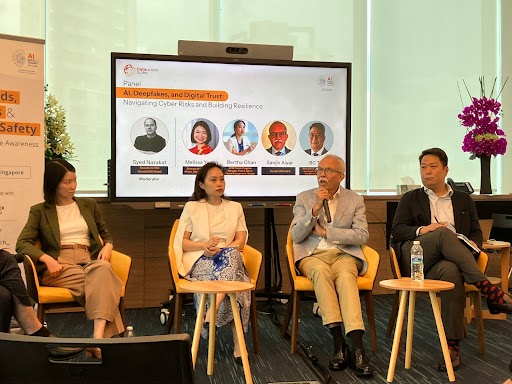
Bertha Chan, APAC Senior Program Manager, Trust & Safety Global Engagement, Google, shared insights from a paper, commissioned by Google and published by Public First, and highlighted the potential of AI to fight cyber scams. The paper notes, “By 2035, we estimate that the combination of more effective prevention and faster response times from AI driven solutions could help prevent over half of the costs from cybersecurity threats and fraud in APAC.”
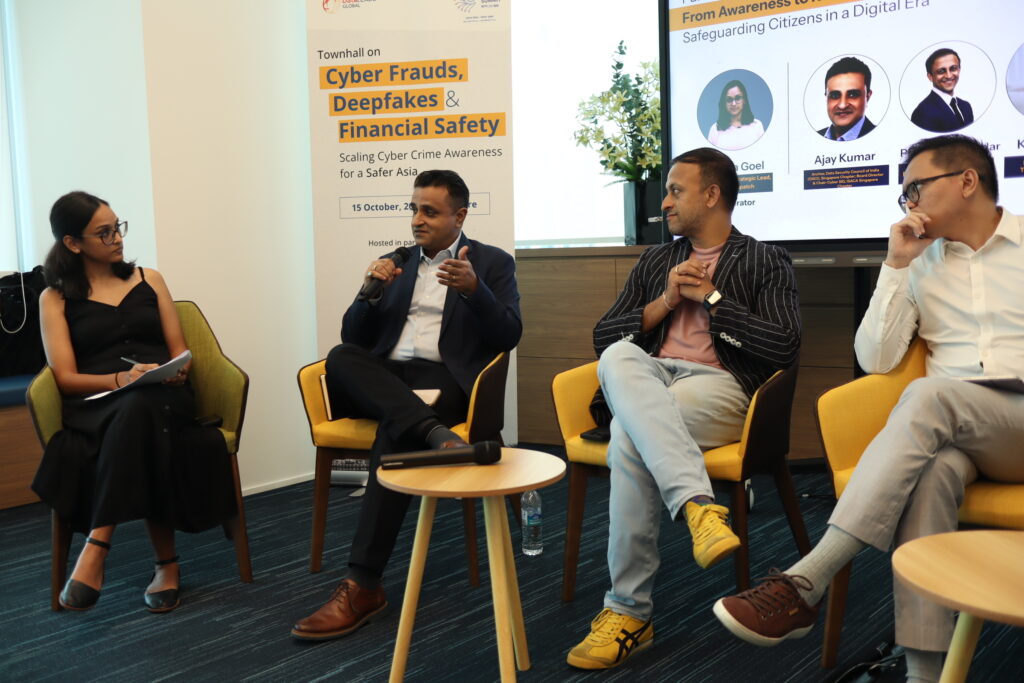
Ajay Kumar, Anchor, Data Security Council of India (DSCI), Singapore Chapter and Board Director & Chair-Cyber SIG, ISACA Singapore Chapter, emphasized the centrality of trust in the modern digital economy. “In a hyper-connected world where every click carries value, trust becomes the true currency. Protecting that trust against cyber fraud isn’t just about security—it’s the foundation of resilience in the digital economy,” he said. “As digital currencies redefine the way we transact, only trust can anchor this new economy. Building safety and resilience against cyber fraud is no longer optional—it’s the price of participation in a hyper-connected future.”
Sanjiv Aiyar, CEO and Founder, ApKar Consulting, too, stressed on the need of cross-sector cooperation. He focused on banks, telecommunication companies, and platforms not just coming together but working together to protect consumer interest.
The Show & Tell sessions spotlighted innovative solutions to protect citizens from scams — from the ASEAN Foundation’s digital literacy initiatives led by Dr. Piti Srisangnam, to Montenegro’s watermarking technology showcased by Slavko Kovačević, Gabriel Tan’s gamified capacity-building model at Bamboo Builders, and the game-based learning approach of Asian Dispatch presented by Kritika Goel.
Building on the townhall consultations in New Delhi and Singapore, the next Pan-Asia Townhall on Cyber Fraud, Deepfakes, and Financial Safety will now take place in Tokyo in early 2026.
About DataLEADS Global
DataLEADS Global works at the intersection of data, technology, and trust, building early-warning systems, digital-risk frameworks, and AI-literacy programs across Asia to strengthen societal resilience against disinformation and fraud. Its flagship initiative, GUARD, provides data-driven insights into scams, frauds, and deepfakes to support proactive intervention and policy coordination.
About Konrad Adenauer Stiftung (KAS) – Media Programme Asia
KAS Media Programme Asia promotes media freedom, pluralism, and informed democratic discourse across the Asia-Pacific region through policy dialogue, research, and capacity-building.