
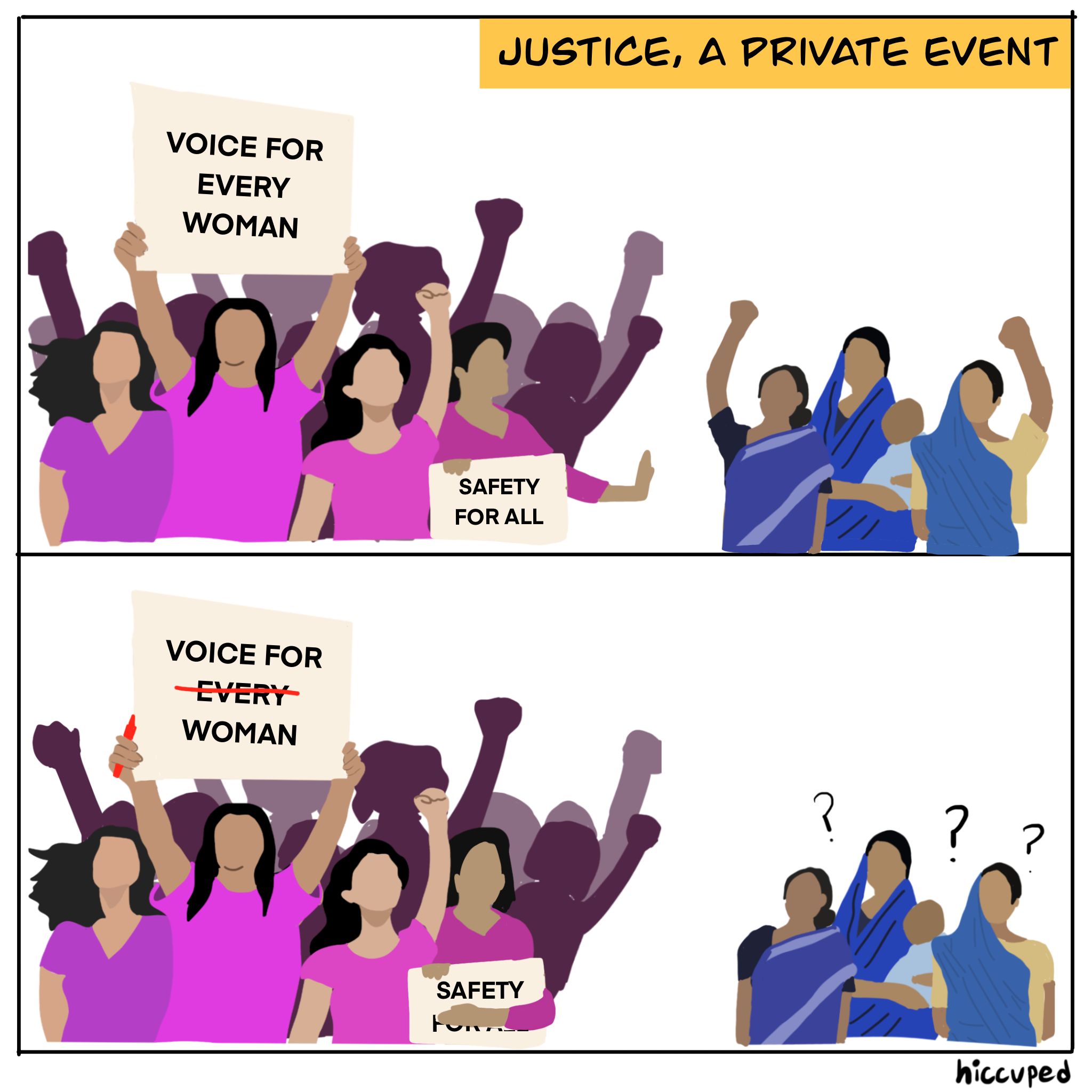
When it comes to feminist movements, are some women more equal than others? Are the brave voices we hear those of a privileged few? And do they really represent the diverse realities of all women? With the emergence of various waves of feminism across Asia, feminist movements have created quite a ripple by making significant progress. However, many have also been criticised for lacking inclusivity.
Today’s illustration for ‘Double Take’ – in which this journalist probes deeper into the socio-political events in Asia from an intersectional gendered lens – looks into this question of intersectionality when it comes to radical movements such as feminism.
The illustration above is based on actual events from last month in India, after protests broke out across the country against the brutal sexual assault of a doctor in the eastern Indian city of Kolkata.
In Mumbai – one of the world’s most expensive cities – one such protest took place at an upscale neighbourhood called Powai. Upper-class women took to the streets to demand safety for women. However, when women from a slum neighbourhood, comprising of historically marginalised and oppressed communities – the Dalits (outside the Indian caste hierarchy) and Adivasis (indigenous people) – joined them, the women from Powai told them they weren’t welcome to take part in “an exclusive protest only for residents of the Hiranandani complex (a posh residential building in Powai).”
The incident underscores how women of oppressed communities often find their struggles sidelined even though they face disproportionately more violence with little access to justice. Their experiences are deemed “different,” highlighting a divide in how feminist activism engages with caste-based oppression.
We’ve seen similar examples, such as in South Korea, where the ‘Escape the Corset’ campaign and the 4B movement advocate for women to fight against oppressive patriarchal norms, but has been criticised for not directly addressing the systemic and institutional barriers that perpetuate gender inequality in their society. This disproportionately impacts rural and economically disadvantaged women, potentially excluding them from the movement’s discourse and benefits.
In another instance, the annual Aurat March (which translates to “Women’s March”) in Pakistan aims to advance women’s rights but has drawn backlash for its controversial slogans that overshadow discussions on inclusivity and intersectionality.
In Myanmar, there are questions around whether the Rohingya women, who are further marginalised because of their identity, are ever a part of feminist efforts or discourse. In Indonesia the feminist movement’s elitist tendencies continue to exist and ostracise marginalised women.
There is a dire need for feminists to engage at a grassroots level to counter conservative movements and avoid remaining a minority confined to the middle class.
While feminism in Asia is increasingly aware of the need for intersectionality, there is still much work to be done to ensure that the voices of all women, regardless of caste, ethnicity, sexuality, education, sexual orientation, location or class, are heard and represented. The challenge is to eliminate further marginalisation of women based on other identities. As the famous civil rights icon Fannie Lou Hamer said, “Nobody’s free until everybody’s free.”