
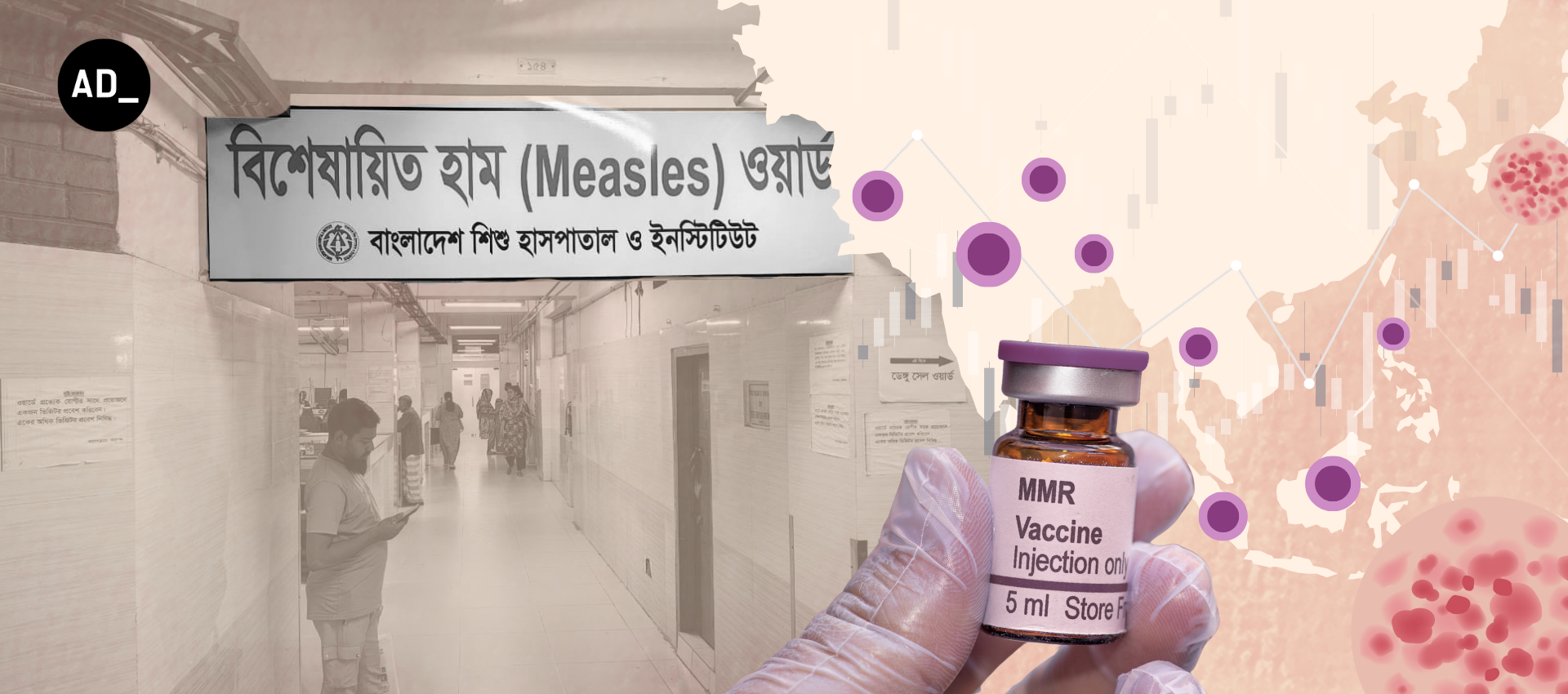
Six-month-old Mohammad Issa is in the ICU at the Shishu Hospital & Institute in Dhaka, Bangladesh. Nearly a month ago, red, heat-rash-like spots suddenly appeared all over his body. Initially admitted to a private hospital in Lakshmipur, he was moved to the capital city when his condition didn’t show any improvement. He was later diagnosed with measles.
We spoke to Issa’s father, Mohammad Zahir, on September 13 when his son was still at the hospital and his condition hadn’t improved.
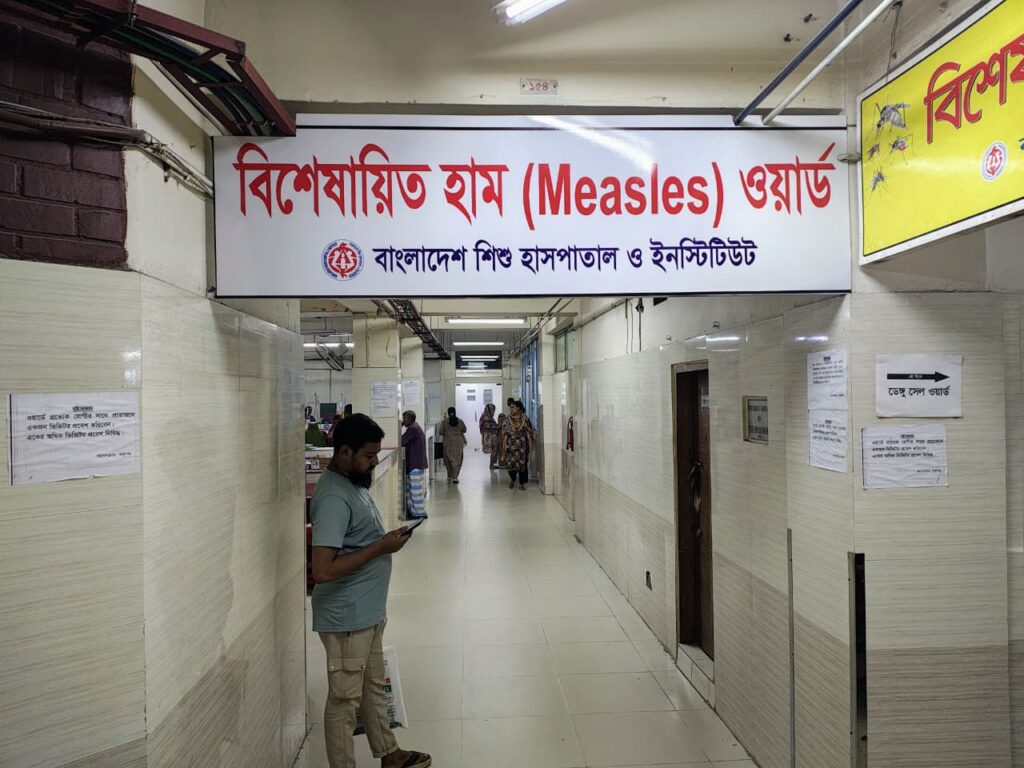
“At first, it looked like a heat rash, but later he developed breathing difficulties and a drop in the platelet count. He also started showing symptoms of pneumonia, cold, fever, and diarrhoea. He had seizures since birth, which made the situation even worse,” Zahir said.
Issa was first admitted on August 24. He was moved to Dhaka on August 28 and was then shifted to the ICU on September 6.
Our child has been in the ICU for a week. The doctors said his condition is not good and that he might have to be put on life support.
Mohammad Zahir
Expressing concern about his family’s financial situation, Zahir said, “Sometimes I spend Tk 6,000 – 7,000 (USD 40-50) per day on medicines. Sometimes it is Tk 2,000 (USD 16). Whatever medicine the doctor prescribes, I have to buy it.”
Zahir is a daily labourer but is currently unemployed and this amount is huge for the family.
“The doctor asked us to give him an injection. It cost around Tk 36,000 (~USD 293). I could not afford to give it,” Zahir added. He says the last option he has is to sell his land to save his son’s life. But he fears that if even that doesn’t save him then he will have nothing left.
Issa is one of the 21,308 confirmed measles cases reported in Bangladesh since April, as per the Directorate General of Health Services (DGHS). The infection had claimed 1,099 lives as of September 28.
While Bangladesh’s outbreak has brought the crisis into sharp focus, measles is making a comeback across several other countries in South Asia. Experts point to widening vaccination gaps, disruptions to immunisation, population movement, malnutrition, and misinformation as some of the factors driving the resurgence.
What’s Driving the Surge in Bangladesh?
Measles is a highly contagious viral disease caused by a virus, primarily affecting children and spreading easily among unvaccinated or under-vaccinated populations.
There is no specific antiviral treatment for measles. The focus is usually on relieving symptoms, preventing complications, and managing secondary infections. The most effective protection remains vaccination. Two doses of the measles-rubella (MR) vaccine are recommended to ensure complete immunity
According to a 2025 World Health Organisation (WHO) report, estimates show that the measles cases had significantly reduced worldwide from 38 million to 11 million over the last two decades. In the same period, the number of deaths have also gone down from 7,80,000 to 95,000.
Bangladesh, one of the worst-hit South Asian nations, had made “substantial progress” towards measles elimination but a recent decline in measles-rubella vaccination has contributed to the current outbreak.
“Recent declines in MR1 and MR2 coverage due to nationwide stockout of MR vaccine between 2024-2025, combined with routine immunisation gaps and the absence of regular nationwide supplementary measles-rubella campaigns since 2020, have increased the number of susceptible children and contributed to the current outbreak,” a WHO bulletin reads.
According to the WHO surveillance data, measles cases in Bangladesh remained as low as 311 cases in 2022, 282 cases in 2023, 247 cases in 2024, and 132 cases in 2025. However, the situation changed dramatically in 2026, with a massive outbreak pushing the total caseload to 64,127 cases (data till August). (Note: The official figures as per the Bangladesh government as of September 28 is 21,308.)
A 2026 Lancet study examined measles resurgence in Bangladesh and highlighted declining measles-rubella vaccination coverage and disruptions to immunisation services as key factors behind the widening immunity gap.
“The current resurgence affecting a large proportion of children under six months of age likely reflects a widening immunity gap due to declining measles-rubella vaccination coverage, with some reports suggesting coverage as low as 57 percent,” the study notes.
It adds that the “disruptions to routine immunisation services and persistent coverage gaps among underserved populations, along with missed doses and delayed vaccination, may have contributed to the gradual accumulation of susceptible individuals over time.”
The study also points to:
- absence of a nationwide measles campaign since 2020
- non-implementation of a planned 2024 campaign
- procurement delays in 2025
- Rapid urbanisation
- Internal migration
as the factors that further widened the immunity gap.
Following the 2024 political unrest and the ouster of former Bangladesh Prime Minister Sheikh Hasina, Muhammad Yunus-led interim government shifted vaccine procurement from UNICEF to an open tendering process for more transparency. According to media reports, this shift was followed by procurement delays and vaccine shortages, even as routine immunisation had already been disrupted after the 2024 unrest.
Dr. Mirza Md Ziaul Islam, director, Shishu Hospital & Institute, also cautioned against underreporting of cases, particularly from remote areas where people may not have access to health facilities.
In many cases, people simply do not have the opportunity to seek care or reach health facilities, especially in remote areas. Many people who have measles in these areas [Monpura or Subarnachar] may not even be diagnosed or come to Dhaka. So, the actual reporting is likely lower.
Dr. Mirza Md Ziaul Islam, Director, Shishu Hospital & Institute
He also identified malnutrition and breastfeeding as other key factors influencing the severity and persistence of the outbreak.
“This [measles] outbreak in Bangladesh will take a little more time to subside… due to malnutrition, the immunity of those who have received the vaccine is taking some time to develop. We are also seeing that children who were not breastfed are being affected more severely. So, nutrition, breastfeeding, and vaccination are all factors at play here,” he said.
Meanwhile, Dr. SM Ziauddin Hyder, special assistant to the Bangladesh prime minister on health affairs, said “The government is focusing on children who have not yet received the measles vaccine, while urging parents to seek medical care as soon as symptoms appear. Authorities are also emphasising home isolation to prevent transmission within families and communities.”
He said the number of new cases have now reached a plateau, with cases remaining “more or less the same”. His concern, however, is related to vaccinated children developing measles.
The Institute of Epidemiology Disease Control And Research (IEDCR), a research institute under the Ministry of Health in Bangladesh, is investigating whether these cases could be linked to a different variant or another infection, while also assessing vaccine effectiveness. Hyder said “health education and public awareness will be crucial in controlling the outbreak”.
But Bangladesh is not the only country in South Asia witnessing a sharp rise in measles cases. India recorded the second-highest number of reported measles cases in the region in 2026, with 26,205 cases reported till August, according to WHO surveillance data.
India recorded an increase in reported measles cases from 18,764 in 2025 to 26,205 till August 2026. The latest increase comes as India works towards its target of eliminating measles and rubella by 2026, after earlier elimination targets for 2023, 2020, and 2015 were not achieved.
Experts attribute this resurgence to gaps in routine and catch-up vaccination, declining population immunity, and the high transmissibility of measles, with population movement, social disruption and vaccine misinformation further increasing the risk of outbreaks.
The Surge Across South Asia
Measles was eliminated in the Maldives in 2017. The current resurgence has been linked to imported cases entering a population with pockets of immunity gaps. While routine childhood vaccination coverage remains high, some adults had missed the second measles dose, while migrant populations were also identified as a group requiring targeted vaccination.
Experts point to several factors that are contributing to the resurgence across the region:
- COVID-19 disruptions: Hyderabad-based paediatrician Dr. Sivaranjani Santosh pointed out that children missed the scheduled dose of their vaccination during COVID-19 pandemic and that created a gap.
- Vaccine misinformation: Santosh also warned that vaccine misinformation and hesitancy are creating a bigger challenge. Misinformation travels far wider and faster than evidence and the truth. People tend to believe these falsehoods and avoid getting vaccinated.
- Movement and social disruption: Dr. Anish TS, professor, School of Public Health, Kerala University of Health Sciences, pointed to population movement and social disruption as potential drivers of outbreaks. He said that when people move between communities, children may suddenly come in contact with others who have different levels of immunity. He cited situations such as displacement following wars and floods, where children from different communities may be brought together in shelters, creating conditions for transmission.
Uneven immunity levels, missed follow-up doses, and crowded living spaces are some other factors linked to an uptick in the number of measles cases.
Underscoring the complications measles can cause in children, Santosh said that the impact of measles on children with lower immunity can be severe. “In malnourished children, with no good immunity, it can cause pneumonia or even encephalitis i.e. inflammation of the brain. And common things are severe diarrhoea and vitamin A deficiency, which can even lead to blindness.”
She also pointed to a less common but serious long-term complication, subacute sclerosing panencephalitis (SSPE), a degenerative brain condition that can develop years after a child recovers from measles.
Adding to this, Anish highlighted that measles spreads faster when population immunity declines.
What Will it Take to Stop the Spread?
While herd immunity can help protect communities when vaccination coverage is high enough, Anish said measles is an exception because of its high reproductive number and requires particularly high coverage to interrupt transmission.
“Vaccination works not because you are able to vaccinate the entire population. One of the major engines of vaccination is herd immunity. That means if you are able to have maybe a coverage of 60 percent or 70 percent, you can protect the entire community because of herd immunity,” he said.
However, he added that this level of coverage may not be sufficient for measles. “Measles is an exception because of its high reproduction number, and the community cannot be protected by maybe 60-70 percent vaccination. So, you have to keep the vaccination coverage very high.”
Anish says creating awareness about the importance of vaccination is, thus, essential. He points towards the role of schools, local communities, healthcare workers in reaching people who may otherwise remain outside routine vaccination efforts.
“Sometimes, non-conventional methods involving school teachers, headmasters, panchayats and local leaders can also help. Community health literacy is very important to reach the middle 50 percent,” he said. However, these approaches can be challenging, especially in areas of low literacy.
Experts and scientific evidence continues to affirm that high coverage of vaccination can help prevent such outbreaks and help reduce mortality.