

In Asia, the battle against gender-based violence reveals the harsh realities of society. World Health Organization reports that 1 in 3 women globally have experienced physical or sexual violence. This alarming statistic, while shocking and devastating, only scratches the surface of a more insidious issue: Marital rape. Despite the prevalence of violence within marriage, the laws governing marital rape in most Asian countries remain nonexistent, leaving countless women trapped in a cycle of abuse.
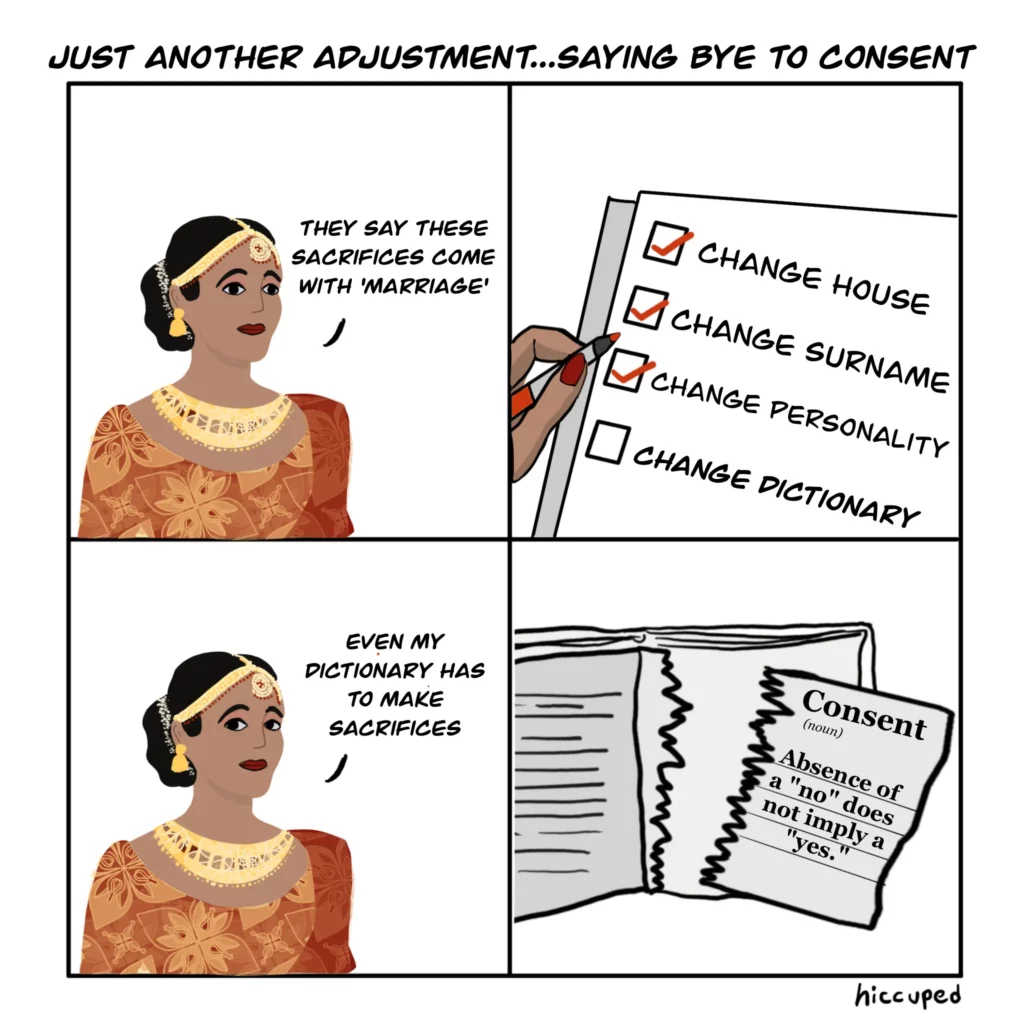
A study by UNESCO reveals that over 37 percent of women in South Asia, 40 percent in Southeast Asia, and up to 68 percent in the Pacific have faced violence from intimate partners. The numbers could be much higher considering that marital rape often goes unreported because women are conditioned to accept, endure and adjust within the confines of marriage. Across Asian societies, marriage is often presented as a sanctuary of security – both economic and physical. But we must ask: Safety for whom? If this institution is meant to protect women, then how are women expected to safeguard themselves from people within the institution? In reality, this “safety” seems illusory, benefitting the patriarchal individuals who designed these institutions.
While countries like Nepal, Bhutan, Indonesia and the Philippines recognise marital rape as a crime, many Asian countries still lack comprehensive legal frameworks to curb it, thereby prioritising cultural norms over safety of women. For instance, in India, the debate over criminalising marital rape, which is currently under judicial review by the Supreme Court, has its opponents – which include everyone from government officials to conservative groups – arguing that the law could be misused against men, and that not allowing marital rape could destabilise family structures. India prides itself in having one of the world’s lowest divorce rates but that speaks more to societal stigmas around divorce (especially for women) in the country and lengthy legal processes. The arguments against criminalisation of marital rape also reveal a troubling prioritisation of protecting men in patriarchal societies.
It’s not all hunky dory in countries that recognise marital rape, such as in Sri Lanka, Malaysia and Bangladesh. There are conditions and limitations. For instance, in Sri Lanka, marital rape is recognised only if the couple is legally separated. Or in Malaysia, it’s recognised only if the husband is causing hurt in order to have sexual intercourse with the wife. In Bangladesh, unless the victim is under the age of 13, marital rape isn’t recognised.
In Pakistan, there is no explicit laws where forced sex within marriage is criminalised. However, a recent ruling in Karachi marked a notable shift: A man was sentenced to three years for forcing his wife into non-consensual sex. This verdict acknowledged intimate partner violence as a criminal offence. In this case, the survivor’s lawyer, Bahzad Akbar, argued that the act of forced sodomy fell under the definition of rape in the amended Section 375 of Pakistan’s Penal Code.
The institution of marriage, peddled to offer protection and partnership, often serves as a deeply flawed and unfair structure for women. The failure to criminalise marital rape fully is a glaring example of shielding men from accountability, and enabling them to commit violence behind closed doors. Since time immemorial, social expectations and legal loopholes have trapped women in a position where they must choose between their safety and dignity, often leaving them deprived of both. The idea of marriage as a safe haven is distorted when norms of “obedience”, “sacrifice” and “submissiveness” to a husband are culturally imposed, and the legal system upholds these expectations.
The complicity of societal norms and the law in many parts of Asia reflects a troubling reality: Marriage is less about equal partnership and more about control. By framing consent as unnecessary within a marriage, the law not only fails women but actively enables perpetrators.
This complicity is not coincidental—it’s a well-orchestrated team effort between tradition and the legal system, where both reinforce each other to keep women subjugated within marriages. Women deserve legal systems that prioritise their rights and safety over outdated notions of family and honour. Until then, the institution of marriage, as it currently stands in many Asian countries, will continue to fail women.