
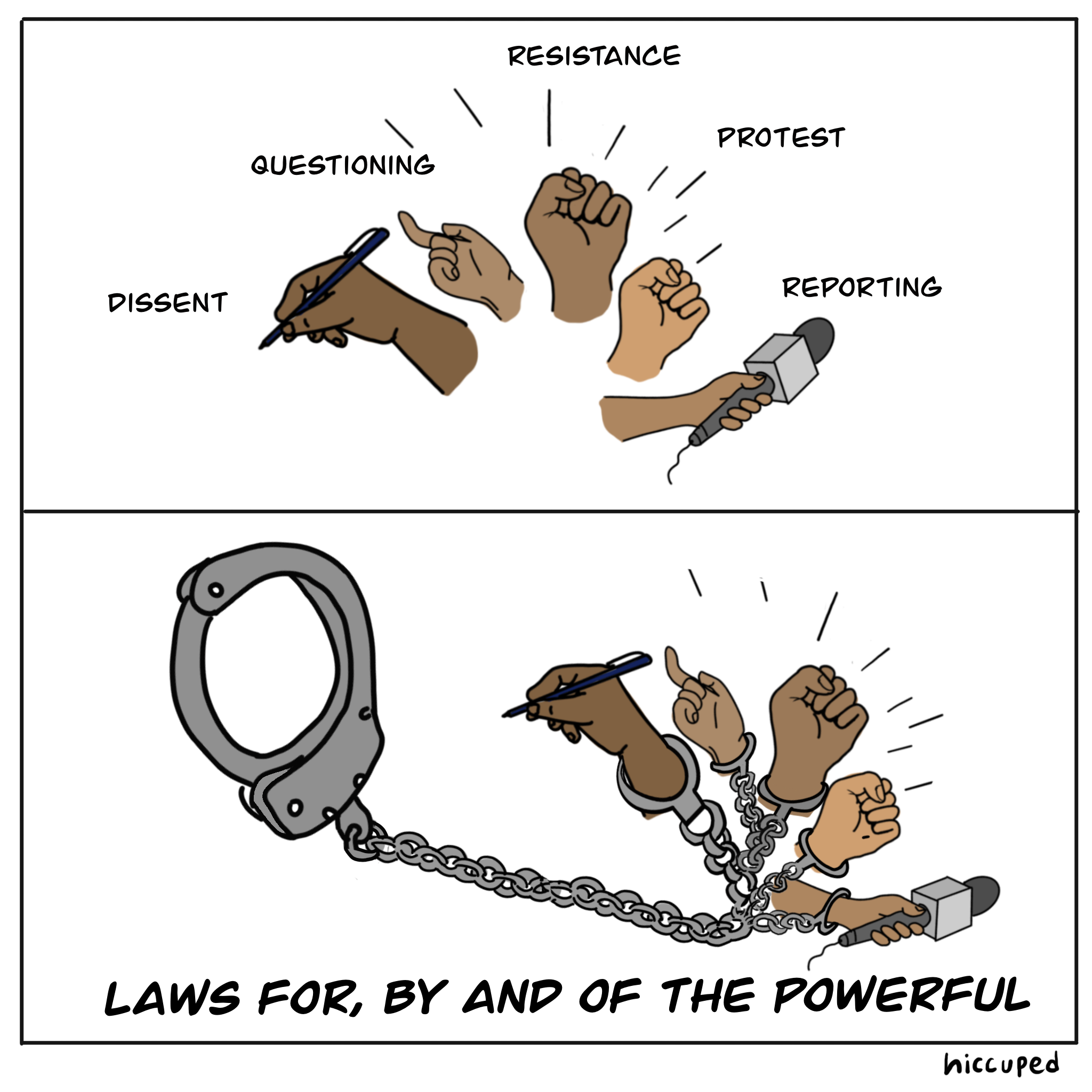
In Asian countries, dissent has severe consequences for journalists, activists and writers. They’re getting silenced by threats not just by the ones opposing their opinions but by the law itself. They are often at the risk of facing imprisonment for reporting, writing on or even questioning the authorities. Doing their job is seen as seditious.
The Hong Kong court recently sentenced Chung Pui-kuen and Patrick Lam, the editors at Hong Kong-based non-profit news website Stand News, to prison. They were charged under the sedition law. This is not an isolated case. Across Asia, there are colonial-era sedition laws and their modern iterations that are used to target pressrooms and activist circles.
In 2020, Indian Muslim journalist Siddique Kappan was arrested while reporting on a gang rape case in the Indian state of Uttar Pradesh, and charged under the Unlawful Activities Prevention Act (UAPA) and sedition laws. In Myanmar, since the 2021 military coup, at least 176 journalists have been arrested, while four have been killed, and approximately 50 are in prison or police detention, according to the International Federation of Journalists. What came as a surprise was when two journalists Tar Lin Maung and Naung Yo were detained by the armed opposition group Kachin Independence Army, signaling a troubling trend of journalists being targeted irrespective of the regime in Myanmar. Their whereabouts remain unknown.
In Malaysia, activist and artist Fahmi Reza has been arrested several times under Malaysia’s colonial Sedition Act for his satirical work that depicts government corruption and monarchy. Vietnamese journalist and writer Truong Huy San was charged for “abusing democratic freedoms” and arrested for his articles and posts that criticised the government.
The list goes on.
The core issue with such laws is their broad, vague definitions of what constitutes as “unlawful” or an “anti-national” activity. This ambiguity grants the government significant discretion to interpret and apply these laws, often targeting individuals who dissent or criticise state policies. Under such provisions, individuals can be accused of threatening national security or government authority and detained on mere suspicion, without clear or direct evidence. This leeway allows the government to effortlessly suppress any dissent or opposition that challenges their authority or contradicts their views.
In India, the Unlawful Activities (Prevention) Act (UAPA) is an anti-terror law designed to prevent activities that threaten the sovereignty, unity, and security of the country. However, the law has stringent provisions, which allows the authorities to detain individuals without formal charges for extended periods, often without trial or bail. Umar Khalid, a student activist who was arrested in September 2020 under UAPA, has been in prison without bail and trial. Multiple bail requests have been denied on the basis of UAPA’s stringent bail restrictions. Similarly, tribal rights activist and priest Stan Swamy was arrested with charges accusing him of Maoist links. He suffered from Parkinson’s disease and was denied bail multiple times despite deteriorating health. He died in judicial custody. GN Saibaba, a professor and disability rights activist, was arrested in 2014 on charges of having Maoist links and supporting activities deemed “anti-national.” After being in prison for over nine years despite being 90% disabled and wheelchair-bound, Saibaba was sentenced to life in prison in 2017 and was denied necessary medical treatment. This year, he was acquitted of all charges and released. But his health deteriorated soon after, leading to his death.
Thailand’s Lese Majeste law is meant to criminalise defamation, insults, or threats to the monarchy, with punishments of up to 15 years in prison per offense. However, there is no clear definition of what constitutes an insult to the monarchy, which allows authorities to interpret the law broadly and curb free speech.
China introduced the National Security Law, enacted in 2020 criminalising acts of secession, subversion, terrorism and collusion. This law was made in response to the protests that erupted in Hong Kong in 2019, making many dissenting acts illegal. In Malaysia, there is Security Offences (Special Measures) Act (SOSMA) which was enacted in 2012, this provides authorities with extensive powers to detain individuals suspected of security offenses for up to 28 days without charge. In Bangladesh, journalists and activists have been arrested under the Digital Security Act of 2018, which grants authorities the power to detain anyone posting “negative propaganda” or “fake news” that threatens national security.
These laws are broadly defined and are abused by authoritarian governments across Asia. The number of arrests made under these draconian laws reveals a troubling pattern: These regimes not only use these laws to silence dissent but also manipulate the judicial process to ensure that the arrested never see a fair trial. The law no longer protects the people. Instead, it protects the powerful from accountability, silencing the very voices essential to democracy and justice.