
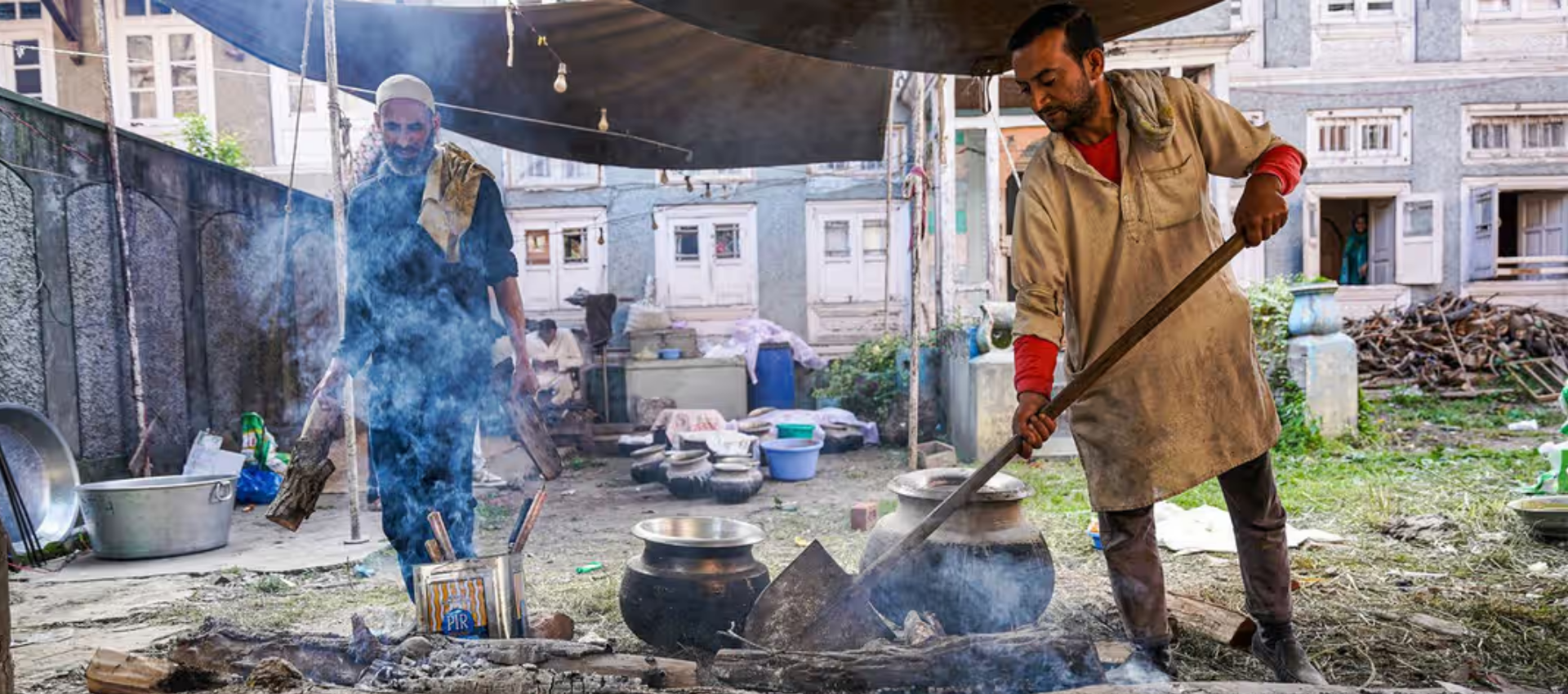
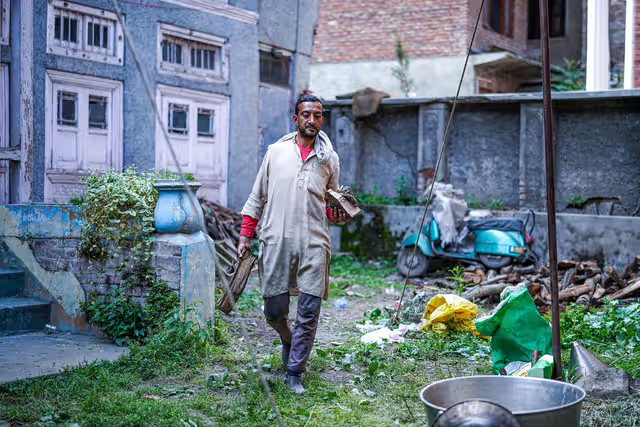
“We had planned to cook this feast on gas,” says Riyaz Ahmad, staring quietly at the dying embers nearby. “But given the shortage, I switched to firewood instead. It’s costing us almost double.”
Riyaz Ahmad Anchari, 50, is, a waza, a traditional Kashmiri chef. In fact, he’s the head waza here, at a friend’s sister’s wedding. And he’s grappling with a till-now unforeseen problem.
The war in Iran nearly 3,000 kilometres away is disrupting weddings in Kashmir.
Earlier, the entire house seemed alive. Some people were singing traditional songs, others dancing, while a few hurried around hosting guests. Strings of lights draped across the house painted the night in warm colours.
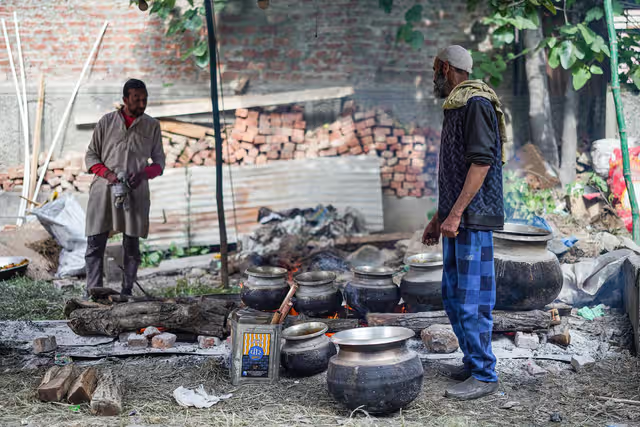
I’ve always found the wazas fascinating, their stories, their recipes going back generations. And so ended up seated beside these chefs around 11 p.m. when they were done cooking for the wedding.
Each waza is highly skilled. One is an expert at cutting meat with astonishing precision. Another understands the delicate timing of slow cooking. While yet another possesses an almost instinctive knowledge of spices, knowing exactly what flavour a dish lacked with just a glance.
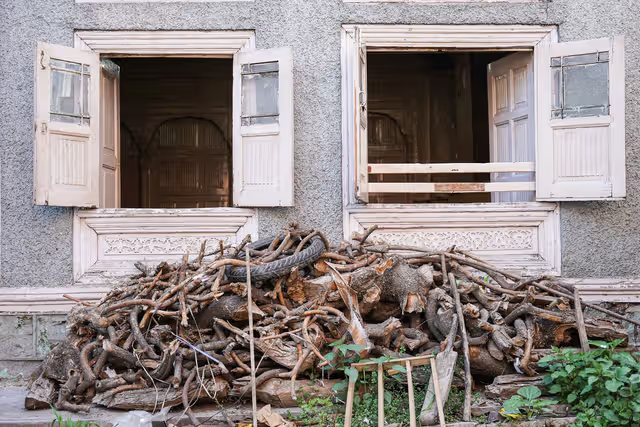
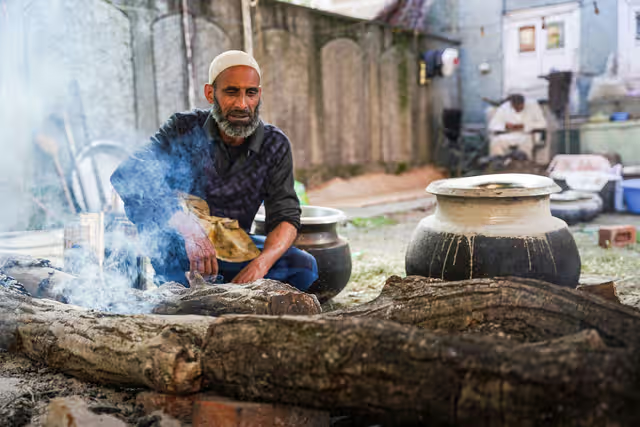
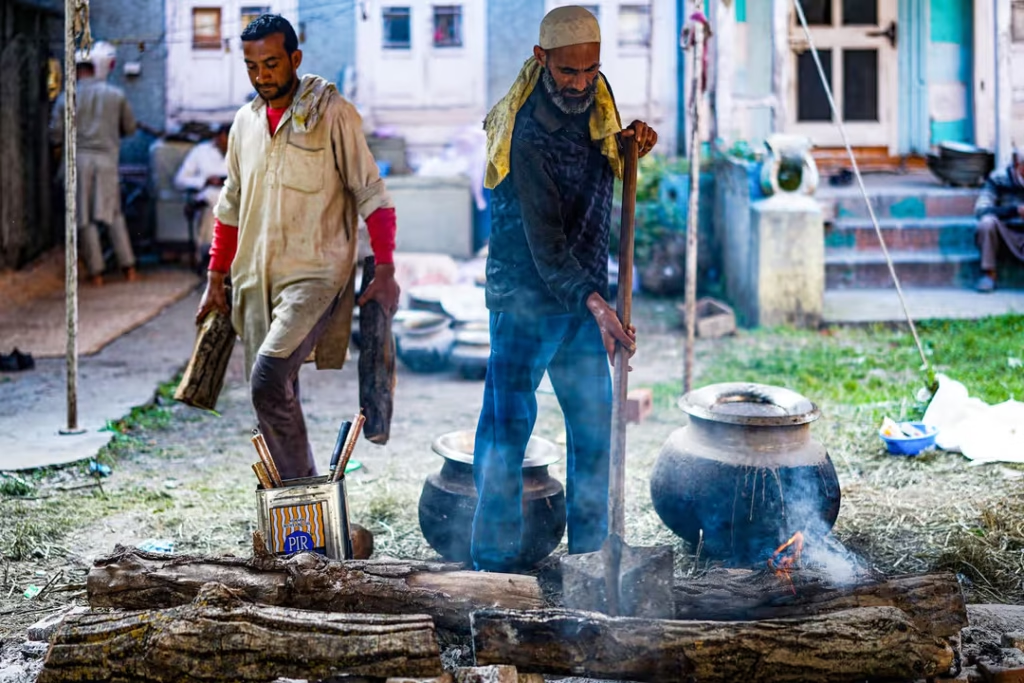
For Riyaz, a head waza with 26 years’ experience, arranging gas cylinders has become as difficult as preparing the feast itself. Today, he has to cook 110 kilograms of meat and more than 50 kg of chicken for over 200 guests at this wedding in Srinagar’s Rainawari area. But the cooking gas shortage has made things very difficult.
Riyaz who earned Rs. 250,000 last year says he is “not expecting even half of that this year.” The LPG shortage has also forced him to turn down some wedding contracts.
Wazwan, the traditional multi-course meal of Kashmir, is central to wedding celebrations across the Valley. The feast tonight includes dishes such as kebab, tabakh maaz, chicken, meethi, rogan josh, rista, korma, aab gosh, paneer, and goshtaba.
“Wazwan is a Kashmiri name given to this multi-course meal which came from central Asia through traders some 700 years ago,” says Zareef Ahmad Zareef, a historian from Srinagar city’s Makhdoom Sahib area.
“Out of seven main items, five were from central Asia and two, rista and goshtaba, were our inclusion in the cuisine,” he says. Over centuries, wazwan evolved into more than just food – it became a symbol of Kashmiri hospitality and culture.
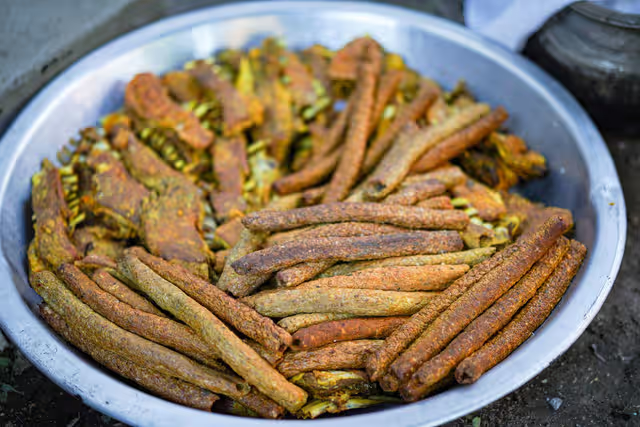
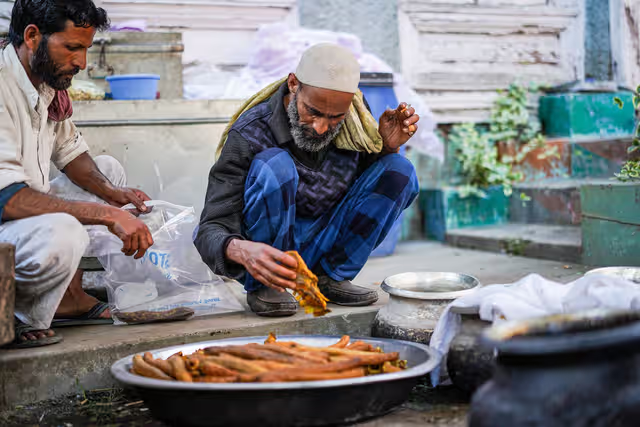
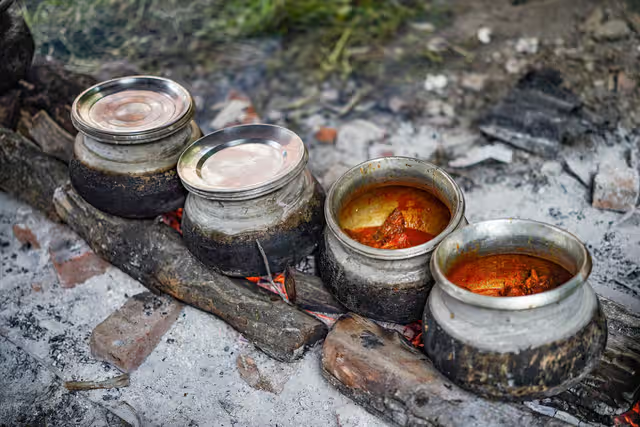
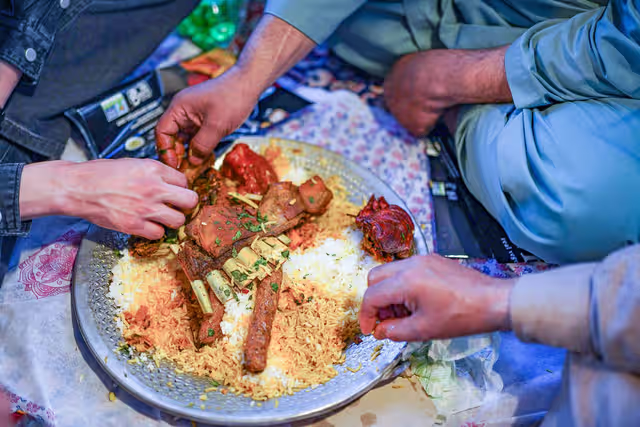
Traditionally, generations of chefs cooked the wazwan on firewood. However, the last 15 years have seen LPG cylinders, which require less space, increasingly replace firewood in crowded urban localities.
“If a customer has a 10×12 foot space, we can cook 150 kg of meat on gas. The same quantity cooked on firewood would need almost six times the space,” Riyaz explains. “Besides, gas is smokeless.”
But the LPG shortage is forcing many wazas to revert to traditional firewood cooking.
“To cook this much food,” says Riyaz, “I would have purchased four smaller gas cylinders, which would have cost me some 4,500 rupees including transportation. Now, I have to use firewood – 10 quintals of it. That’ll total around 8,500 rupees, almost double the cost of gas.”
The shortage is also hurting livelihoods tied to the wedding economy.
“I have dropped four or five events because of the non-availability of gas, and the loss is around 1 lakh rupees. But the losses are not mine alone. They affect all those who assist me in the cooking. For these bookings,” says Riyaz, “I would have needed almost 25 people.”
“It takes five wazas, including two head chefs and three helpers, two days to cook 150 kg of food, so the loss hurts their families as well. If this continues, I think I will have to cancel half my bookings this season.” Some of those wazas, mainly helpers, are from Beerwah village of Budgam district, a reservoir for such skills.
The impact is being felt by other wazas across Srinagar as well.
Waseem Ahmad Mattoo, another waza from Nawakadal in downtown Srinagar, said he recently purchased a 19 kg gas cylinder for 3,000 rupees as he had no other option. The client concerned had no space to cook on firewood.
People across Srinagar have been struggling to get gas cylinders.
The wedding I was at went off fine, but: “I had decided to do a simple Nikah of my sister when I heard that there might be a lockdown,” says my friend Zahid Ahmad who is hosting the wedding I’m attending. He acknowledges, though, that in several weddings, hosts cut down on both guests and the number of dishes.
The war in Iran is running up casualties of other kinds in Kashmir.
Also Read