
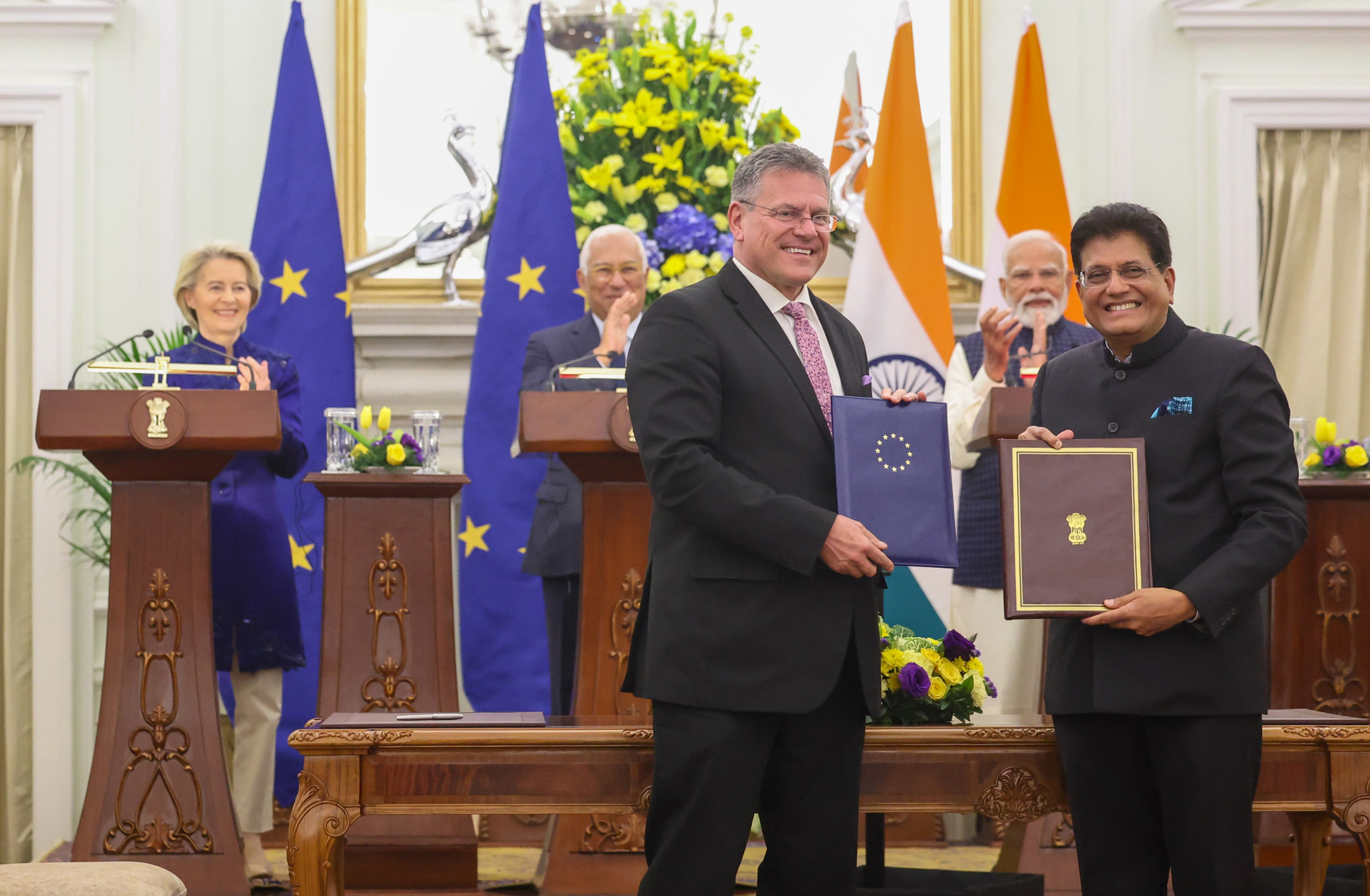
After nearly two decades, India and the European Union (EU) concluded negotiations for a landmark Free Trade Agreement (FTA) on January 27, 2026, at the 16th India–EU Summit in New Delhi. The agreement is expected to be formally signed in December 2026 and aims to reduce trade barriers, expand market access, and strengthen economic ties.
The FTA brings together India and the EU’s combined market estimated at INR 2091.6 lakh crore (USD 24 trillion) market serving two billion people. Bilateral merchandise trade between India and the EU stood at approximately INR 11.5 lakh crore (USD 136.54 billion) in 2024–25, with Indian exports accounting for around INR 6.4 lakh crore (USD 75.85 billion). Trade in services reached INR 7.2 lakh crore (USD 83.10 billion) in 2024.
For healthcare, the agreement opens opportunities in pharmaceuticals and medical devices, with the government highlighting access to USD 572.3 billion EU pharmaceuticals and medical devices market.
This also comes as India’s pharmaceutical industry, the world’s third-largest by volume, has a domestic market valued at USD 60 billion, projected to reach USD 130 billion by 2030. India’s pharmaceutical exports stood at USD 30.5 billion in 2024–25, with products shipped to 191 countries.
Experts highlight that the FTA’s impact will likely extend beyond exports to medicine affordability, healthcare access, and domestic investment. Its outcomes will depend on implementation and its effects on patients and healthcare industries in both regions.
The Key Provisions
What the EU Offers India
- Market access: Access to the European markets
- Duty elimination: Immediate duty elimination on 70.4 percent of all product categories exported from India, with further concessions phased in over three to five years.
- Services and mobility: Commitments across 144 services subsectors and provisions for temporary entry of specified categories of Indian professionals.
- Traditional medicine: Opportunities for AYUSH practitioners to offer services in EU member states where relevant regulations do not exist.
What India Offers the EU
- Phased tariff reductions: Immediate duty elimination on 49.6 percent of tariff lines, with further elimination phased in over five, seven, and ten years.
- India will offer EU businesses a predictable regime to support bringing in investment and innovative services. This is likely to enhance exports and bring in best services to Indian businesses.
The India–EU FTA is expected to create new export opportunities for Indian pharmaceutical and medical device manufacturers. The agreement opens access to the EU’s pharmaceuticals and medical devices market, valued at USD 572.3 billion.
Tariffs of up to 6.7 percent are set to be eliminated across 99.1 percent of relevant tariff lines, potentially improving the price competitiveness of Indian exports such as lenses, spectacles, medical devices, and measuring and testing instruments.
Sudarshan Jain, secretary general, Indian Pharmaceutical Alliance (IPA), described the India–EU Free Trade Agreement (FTA) as a significant milestone, highlighting the potential benefits of reduced tariffs, continued recognition of India’s intellectual property framework and greater investment in the country’s pharmaceutical sector.
“Some of the highlights from the healthcare point of view, tariffs are reduced to zero or preferential level for most of the healthcare categories. The healthcare product will become economical for patients in India. It brings predictability in the system,” Jain said.
He also welcomed the recognition of India’s position under the World Trade Organization’s TRIPS framework (Trade-Related Aspects of Intellectual Property Rights).
India is a TRIPS compliant country and IPA laws in India are aligned to the global framework provided by the TRIPS Agreement. He also argued that provisions going beyond TRIPS requirements could delay the entry of affordable generics and increase medicine prices. Maintaining India’s existing safeguards, he said, “was important for protecting patients’ access to affordable medicines.”
A 2026 study in The Lancet Regional Health – Southeast Asia similarly noted that excluding proposed TRIPS-plus provisions could support access to affordable generic medicines, while warning that stronger trade-secret protections could hinder domestic production of biosimilars, vaccines, and other treatments.
Jain called for European companies to go beyond marketing agreements and invest more in manufacturing and research and development (R&D) in India, which he said remains limited.
“There is a big opportunity because India is the youngest country in the world. India has one of the largest markets in the world,” Jain said, pointing to the potential for European companies to collaborate with Indian firms. Such investments, he said, “could help strengthen India’s healthcare industry and expand collaboration between the two regions.”
On medical devices, Jain acknowledged that lower tariffs on European imports could improve access to sophisticated technologies for Indian patients. However, he also emphasised the need for Indian manufacturers to compete on merit.
Archana Jatkar, associate secretary general, Indian Pharmaceutical Alliance, also highlighted that regulatory convergence is crucial and would need to be addressed as the agreement is implemented and reviewed.
She also pointed out that currently, India and the EU do not have mutual recognition of Good Manufacturing Practice (GMP) inspection. It will be helpful to have this mutual recognition of manufacturing GMP inspection. “So, regulatory cooperation, therefore, will become a very important point going forward,” she said, emphasising the need to reduce regulatory hurdles and improve cooperation between India and the EU.
What Could the FTA Mean for European Healthcare?
Elena Petelos, president, Global Health Section and vice president of the Health Technology Assessment Section at the European Public Health Association (EUPHA), said that the India–EU FTA could improve access to health technologies, provided commercial opportunities are supported by sustained regulatory cooperation, effective purchasing policies, and monitoring of outcomes.
“The fact that you’re going to import cheaper does not automatically mean that you’re going to see lower prices,” she said, explaining that medicine pricing and reimbursement remain decisions for individual EU member states.
For example, a hospital purchasing an approved technology at a lower price may use the savings to treat additional patients or even increase profit margins.
The same principle would apply to diagnostics, so while equipment may become cheaper to purchase, test availability and affordability would also depend on maintenance, trained staff, and quality assurance.
Petelos said greater access to Indian generic medicines could help Europe address medicine shortages, given India’s substantial manufacturing capacity. She also highlighted “the potential of biosimilars to improve access to treatments for cancer, diabetes and autoimmune diseases, provided they are properly manufactured and meet quality requirements”.
In Europe, EU approval provides a strong scientific basis for confidence in Indian-manufactured biosimilars, which must demonstrate no clinically meaningful differences in quality, safety, or efficacy from their reference medicines. Addressing remaining hesitation among clinicians and patients requires clear communication, transparent regulatory cooperation, and continued safety monitoring, including when patients switch treatments.
Petelos also called for closer regulatory cooperation and the practical work needed to make expanded trade deliver public-health benefits, including clear and predictable evidentiary requirements, scientific dialogue, and cooperation on quality defects and shortages.
She added that technology-transfer partnerships combining manufacturing know-how, staff training and validated production processes could build sustainable local capacity and widen access to quality-assured medicines and diagnostics.
Petelos also said it’s imperative to:
- Monitor adverse reactions and continue oversight after products enter the market.
- Assess how health benefits and environmental harms are distributed.
- Focus on cross-sectoral and interdisciplinary collaboration for frameworks that consider where products are developed, manufactured, exported, imported and used.
She also pointed to opportunities for India–Europe research collaboration, including clinical trials that adequately represent women and diverse health populations. Petelos stressed that “the agreement’s health impact should be transparently monitored over the short, medium and long term, beginning with a baseline before implementation.”