
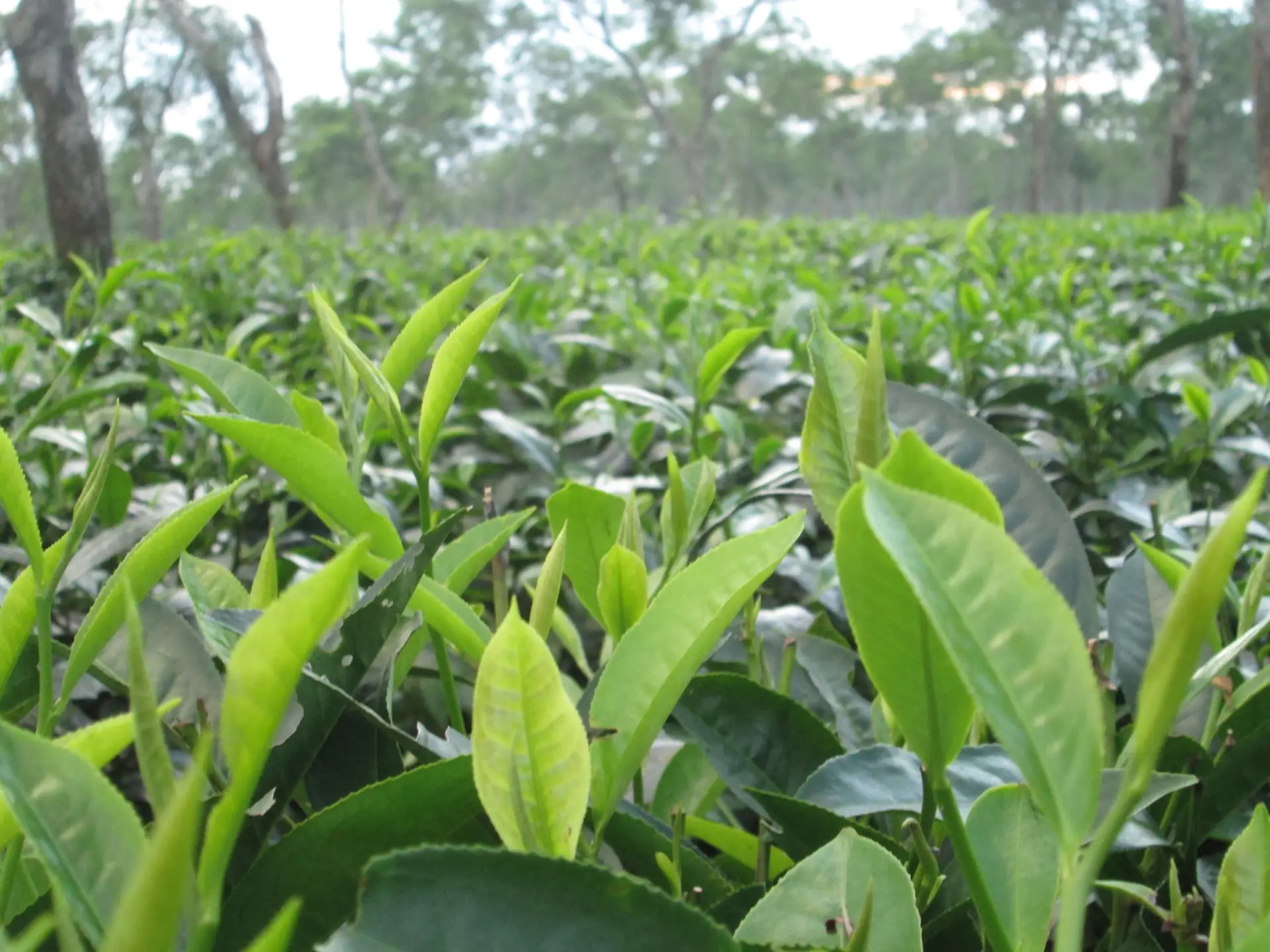
The tea leaves look the same, but they no longer feel the same in Renuka Devi’s hands.
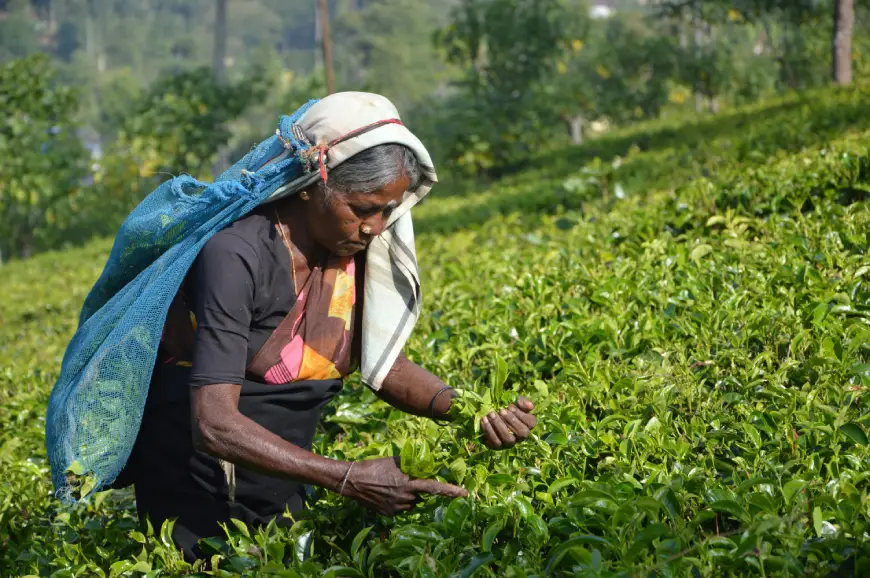
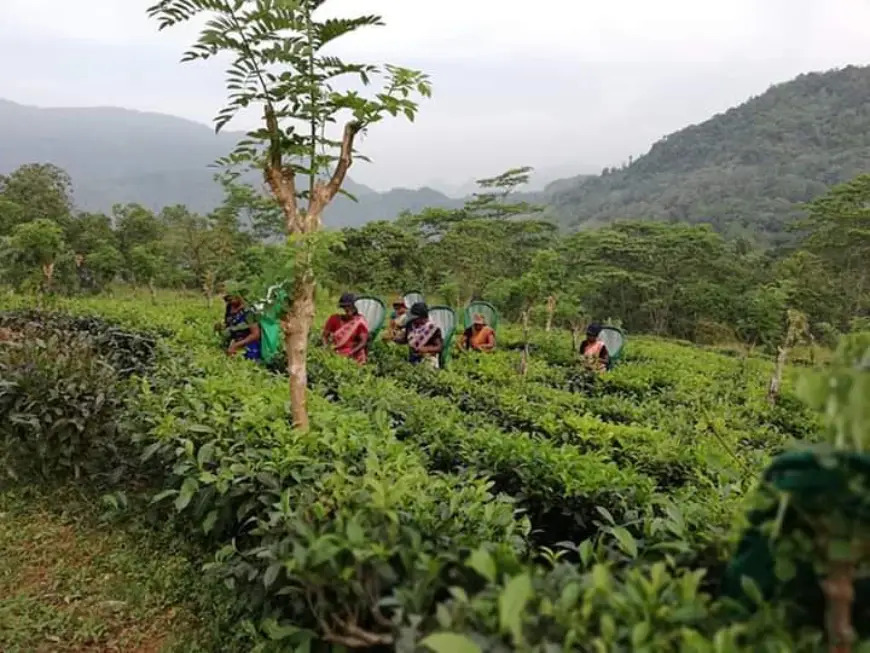
Devi, a tea estate worker in Sri Lanka’s Wanaraja Lower Division, has been plucking tea leaves in a plantation for two decades. This region is renowned for its rich, full-bodied tea leaves, which consistently produce a luxurious texture and exquisite taste throughout the year. But lately, no matter how many leaves she gathers, they feel lighter – even frail. It’s as if the weight of the leaves has diminished, Devi notes.
“When it’s sunny, the leaves are lighter,” she tells Asian Dispatch, holding up a handful of freshly picked tea. “The drought makes them lose weight.” Lighter weight means Devi can’t meet the tea company’s target of plucking 19 kilograms per day, which means losing out on a daily wage of Sri Lankan Rupees 1,350 (USD 4.50). It barely covers her family’s needs.
The shifts in weather — unseasonal rains one day, punishing heat, the next — have upended the rhythms of tea harvesting across South Asia. “Tea used to be easier to pluck,” Devi says. “But now, even when we work harder, the weight isn’t there.”
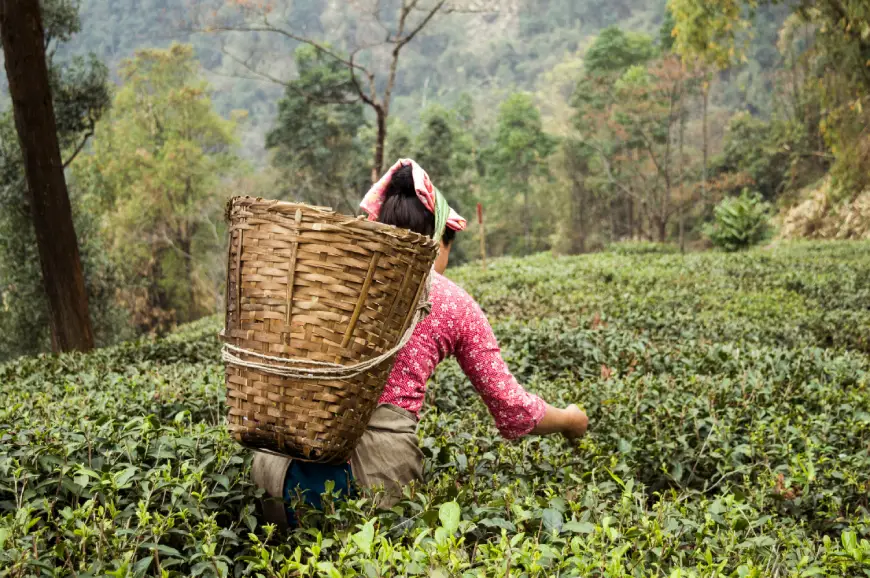
India and Sri Lanka are pivotal players in the global tea industry, collectively accounting for approximately 20 percent of the world’s tea gardens and 30 percent of the global tea production. At the same time, the tea industries of India and Sri Lanka support the cumulative livelihoods of more than 4.5 million people – directly and indirectly – who rely on daily harvests and, therefore, face the disproportionate impacts of climate change.
Devi’s story reflects the crisis that her industry faces in the subcontinent. Sri Lanka’s tea yields fell by 14.95 percent in 2024 compared to the previous year, the greatest crop shortfall since 1995, according to the Food and Agriculture Organisation.
Some 4,000 kilometres away from Devi, tea workers in the northeastern Indian state of Assam are battling the growing unpredictability of the weather. India saw a 100 million kilograms worth of dip in tea production in 2024, which tea producers attribute to erratic weather patterns. However, there’s an added factor of heat stress too.
Bijili Sahu, a worker at a tea estate near Segunbari in Assam’s Udalguri district, has been leaving the fields early every day. For the woman in her 40s, the punishing heat affects productivity. “The heat is so intense that my head starts pounding hard. I have to be back at home by the afternoon for relief,” she says when Asian Dispatch met her in 2024, referring to the cauldron of heatwaves in the country back then.
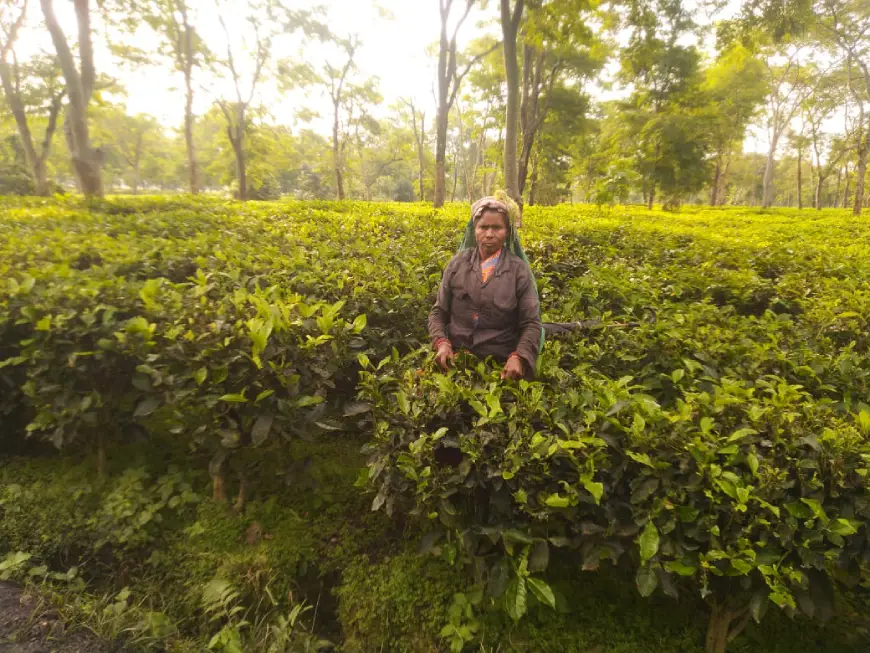
Sahu is a temporary worker in a job she’s held for 16 years. Her husband abandoned the family years ago, forcing her to be the provider. Sahu works six days a week, for over 8 hours daily, only to earn INR 1,200-Rs 1,300 a week ($15). Like many temporary workers, Sahu is penalised with pay cuts if she fails to log in for work.
The Indian tea industry – the world’s second largest – is increasingly employing temporary workers who are mostly migrants or retirees. Unlike permanent employees, they are deprived of rights to bonus, health benefits, pension and creche facilities among other benefits. India’s Plantation Labour Act 1951 further denies them the right to land or home. An Oxfam study on Assam’s tea workers found that 61 percent of the state’s tea workers are temporary. So it doesn’t help that tea cultivation is an exceptionally labour-intensive process, with harvesting alone accounting for nearly 70 percent of the efforts.
The conditions in the subcontinent’s tea industry has colonial history – the British built them in colonies to compete for the global tea market – that continues to perpetuate labour exploitation to largely benefit the Global North.
Sabita Banerji, founder and CEO of The International Roundtable for Sustainable Tea (THIRST), reiterates that the plantation model is still deeply rooted in its colonial conditions. “The [tea plucking] ecosystem depended on low wages and vast amounts of labour, in an environment that is controlled and managed. This structure inevitably leads to exploitation and forced labour,” she tells Asian Dispatch.
MA Wijeratne, Senior Research Officer at Sri Lanka’s Tea Research Institute, explains the complex intersections of exploitative labour conditions and climate change. “Any slight change in climate factors affects workers’ productivity,” he says, “which is further hampered during prolonged shifts of four-six hours in dry or high-temperature conditions. Continuous work becomes difficult under such circumstances.”
The politics of tea
The tea industry is deeply intertwined with the identity politics in South Asia.
In India, the vast majority of tea plantation workers are from marginalised communities, primarily Adivasis (tribals) and Dalits. These groups were historically brought from central India to Assam and other tea-growing regions during the colonial era. Their descendants continue to make up the backbone of the workforce today. Their social and economic marginalisation has persisted, with limited access to education, healthcare, and upward mobility, reinforcing cycles of poverty and exclusion.
In Sri Lanka, the tea estates are predominantly staffed by Dalits of Indian Tamil descent. Brought to the island by British planters in the 19th century, these workers and their descendants have faced systemic discrimination and social exclusion, both within the broader Sri Lankan society and the Tamil community itself. The intersection of caste and ethnic identity shapes their experiences, often resulting in limited rights, poor living conditions and ongoing struggles for recognition and dignity.
An ageing workforce
Compounding the challenges in the tea sector is the ageing workforce. According to a 2025 report by The International Roundtable for Sustainable Tea, or THIRST, the average age of Indian tea workers has risen from 38 to 47 years, underscoring a growing demographic shift.
In Sri Lanka, a survey cited by the Tea Research Institute reveals the severity of labour shortages on estates, driven in part by an ageing workforce and the difficulty of attracting younger generations to tea plantation work.
Banerji notes that when THIRST spoke with young people from tea worker families in Darjeeling and Kenya, the responses showed a pattern.
“With few, if any, alternative sources of income, Kenyan families are immersed in the tea industry and young people are very aware of the hardships their parents experience. They hope for good jobs in the industry, but feel that these are not open to them,” she said.
In Darjeeling, similarly, Banerji noted that many young people knew little to nothing about the tea industry. “The parents had intentionally kept them out of [this business],” Banerji explains. “They didn’t want their children working for low wages, in physically demanding conditions, under insecure contracts and without respect.” She added that Indian youth didn’t harbour any aspirations of upward mobility within this industry.
Extreme weather brews trouble for South Asia’s tea
Workers and activists have been calling attention to the climate crisis, especially as the weather conditions impact the quality and quantity of the leaves. “In some months, the temperatures are so high that even the tea bushes can’t tolerate it,” says Bidyananda Barkakoty, an advisor to the North Eastern Tea Association (NETA) a body of planters and producers and former vice chairman of the Tea Board of India.
From January to August 2024, the Tea Board of India documented the fall in Assam’s tea yield by 31.85 million kilograms compared to the same period in 2023 — a 7.9 percent drop. Across India, the decline was even steeper, by 87.94 million kilograms, or 10.69 percent. Factors, according to the Toklai Tea Research Association, included dry spells that included a deficit of 375 mm of rainfall last year while the average maximum temperature [up to August 2004] was nearly 1°C higher than the long-term normal, thereby affecting tea productivity, which thrives within a specific climatic range.
A 2016 trend analysis by the Centre for International Environment and Resource Policy, India’s Tea Research Association, The University of Western Australia, University of Southampton from the UK and India’s World Resources Institute further predicted that an extra 1°C warming at an average monthly temperature of 28°C could reduce tea yields from India by 3.8 percent.
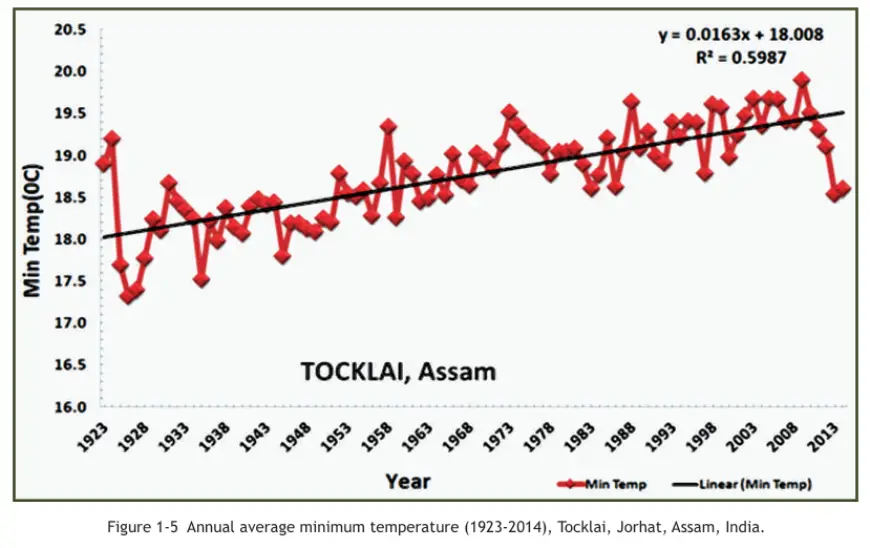
A trend graph showing the trend in temperature from 1923 to 2014 in a report by UN
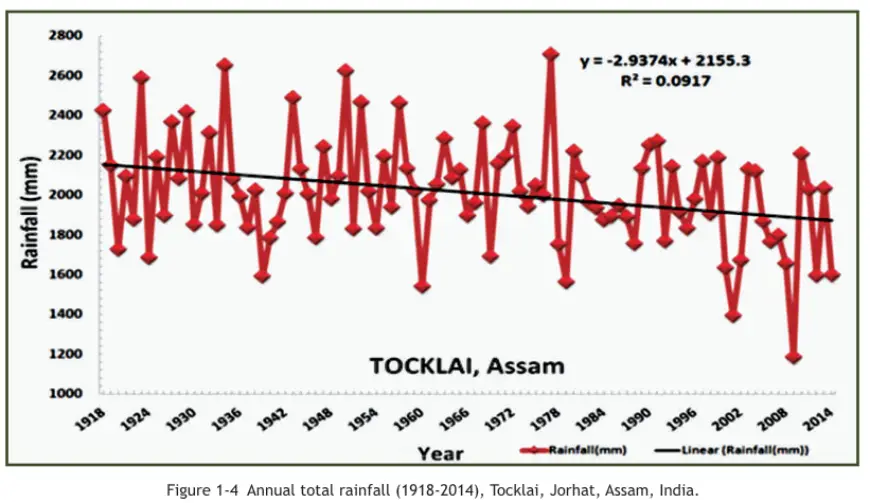
A trend graph showing the trend in rainfall from 1914 to 2014 in a report by UN
Graphs showing the trend in temperature and rainfall changes in Tocklai Jorhat, Assam, India in a report of the Working Group on Climate Change of the FAO Intergovernmental Group on Tea by Food and Agriculture Organisation of UN
According to the data accessed by Bidyananda from the Tea Board of India, there has been a loss equivalent to 31.85 million kgs in Assam – 7.9 percent – and 87.94 million kgs in India – 10.69 percent – when it comes to tea yield from January to August 2024 vis-a-vis 2023. “Due to less production, the price of Assam’s tea on average has increased by INR 50 per kg (0.58 USD),” explains Bidyananda.

Adding to the existing stress is the annual flooding of India’s largest river, the Brahmaputra, which runs through Assam and causes significant waterlogging in the tea-growing regions of northeast India. This waterlogging, a major abiotic stressor, affects plant growth and survival, resulting in 15-20 percent crop damage each year across tea plantations.
In Sri Lanka, Wijeratne observed that increased and long spells of drought have massively impacted tea production in the country. “Even a week of dry weather leaves the soil in poor condition, affecting productivity,” he says, adding that Sri Lanka’s tea production, which stood at 340 million kilograms in 2013, has now dropped to 250-260 million kilograms. “There is certainly a correlation between climate change and the quality of tea,” he adds.
Wijeratne’s research on climate change’s impacts on Sri Lankan tea between 2002 and 2004 found that the majority of tea plantations, except those at high elevations (1,200m and above), are likely to be disproportionately impacted by climate change. He says the ambient temperatures (maximum and minimum) of most of the tea-growing regions have increased over the last 50 years.
Fighting the invisible enemy
Adopting mitigation measures is no longer an option, says Barkakoty from India’s tea board. Across Assam’s tea estates, shade trees are being planted to regulate temperatures, rainwater is being harvested to combat droughts, and new tea cultivars are being chosen for their resilience to changing conditions. “Some cultivars that were perfect a decade ago are no longer suitable for planting,” Barkakoty adds, pointing to the necessity of innovation.
In Sri Lanka, where upcountry tea is concerned, the cost of replanting is very expensive and the payback period is long. Scientists now advise the government to consider land suitability classification and mapping for future tea plantations. They also suggest that tea growers should be assisted with a reliable weather/rainfall forecast for them to prepare their tea lands to better face adverse weather conditions.
Sumendra Tamang, Assistant Secretary of the Hill Plantation Employee Union in India’s West Bengal state, notes that the crisis in tea gardens remains a man-made tragedy, as most estate owners usually neglect essential mitigation and adaptation strategies.
Some union workers, including Tamang, allege that tea estate owners are now using climate change as an excuse to deny workers their rightful dues such as fair wages and bonuses. “Climate change is happening here, and irrigation has become crucial,” says Tamang. “But the problem isn’t so severe that it justifies ignoring workers’ basic rights. This year alone, there was a 16 percent cut in bonuses.”
In the last two years, he adds, the tea workers have seen shade-providing trees being cut and sold for profit, and tea bushes as old as 80 years being used instead of replacing them with younger, more productive plants. “Irrigation, too, is often ignored,” says Tamang. This negligence, coupled with a shift toward contractual labour, is eroding the rights and livelihoods of the 3.5 lakh permanent tea workers in Assam.
Winds of change
A positive example of progress in the tea sector comes from India’s Dikom Tea Estate, located in Assam’s Dibrugarh district. The estate received international recognition for advancing Goal 3 of the Sustainable Development Goals, which aims to “ensure healthy lives and promote well-being for all.” Among its initiatives are a sanitary napkin production unit for workers, a ban on country liquor and the traditional salted tea indulgence during work hours, and close collaboration with unions, clubs, and the wider community to drive social change.
“Tea gardens are not just about producing tea by selecting a few tea bushes,” Samar Jyoti Chaliha, Deputy General Manager of Dikom Tea Estate, tells Asian Dispatch. “You have to work with people, their livelihood, their education, and their aspirations to effect social change.”
In recognition of these efforts, the estate was honoured last year at the North American Tea Conference held in Canada.
In Sri Lanka, Banerji highlights an approach that views tea workers not merely as labourers but as artists too. “Because they rightly are,” she says. “Tea plucking is still a learned skill—part wisdom, part art.” She points to the Sri Lankan Artisanal Tea Association as an example others could learn from.
“The artisan model is inherently community-based and inclusive,” she adds. “It doesn’t aim to replace the plantation model but forges a new path.”
Here, small quantities of tea are produced with a focus on being handmade, high quality, and naturally grown. The result is a product that appeals to consumers who value craftsmanship and ethical sourcing—tea made with care, without exploiting those who work in the fields.
As the global tea industry grapples with questions of equity, sustainability, and renewal, models like these offer a glimpse of what a more inclusive future could look like. Whether through recognising the artistry of tea workers or reimagining production systems to center dignity and community, the winds of change are stirring. The challenge now is whether the broader industry is willing to listen and follow.