
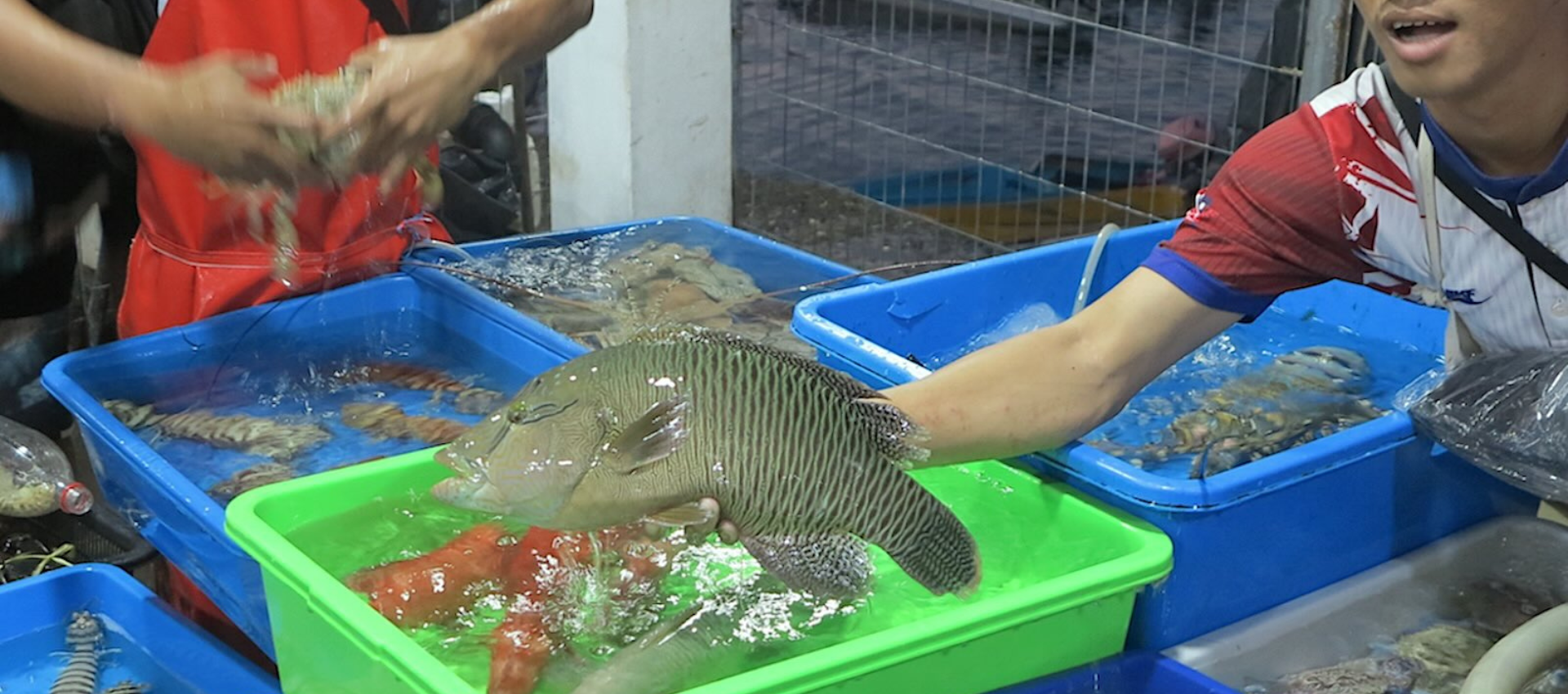
“SIS! BERAPA?,” a fish seller shouts out to marine biologist Dr Achier Chung. “Sister! How much are you offering?” He lifts a fish to the water surface. In his palm, the fish flaps its pectoral fin.
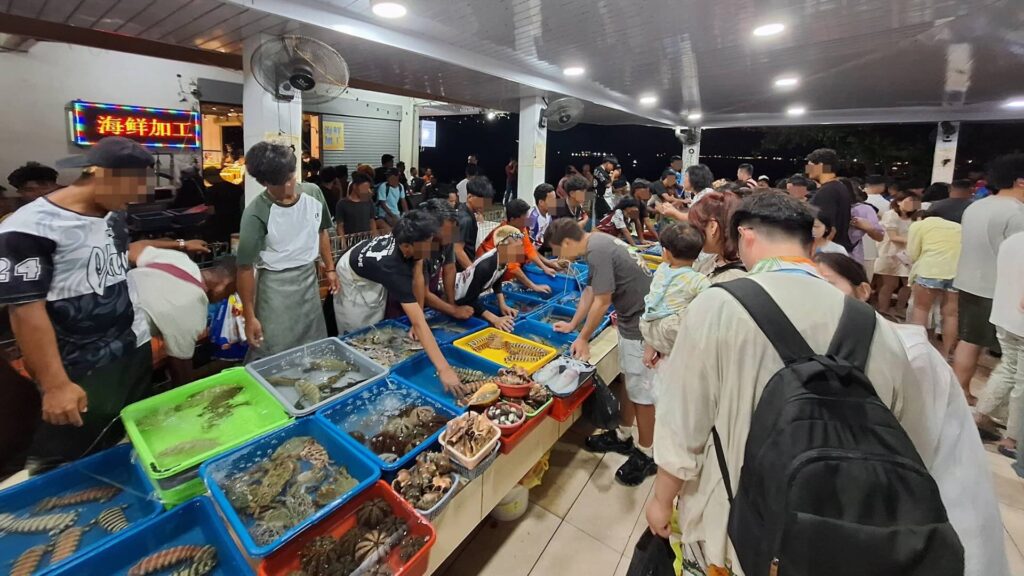
Chung is at Semporna’s live seafood market, where most seafood is sold live, without price tags or weighing scales. Instead, sellers and buyers – largely tourists – negotiate through loud bargaining, hand gestures, and phone calculators.
Chung is a marine biologist at the Institut Marin Borneo (IMB), Universiti Malaysia Sabah. She discovered this live seafood market in Semporna two years ago. She also discovered that the market had become a quintessential Semporna tourist attraction for Chinese tourists.
However, she is concerned about the number of threatened species being sold.
Overexploitation for trade led to its listing as endangered on the IUCN Red List of Threatened Species as far back as 2004. Its sale has been banned in China since 2021.
But it is available in Semporna, and Chinese tourists have taken note of this with the help of social media, much to Chung’s alarm.
On the Chinese social media platform Xiaohongshu, a post shows a man and a woman each holding a Humphead Wrasse in front of the Semporna market. The caption reads, “牢底坐穿鱼” — “the fish that can get you jailed”. The post was referencing China’s strict wildlife law.
A 2022 research paper, whose lead author is on the IUCN Red List Committee, found that in China, Humpheads were no longer sold openly online and in restaurants after the 2021 ban. But it added that “personal messages and videos of humphead wrasse in seafood restaurants” were still found on social media platforms such as WeChat and Baidu.
Still, even before the ban, Chinese seafood lovers were already buying and consuming this delicacy in a tiny Sabah town: Semporna.
Tropical Paradise
Semporna is a jump-off to beautiful islands that offer turquoise waters, white sandy beaches and exceptional dive sites teeming with underwater wonders. In 2024, Chinese tourists topped the number of Sabah’s foreign visitors at 453,600 arrivals; Semporna tour operators told Macaranga they make up 90% of tourists there.
Indeed, Chinese social media posts declare, “It’s like I’m still within China.” The crystal-clear waters are dubbed the “jelly sea” (“果冻海”), and the large swirling schools of fish at the world-famous Sipadan dive destination are known as barracuda storms (“海狼风暴”) and jackfish storms (“杰克鱼风暴”).
Reports are increasing on the tourism pressure put on the small town. Seafood consumption is the one that marine biologist Chung is focussing on.
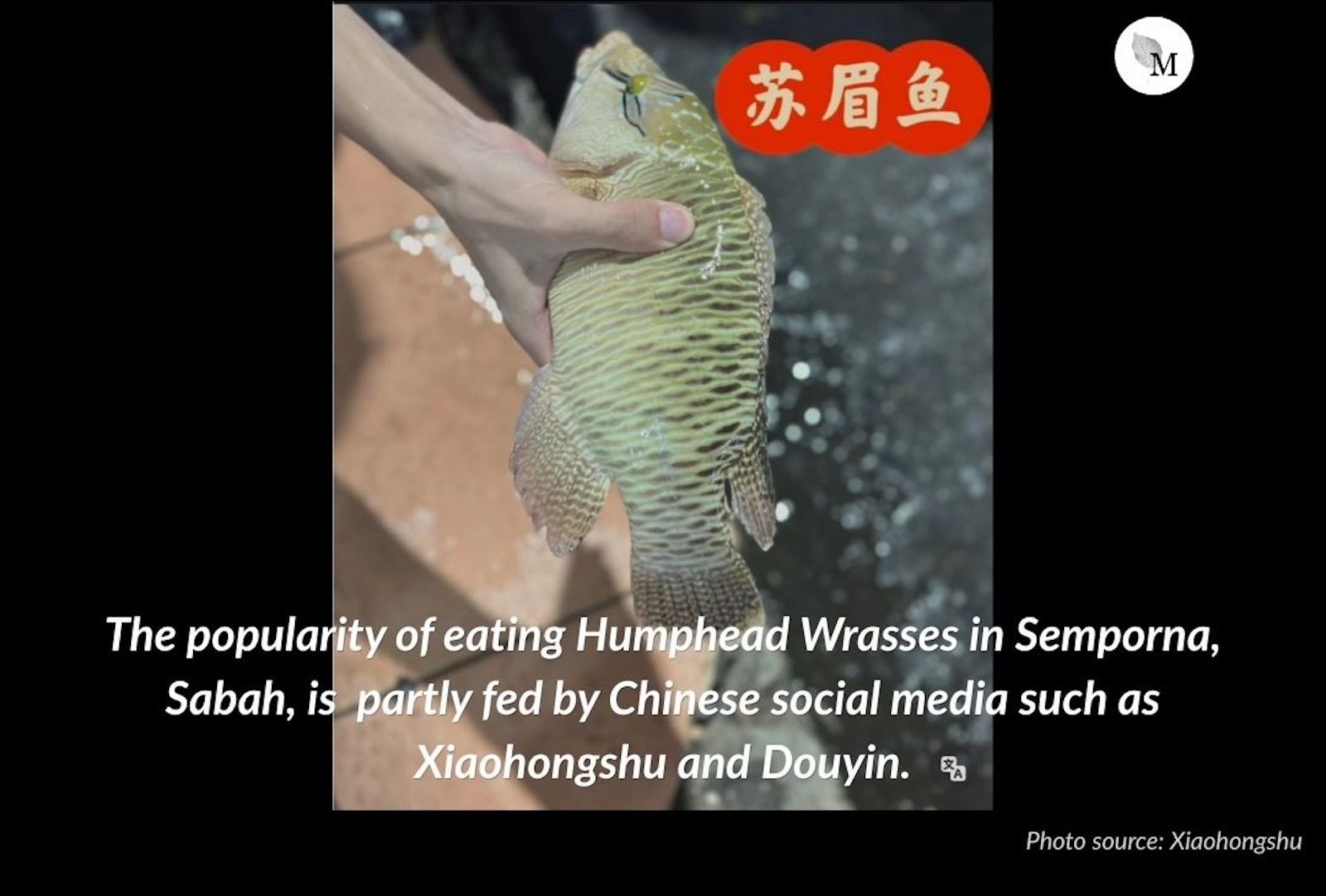
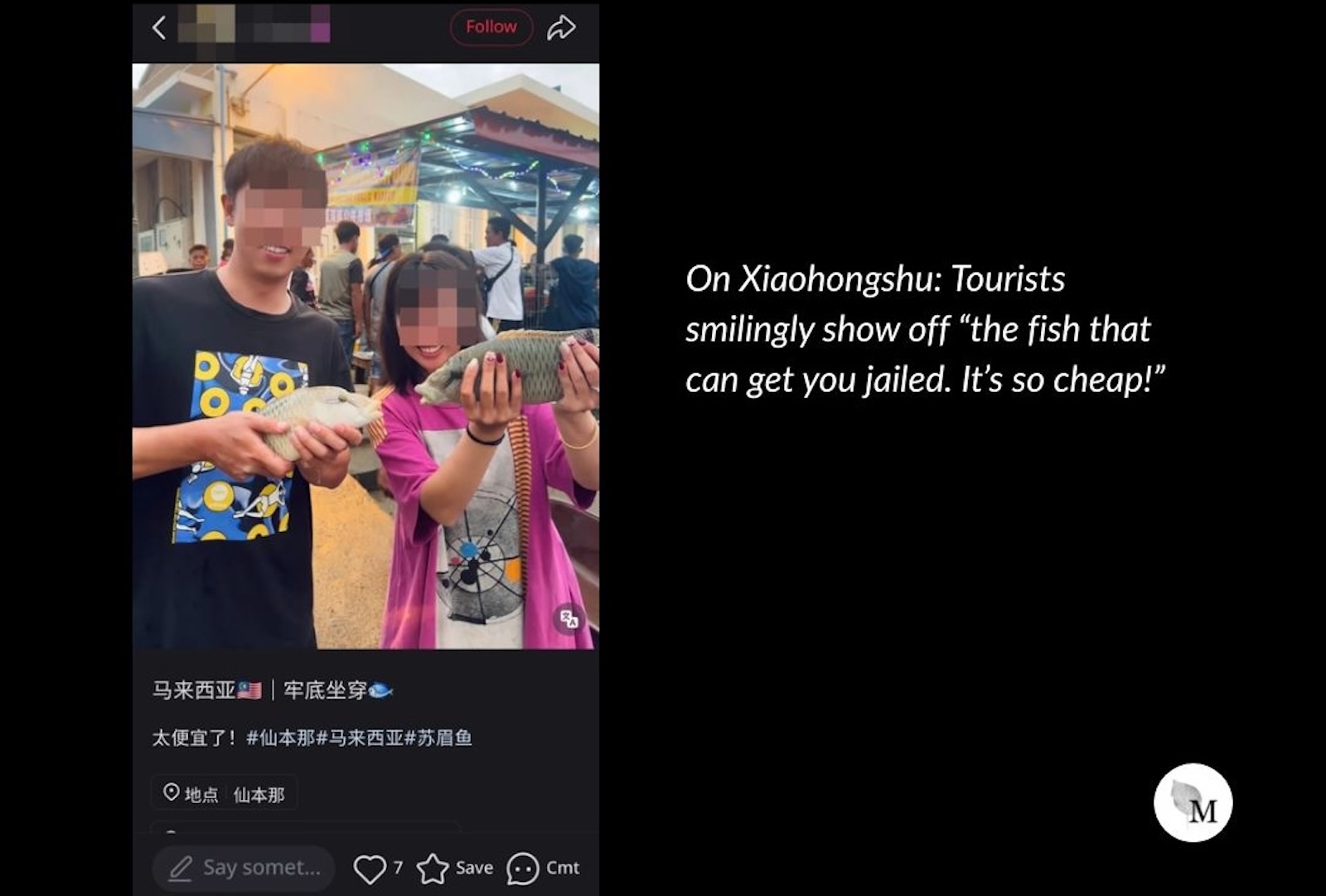
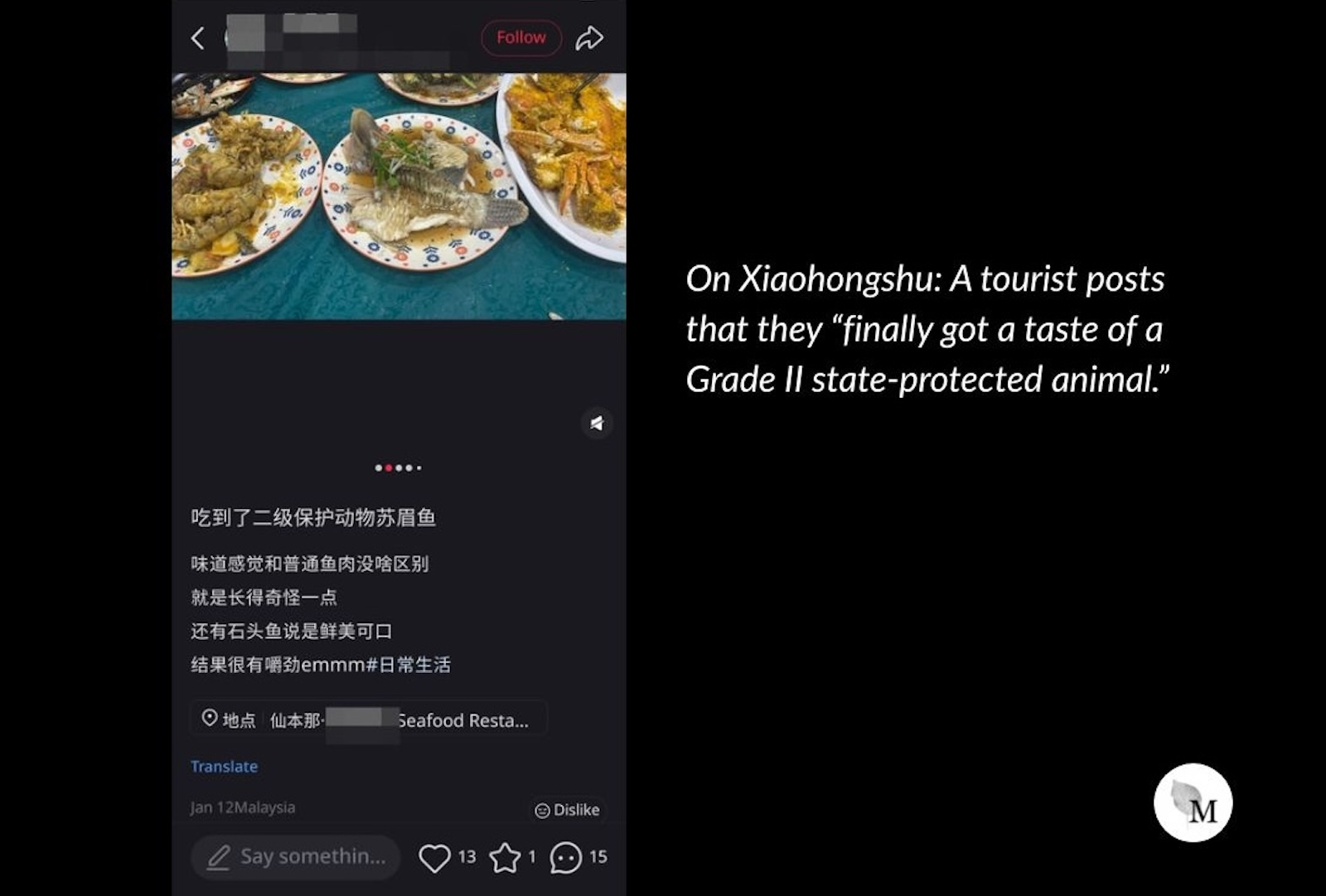
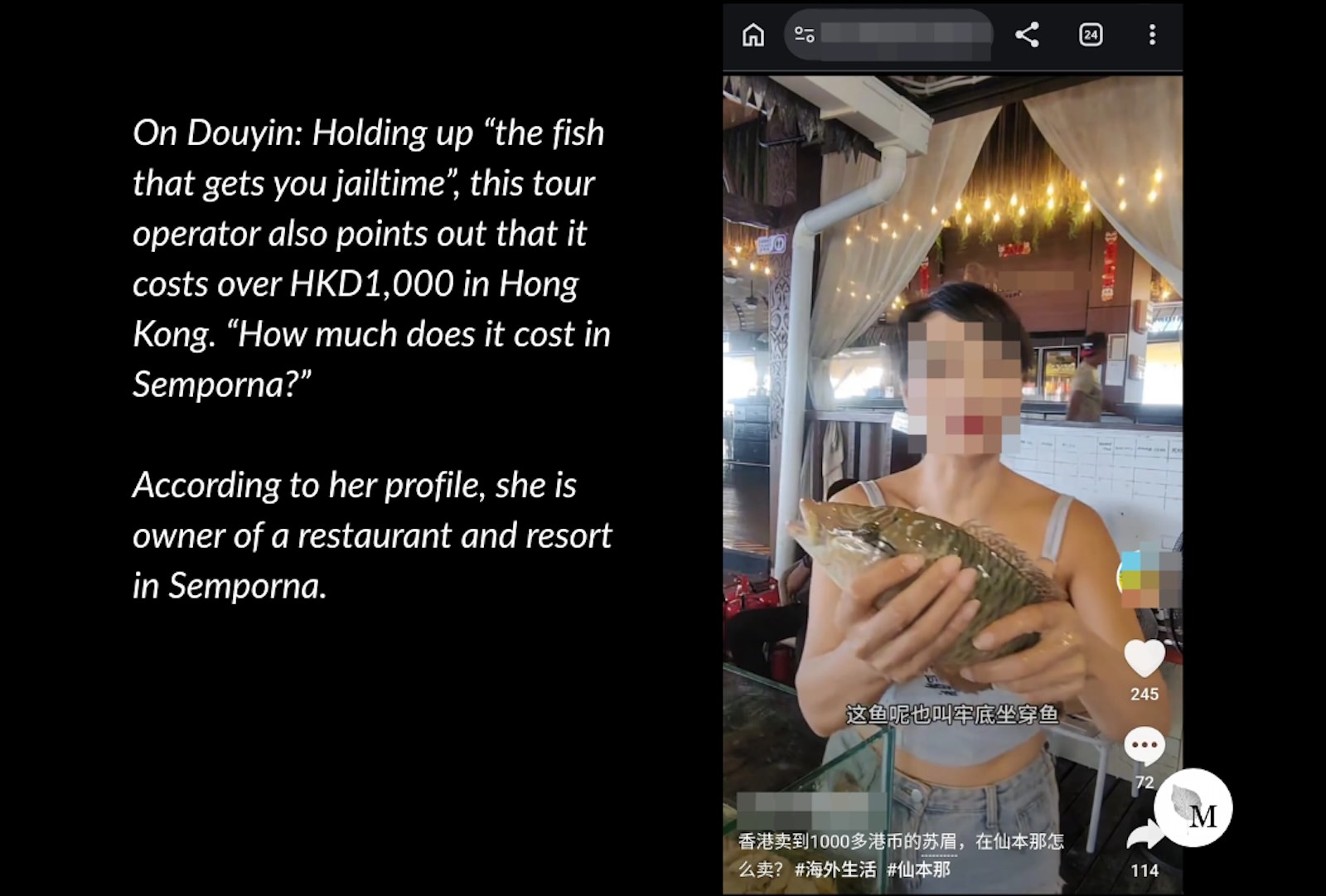
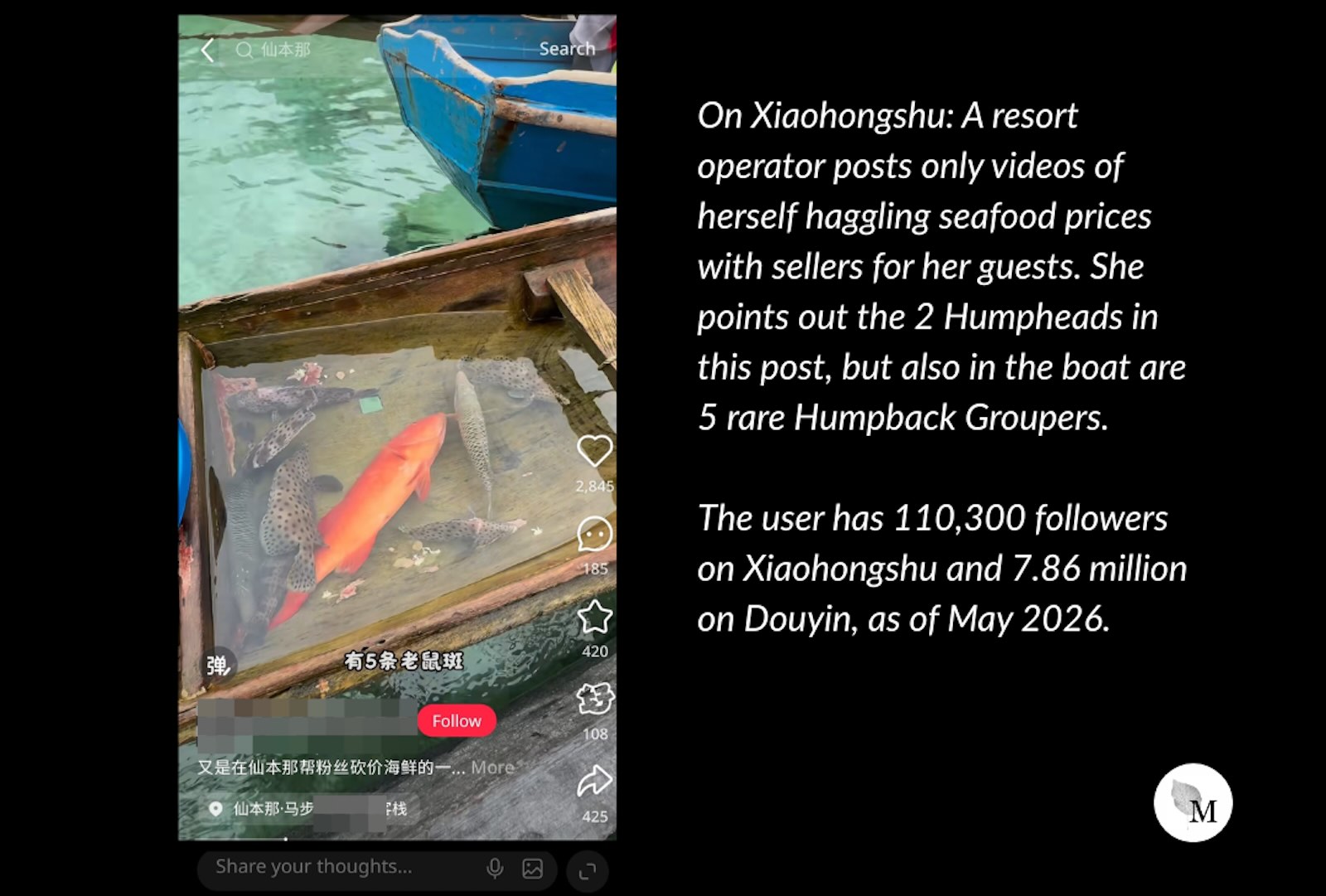
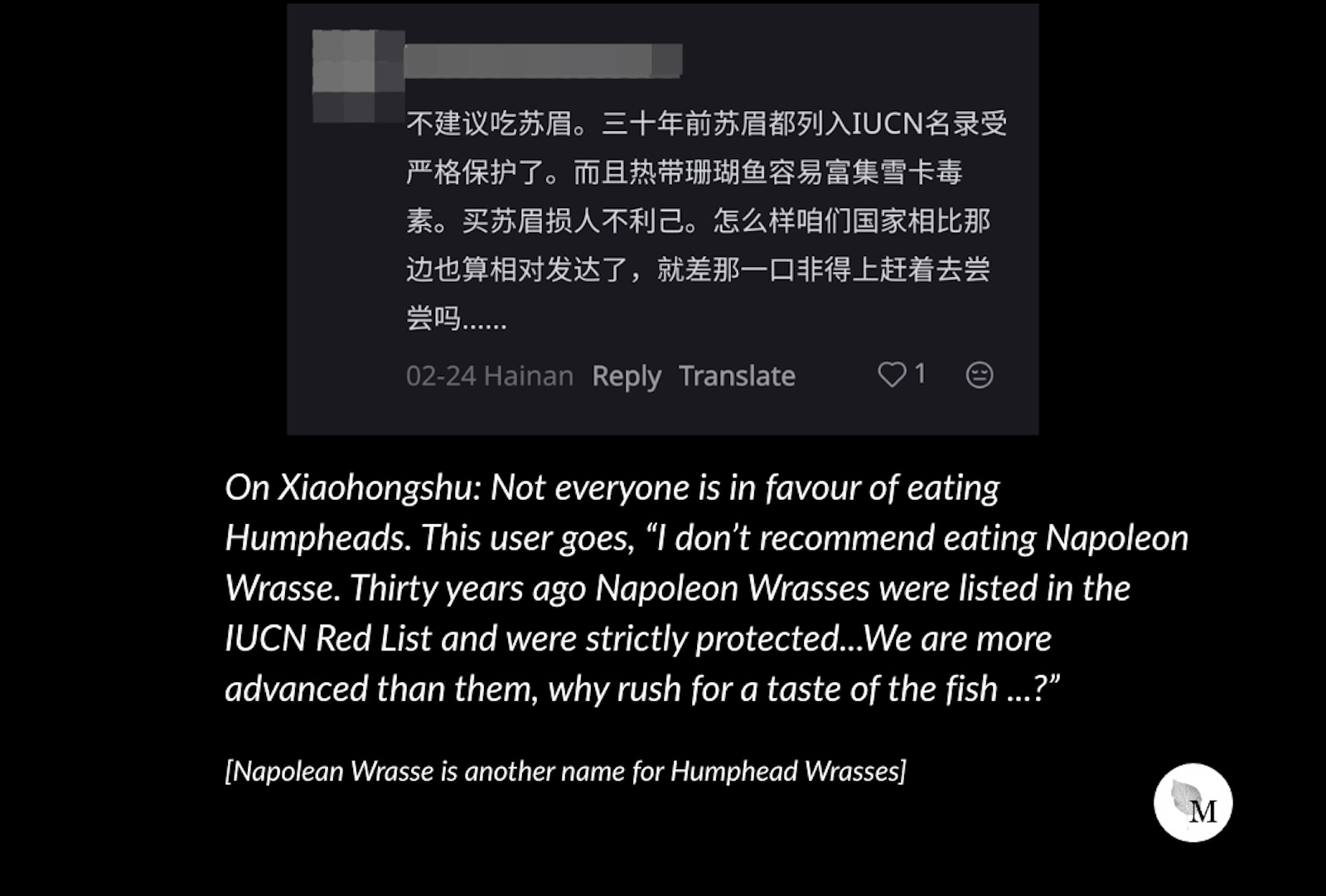
On Xiaohongshu, one user posted that he travels to Semporna mainly to eat Humpheads. Another wrote, “In Semporna, I bought a Humphead that I don’t dare eat in China, for 55 ringgit.” These social media posts highlight the contrast: Grade II protection in China, but freely sold in Semporna.
Malaysia does not regulate the domestic trade in Humphead Wrasses. Catching, selling and eating this endangered fish is legal. It is also affordable. In Hong Kong, where it is also legal with valid permits, the price is sky-high. Seven years ago in 2019, a fish was reportedly sold for USD 850 per kg (RM 3,500).
In contrast, Xiaohongshu posts about Semporna trips often include the hashtag “实现海鲜自由” (“seafood freedom achieved”). This is a colloquial expression which translates to being able to eat luxury seafood without worrying about the cost.
Getting a Deal
Bargaining is part of the attraction. Many posts also share users’ bargaining wins, complete with bargaining tips and price guides. This extends beyond Humpheads to various groupers and lobsters.
Ken Lim, who runs a restaurant in Semporna said most tourists eat the Humpheads because of its fame, not because they truly enjoy it. “Many people want to try it because it’s expensive, and it’s banned in China.”
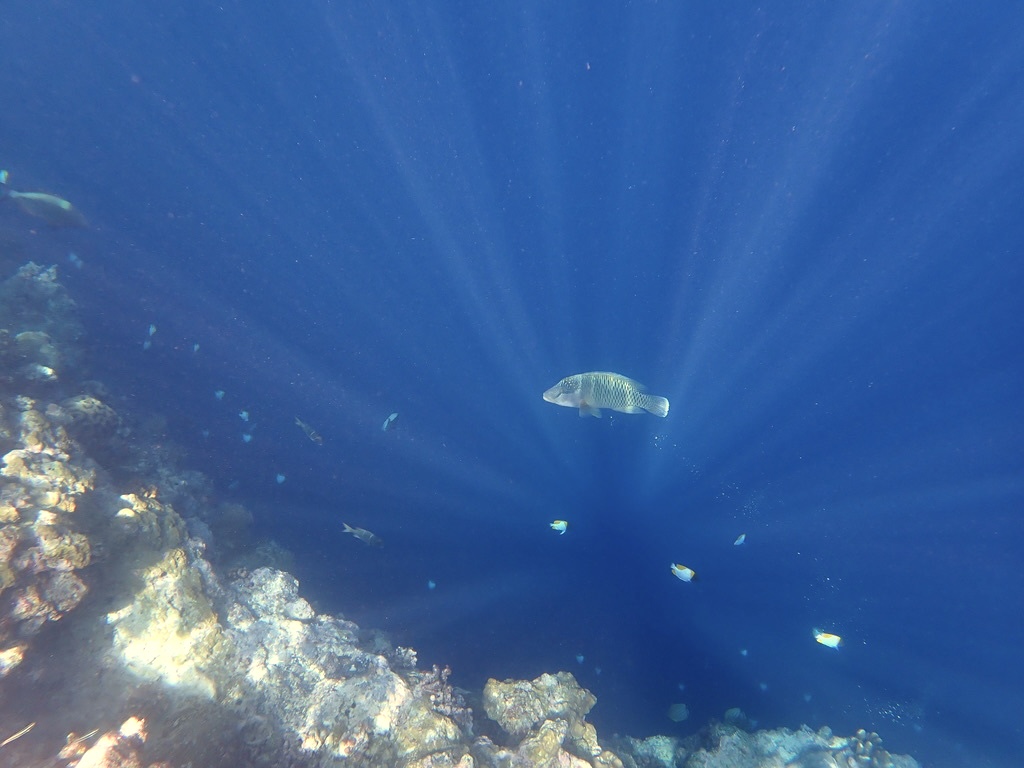
Where Are the Wild Fish?
While Humpheads are common on land in restaurant dishes, the reality underwater is different.
“I was shocked,” said Chung as she recalled her first visit to the market. “As a diver – and I’ve been diving here for a long time – some of the fish, you seldom see. Mameng are found mostly in marine parks, not in fishing areas. So, if this [many fish] are taken, where are they getting the fish from?”
On Pulau Larapan, a 20-minute boat ride from Semporna town, sun-browned fisher Jakarluah Hamad told Macaranga that he used to catch mameng in the surrounding reefs.
“They were easily found back in the day, but seldom nowadays.” But he said he can still see them around at certain times, for example, when the sea is calm, though they are small, only weighing 100 – 200 grams.
Low Numbers
Pulau Larapan is among the five areas in Sabah where Humphead Wrasses were recorded last year by NGO Reef Check Malaysia (RCM). It recorded an abundance of 0.05 fish per 500 sqm. That is equivalent to one fish in a reef area the size of eight Olympic-sized swimming pools. This is on the lower end of typical numbers, according to IUCN.
The most Humpheads were recorded around Pulau Sipadan: basically, one fish in an area slightly smaller than an Olympic swimming pool. Sipadan is a protected area and commercial fishing is not allowed.
Still, other fishers told Macaranga that mameng can be found elsewhere – if you knew where to look. They pointed further east and south of Semporna waters. Some of these sites are within the Tun Sakaran Marine Park, again where commercial fishing is banned.
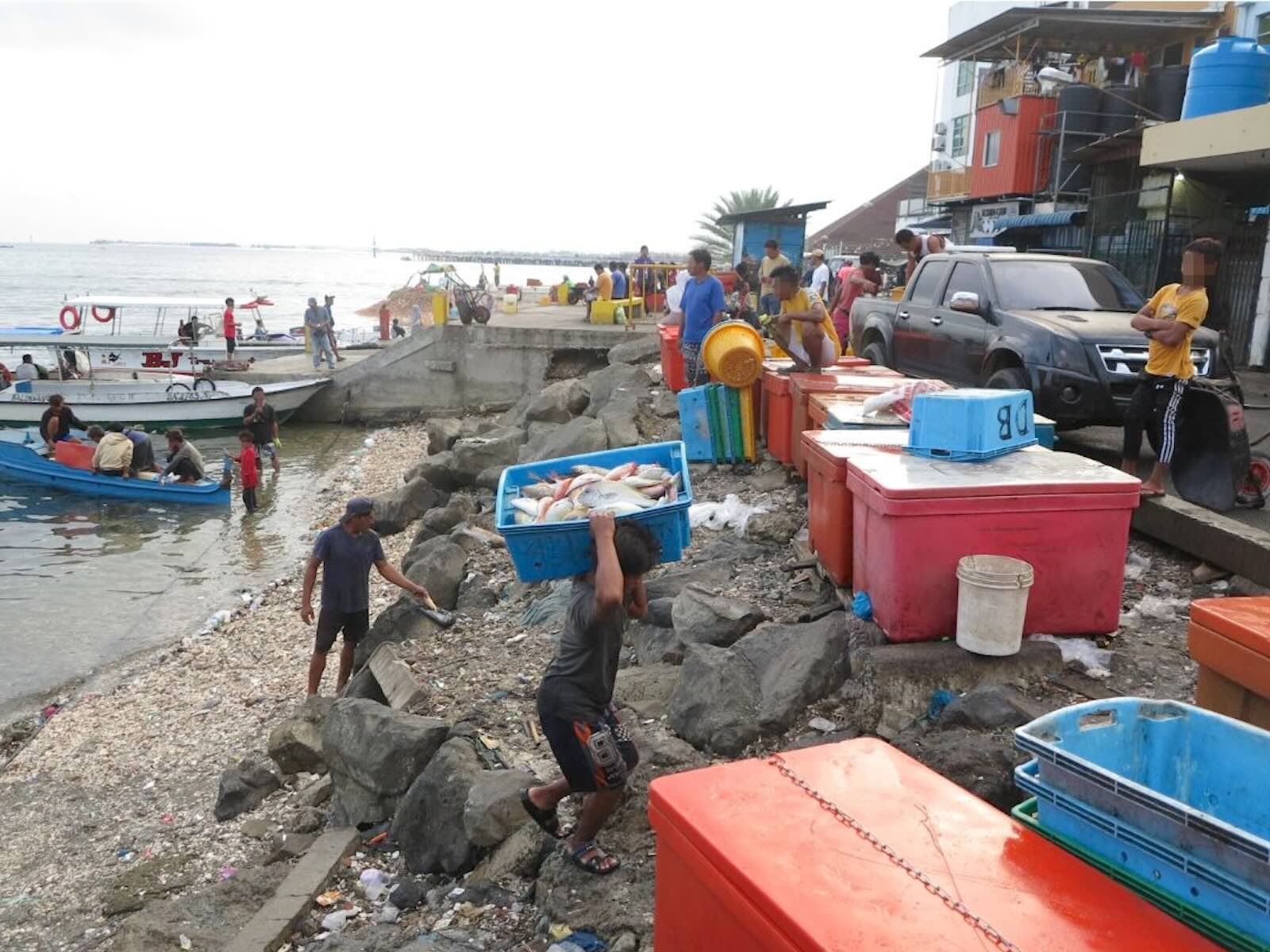
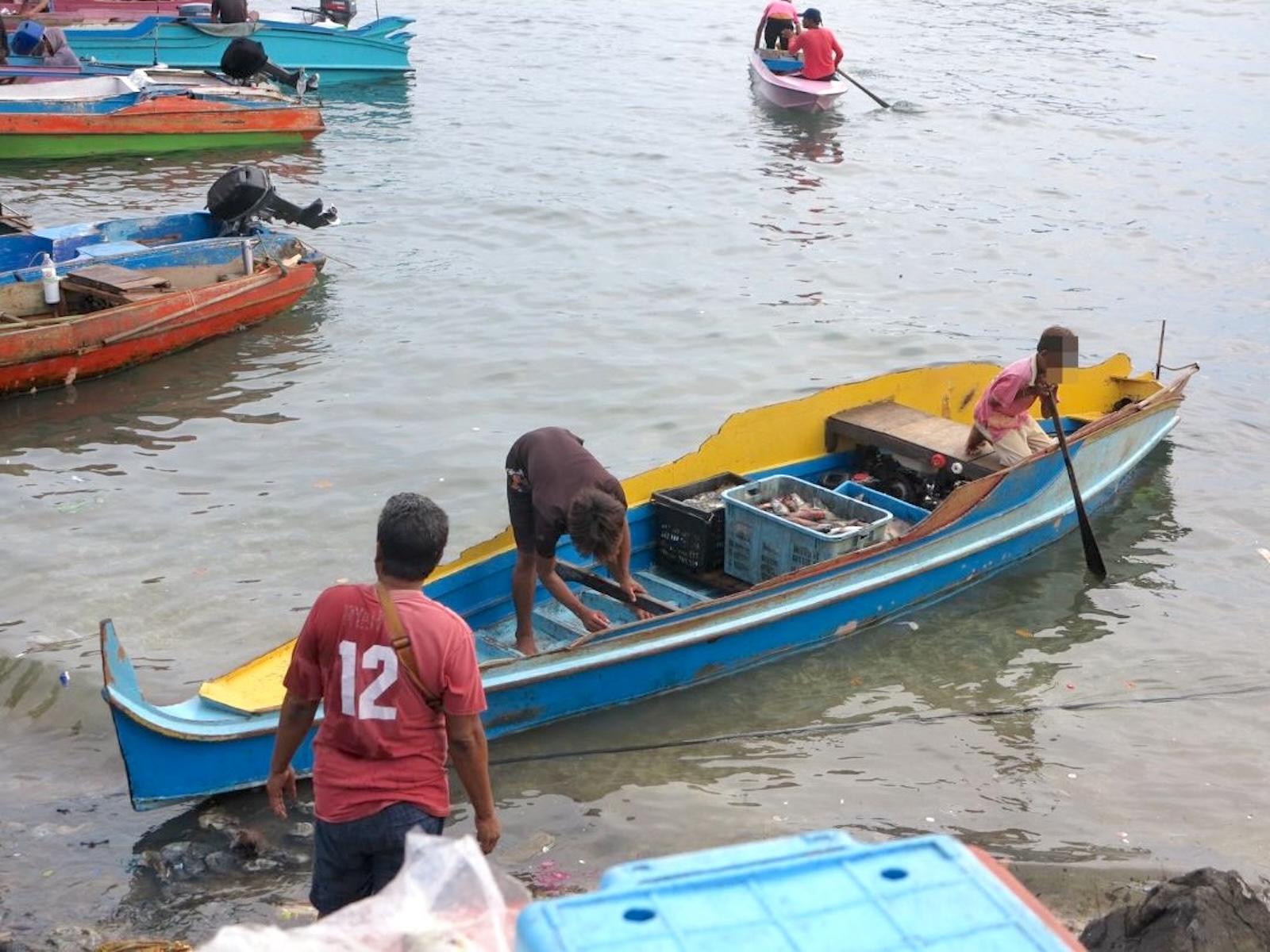
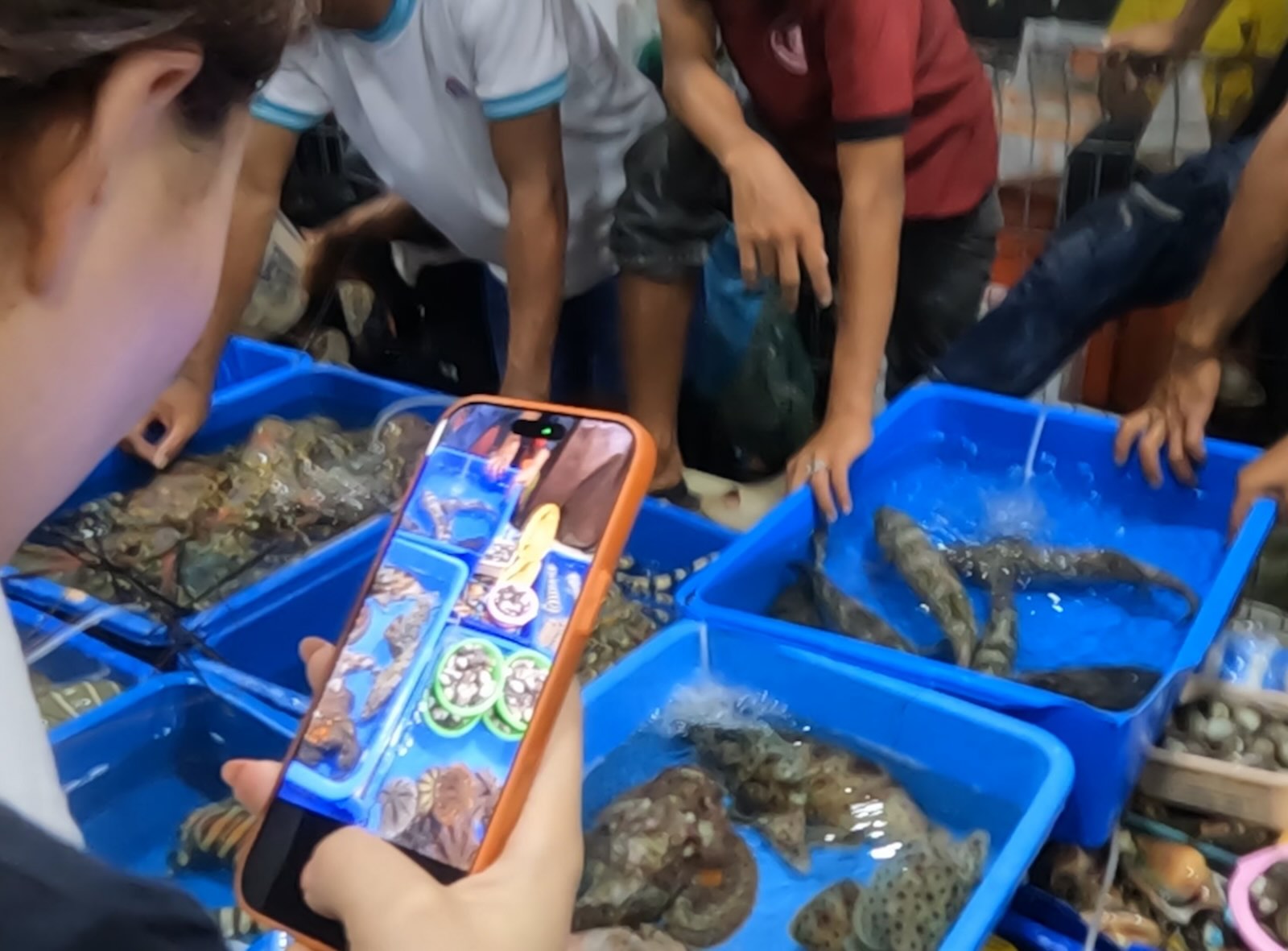
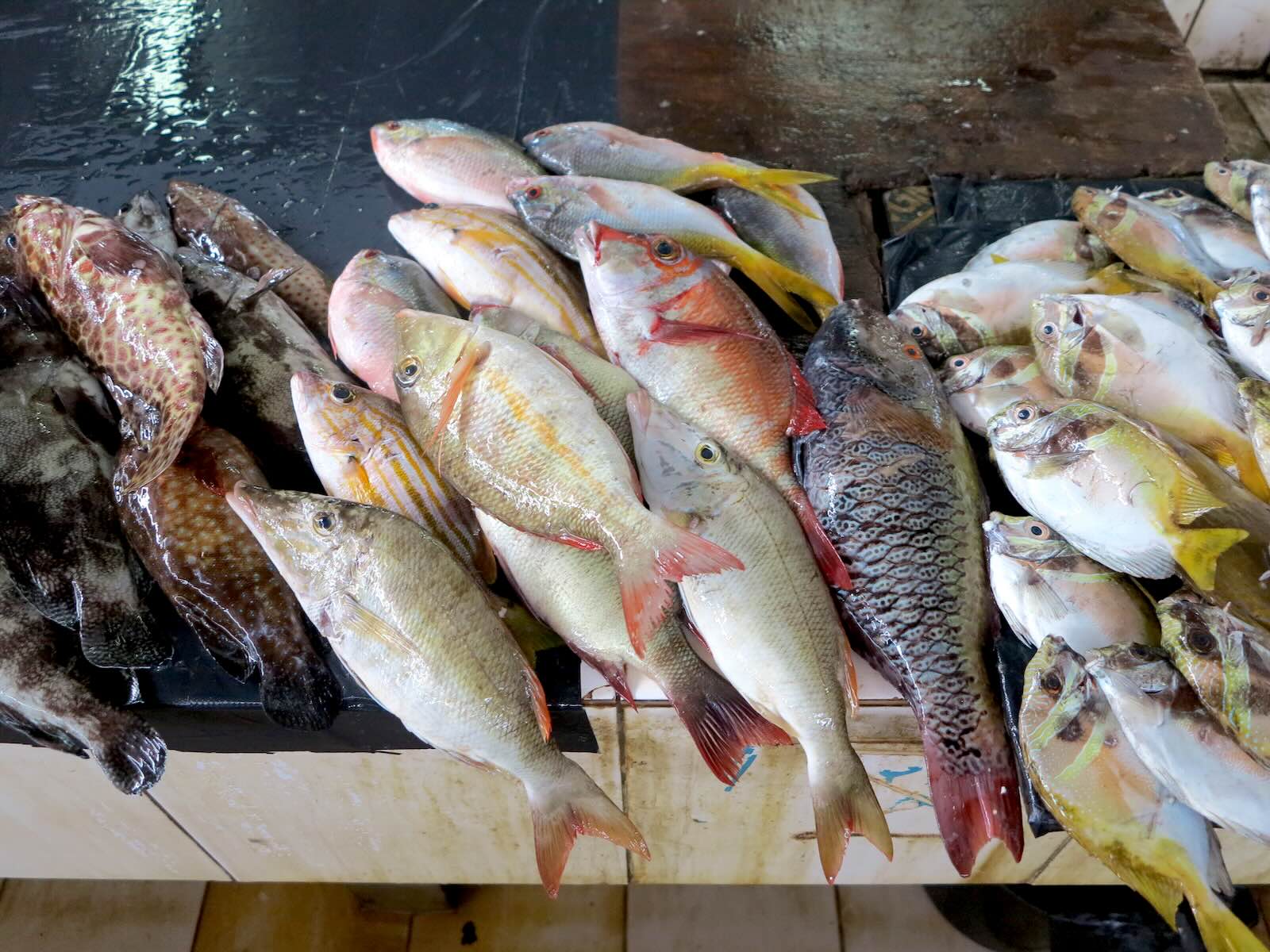
Semporna is home to multiple fishing villages, and fishing is both for subsistence and livelihoods, but is tourism leading to unsustainable extraction of endangered species? Photos: Lee Kwai Han/Macaranga
Chung knew that Sabah’s Humphead Wrasse population had never been scientifically researched. Her personal experience showed that it was difficult to detect live fish in Sabah’s waters. So, she decided that instead of studying the reefs, she would study the fish market.
Last year, she sent her research assistant 24 times to that market. The assistant recorded more than 400 Humpheads. That averages to more than 16 fishes per visit.
Chung was puzzled. Where were all these fishes coming from? Could it be the neighbouring Philippines? After all, Sabah and the Philippines share the Sulu Sea and Sulawesi Sea fishing grounds. And Semporna is only about two hours by boat from the nearest Filipino island.
Protected in the Philippines
But the Humphead Wrasse is legally protected in the Philippines. Catching, selling and possessing it are not allowed.
In 2017, the Philippine government published a national action plan to conserve the Humphead Wrasse. The plan reported that fish in grow-out pens in Sibutu and Sitangkai islands were sent to Sandakan and Kudat in Sabah using “native sea crafts”. Sibutu and Sitangkai are only about 90 km from Semporna.
Because Humpheads are listed in CITES Appendix II, international trade requires a CITES permit. But the CITES trade database shows no Humphead trade between the Philippines and Malaysia. Macaranga could not confirm whether the trade was still happening.
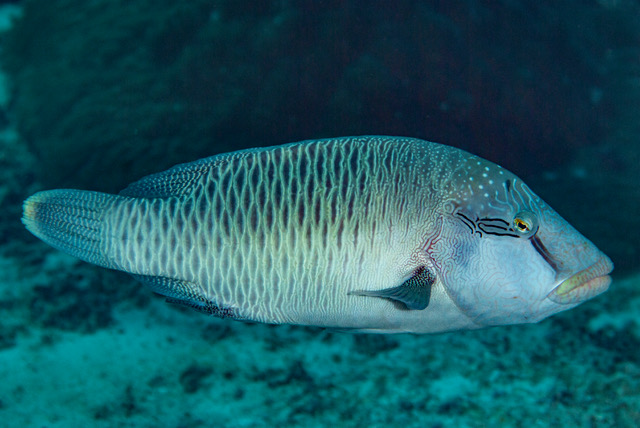
Now that she has data from the market, Chung plans to next do a population study of Humpheads in the wild. She also wants to conduct a cross-border DNA study.
With the DNA study, “then you’ll know, you can confirm the fish, where the fish comes from,” said Chung.” And then you have an IC (identity card) or like a marker. You’d know that: Oh, the Philippines’ one is AABB, let’s say; the Malaysia one is CCDD…”
This is important for enforcement, she added. She pointed to a genetics population study being done for Sabah’s turtles.“
“So they know that the turtle in Sipadan is like this. The one in [the] Sulu Sea is like that. The one in KK (Kota Kinabalu) is like this. So, one day, for example, when people catch the sea turtle, illegal trade. They get the sample. They do a genetic analysis and they know where that turtle comes from. Here (Kota Kinabalu)? Semporna? Or Sulu Sea?”
Dr Achier Chung, Marine Biologist
Genetic tracing tools are increasingly used to combat wildlife trafficking of various species.
Legal Backing
Chung also hopes the government will soon pass a law to legally protect the Humphead in Malaysia. Back in 2019, the state considered a state fisheries law to protect this wrasse and other Sabah fish.
Deputy director of Department of Fisheries Sabah, Lawrence Kissol Jr. told Macaranga that the department is “open to the idea of mameng to be listed” in the endangered species list in the Fisheries Act 1985. This means that the Humphead may not be fished, bought or exported.
But he added that “we need to have a valid reason to do that, backed by scientific evidence,” specifying the need for population studies.
The reason for caution is having to balance protecting the fish and its role as food source. Mameng “can be considered as part of our food security,” he pointed out. “So, I think the basic principle of managing our aquatic species is it can be exploited in a sustainable manner.”
In other words, “you can makan tapi…boleh makan sikit-sikitlah (you can eat it but…in small amounts),” Kissol said.
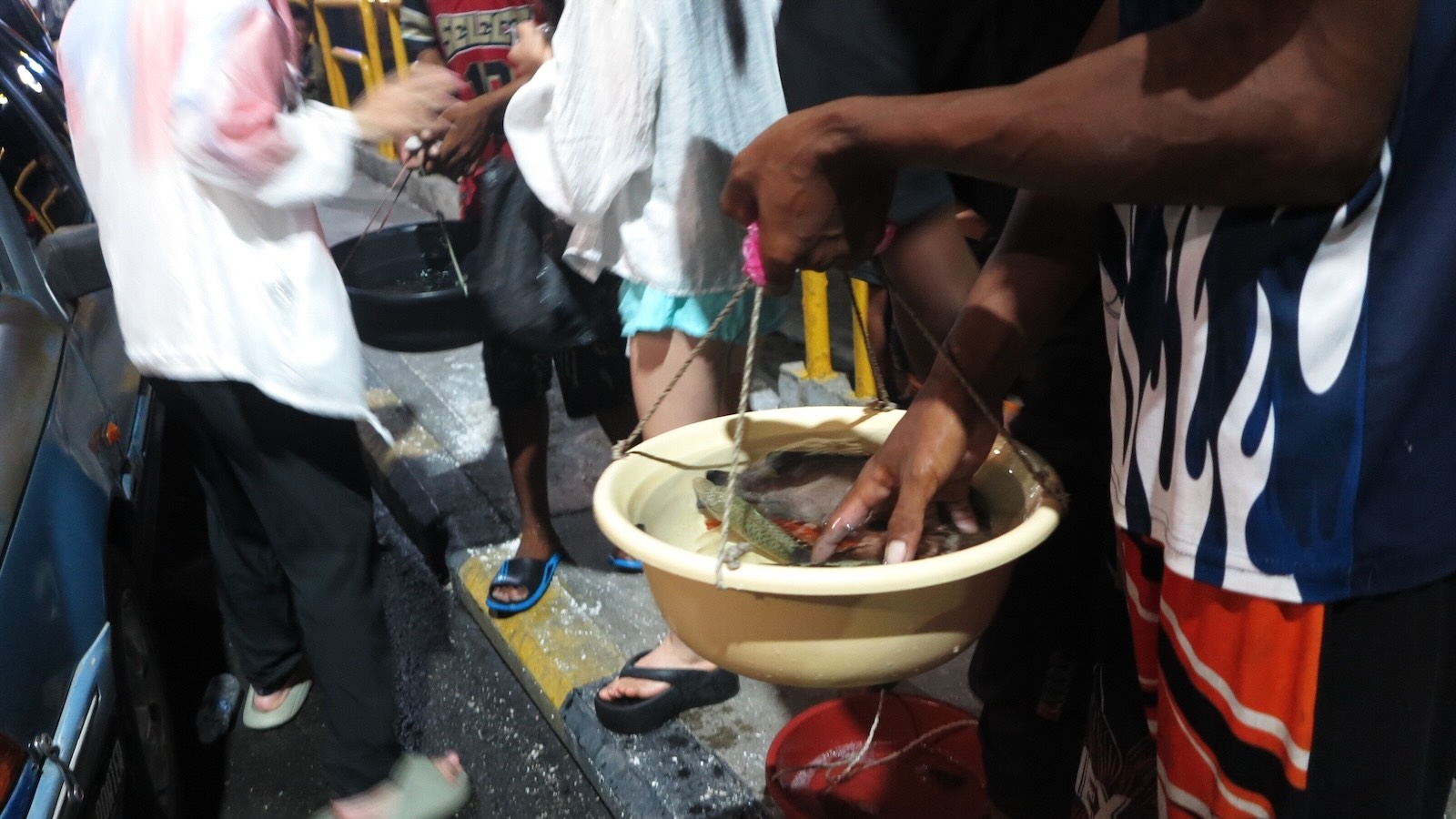
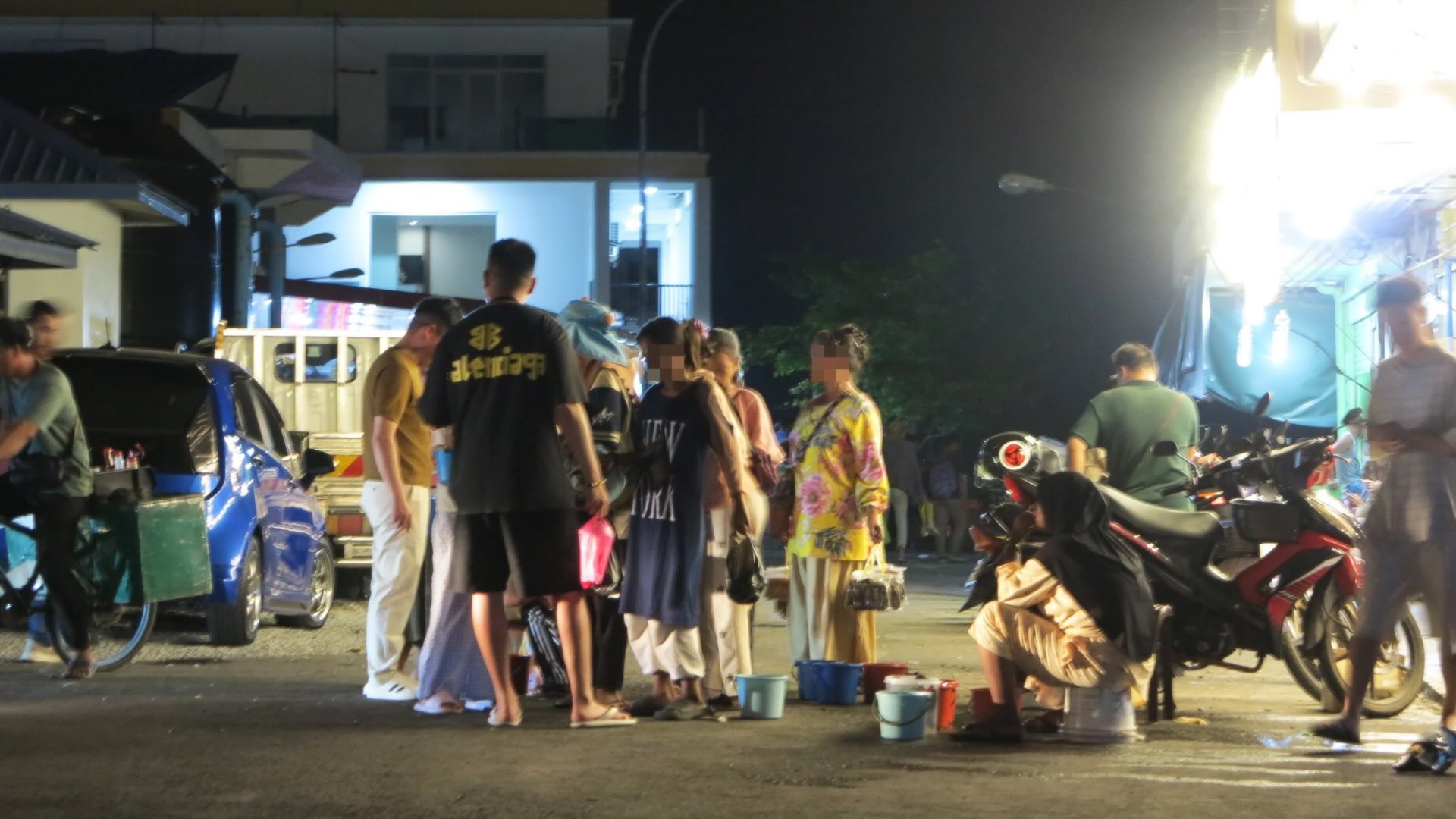
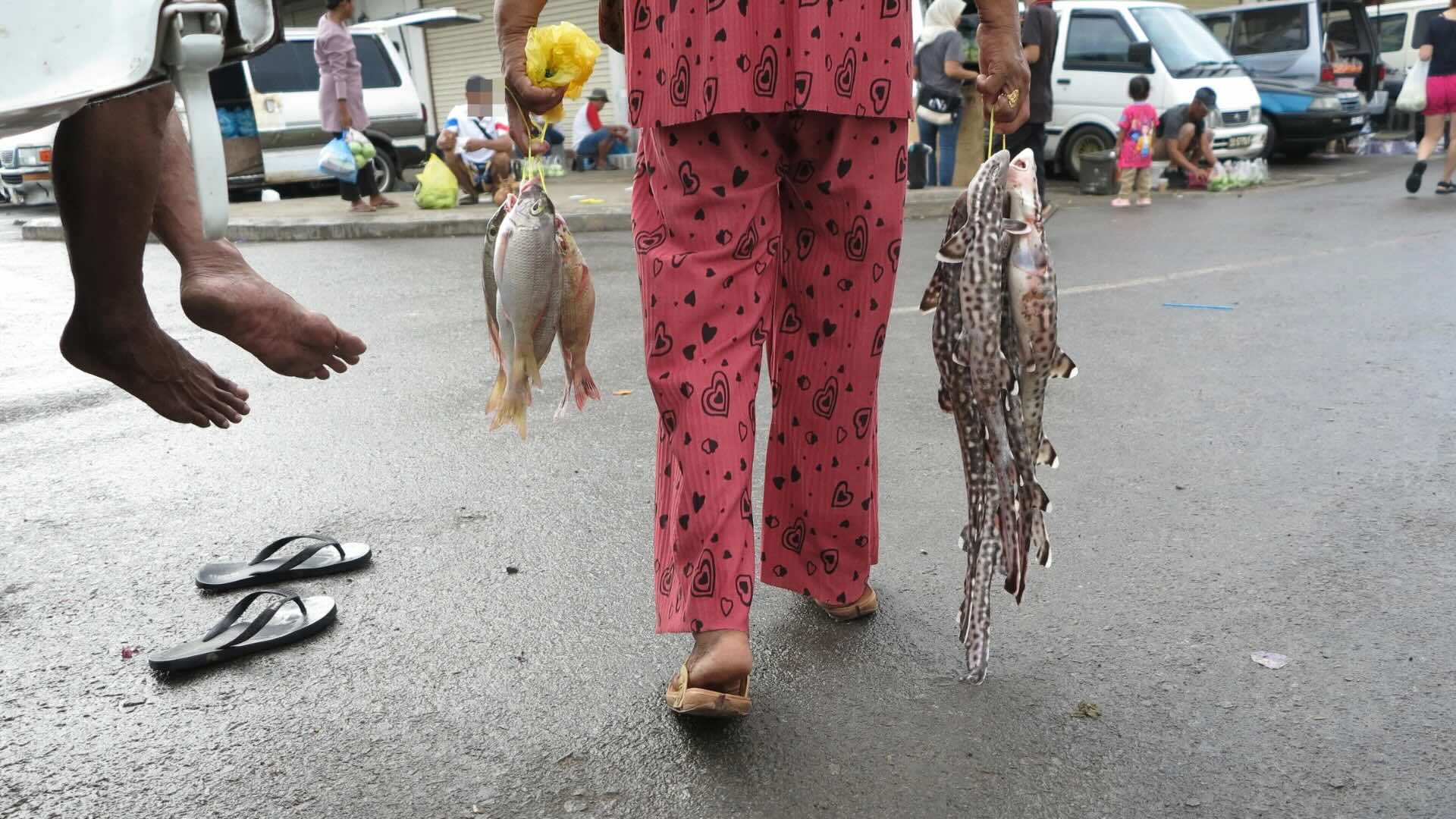
Tourist demand draws itinerant sellers on Semporna streets who badger tourists to buy hot-ticket seafood like Humphead Wrasses; sellers like the one in red also hawk other fish like Coral Catsharks to locals. Photo: Lee Kwai Han/Macaranga
A Threat to Whole Reefs
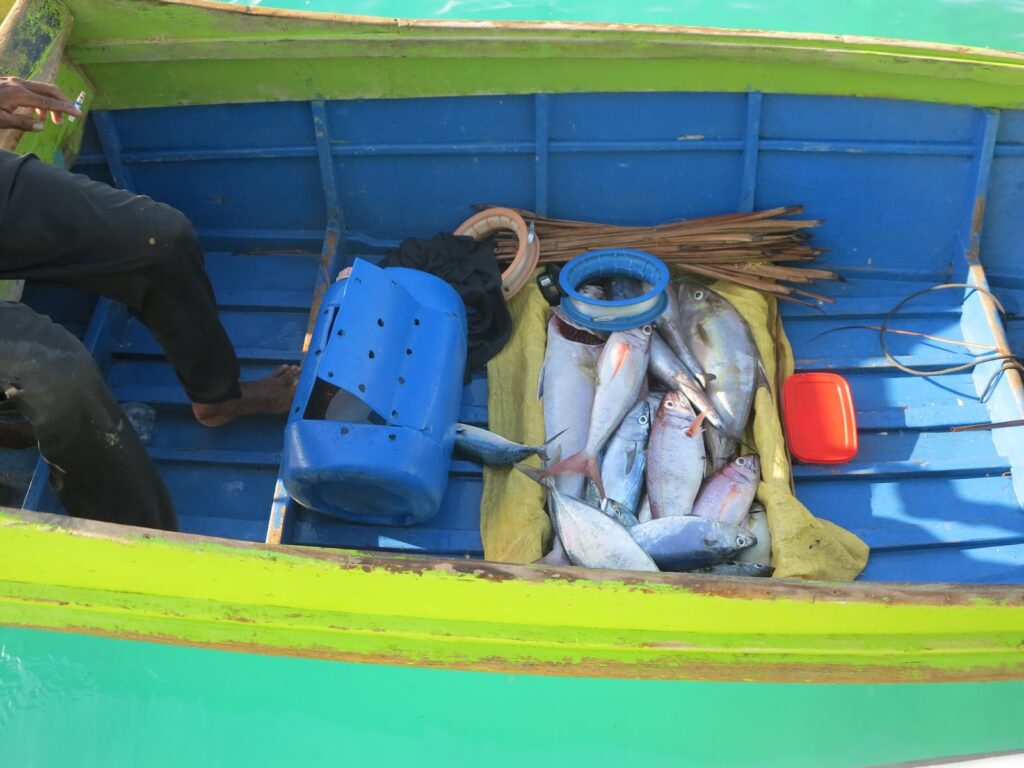
The urgency to protect Humphead Wrasses is not only due to increasing demand, but the way they are caught. Former fisherman Ismail bin Pelmin used to catch mameng to sell. Live, intact fishes fetch the highest price, he explained, between RM150–300 per kg. But if a fish is dead or injured, the price tumbles to RM50 per kg.
Using a hook and line or a fish trap could injure the fish when it thrashes. So, like other fishers, Ismail used poison.
Now a dive centre worker, he said the poison “just knocks out the fish, not kills it. Knock it out, then we bring it back to consciousness in 5 to 10 minutes.” He would collect the stunned fish using a plastic bag rather than a hand net to reduce injuring the fish.
Cyanide Fishing
Fishers told Macaranga they buy the poison – usually sodium cyanide – from fish-holding pens outside Semporna town. They then sell their catch to these fish pen owners.
The local name for the poison is sujum, but the poison is actually so closely associated with Humpheads that it is also called “tambal pehakan”—the Humphead Wrasse drug. In the Bajau language, pehakan is a female Humphead.
Cyanide fishing is illegal in Malaysia because it damages corals by disrupting the algae on which they depend for survival. But it is also used to catch aquarium species.
And enforcing a ban on cyanide fishing is challenging, said RCM’s programme manager Adzmin Fatta.
Unlike the other illegal fishing technique of fish-bombing, “…you can’t hear [it] when people [do] cyanide fishing,” said Adzmin. “Divers can hear fish bombing, local communities can hear fish bombing, so they can report [it to the authorities]. Even on the land you can also hear [it]… But the cyanide fishing mostly is underwater. There’s no sound.”
The Department of Fisheries’ Kissol said fishers use cyanide because it is faster and some of the coastal communities might have been exploited by middlemen to conduct illegal fishing activities.
Higher Awareness
But he added that cyanide fishing is now “under control” and “not as rampant as before (20 to 30 years ago)” because “we also have this awareness programme with all the coastal communities from time to time. And it seems that most of them understand what’s right and what’s wrong.” He clarified that the target group was fishers.
To raise conservation awareness among Semporna communities, RCM has been working with them to restore corals since 2024.
But tourists need educating too, said Adzmin, as tourists do not seem aware that what seafood they eat today affects their future holiday trips. “The next time you come [to dive], and then you complain, ‘Oh, I don’t see them in the underwater anymore compared to 10, 15 years ago when I first dived in Semporna.’”
He urged tourists not to buy cyanide-caught fish. “[If] you don’t have the habitat, you don’t have the fish.”
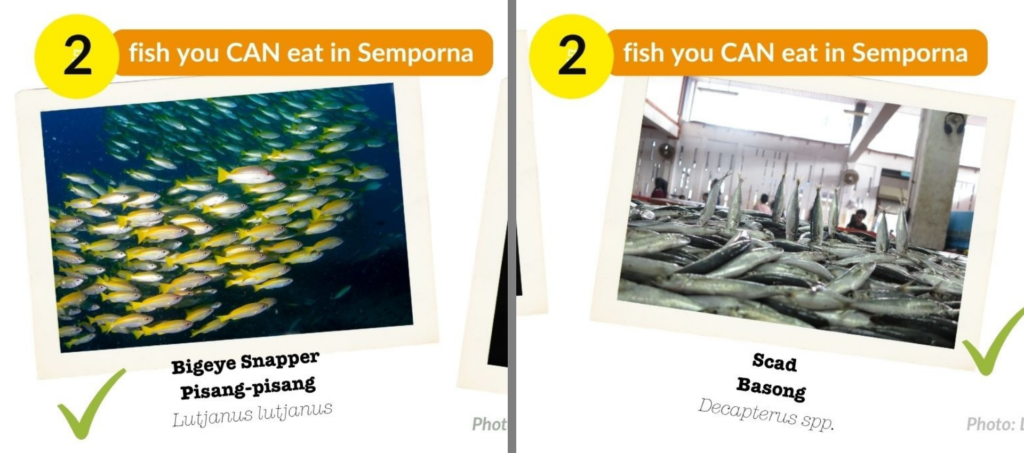
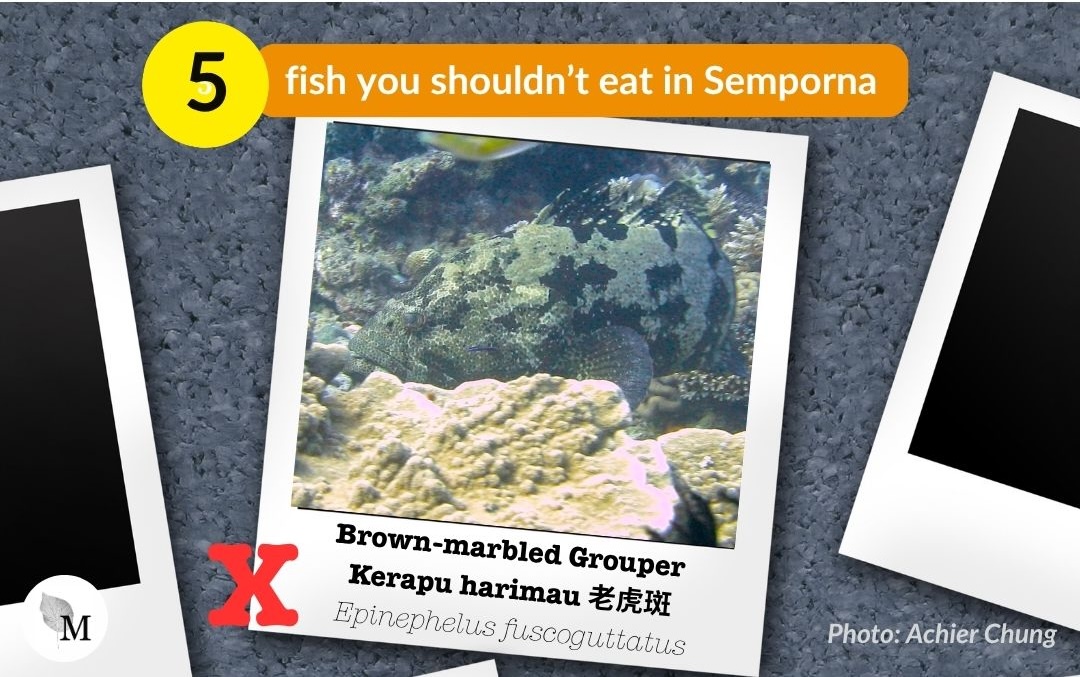
Without hesitation, Dr Achier Chung listed the 5 top fish that should not be eaten for conservation reasons. But when it came to what could be consumed, she says, “It is quite hard for me to tell you what to eat, actually.”The trouble was that tourism was driving harvesting to unsustainable levels, she added.
Then there was the issue of fish-bombing affecting common species such as ikan tauhu (Yellowtail fusilier, Caesio cuning). Fish-bombing destroys reefs and is illegal but is still practised.
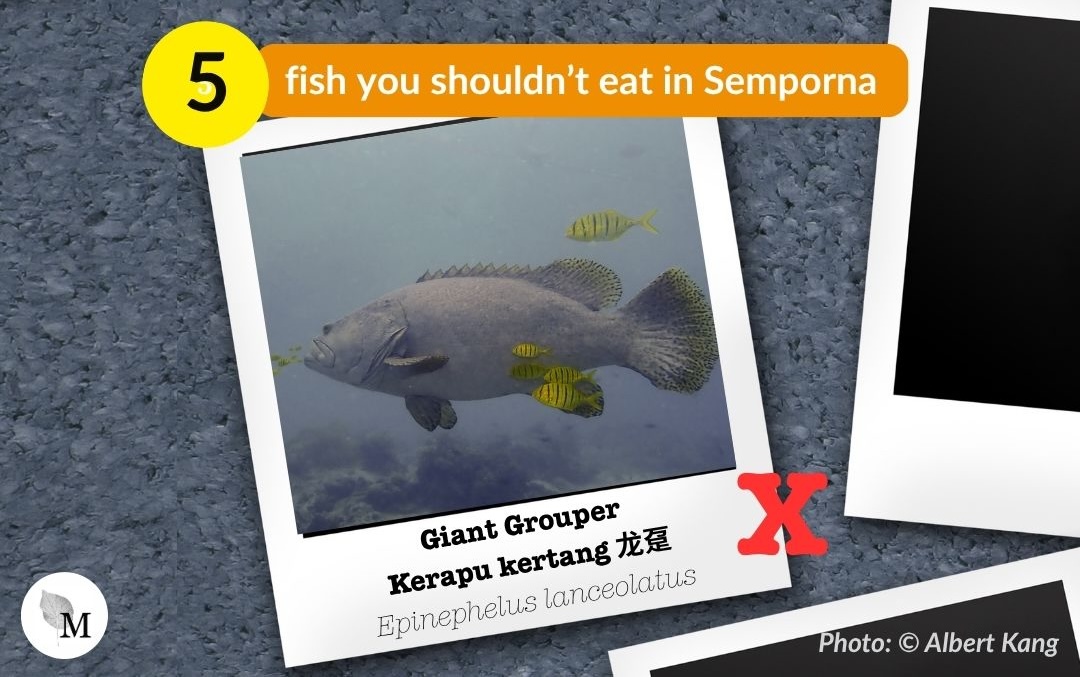
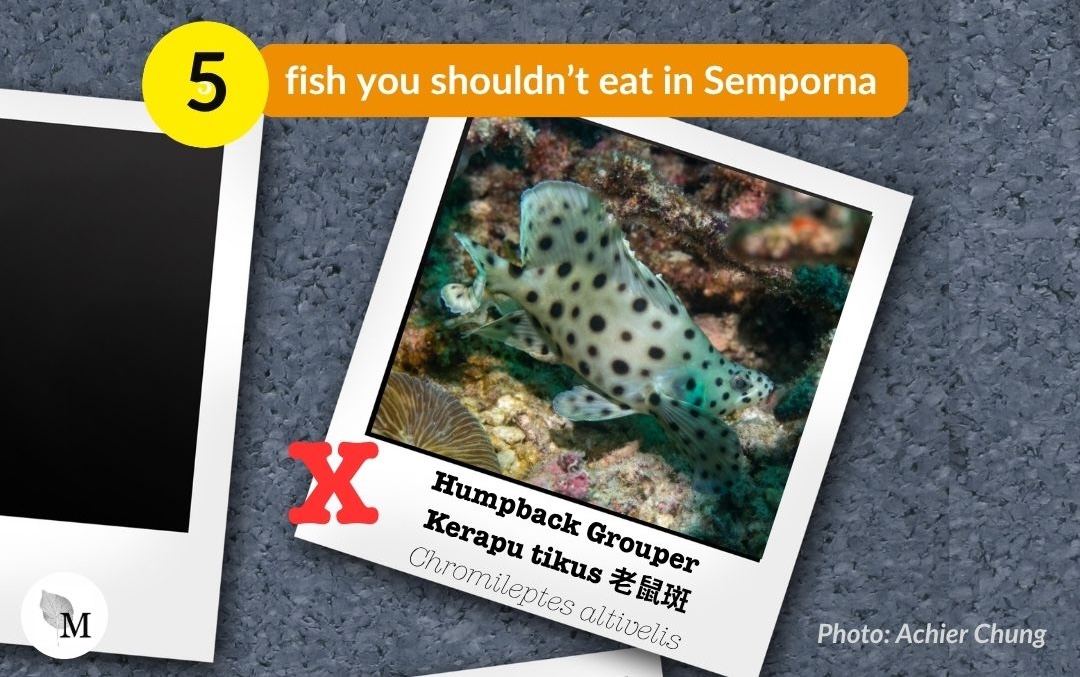
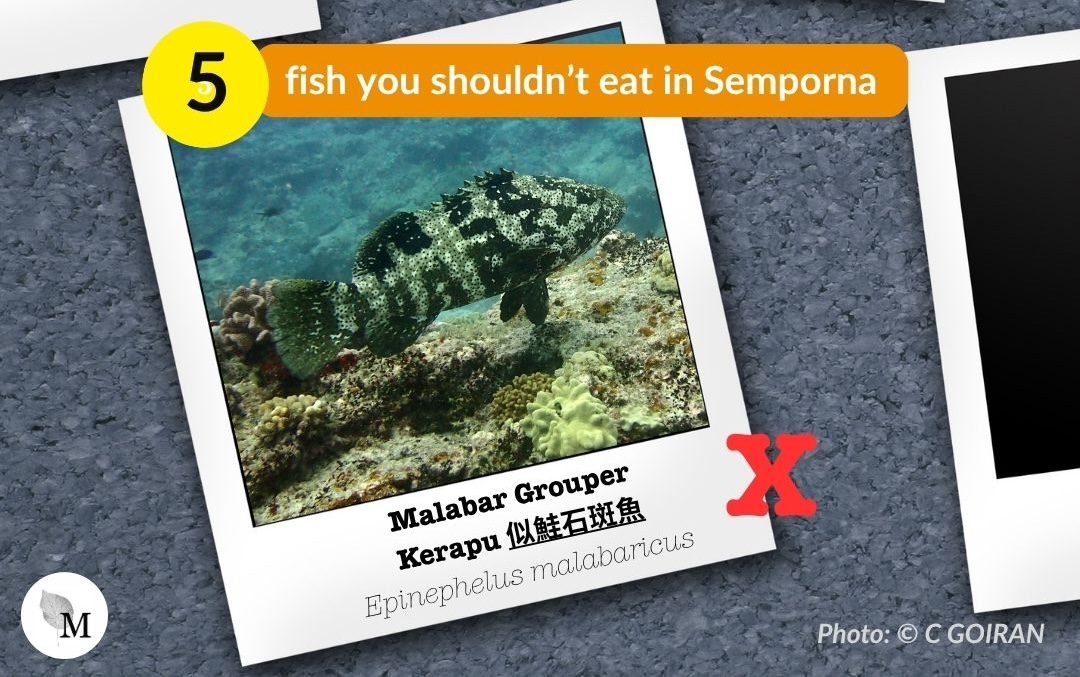
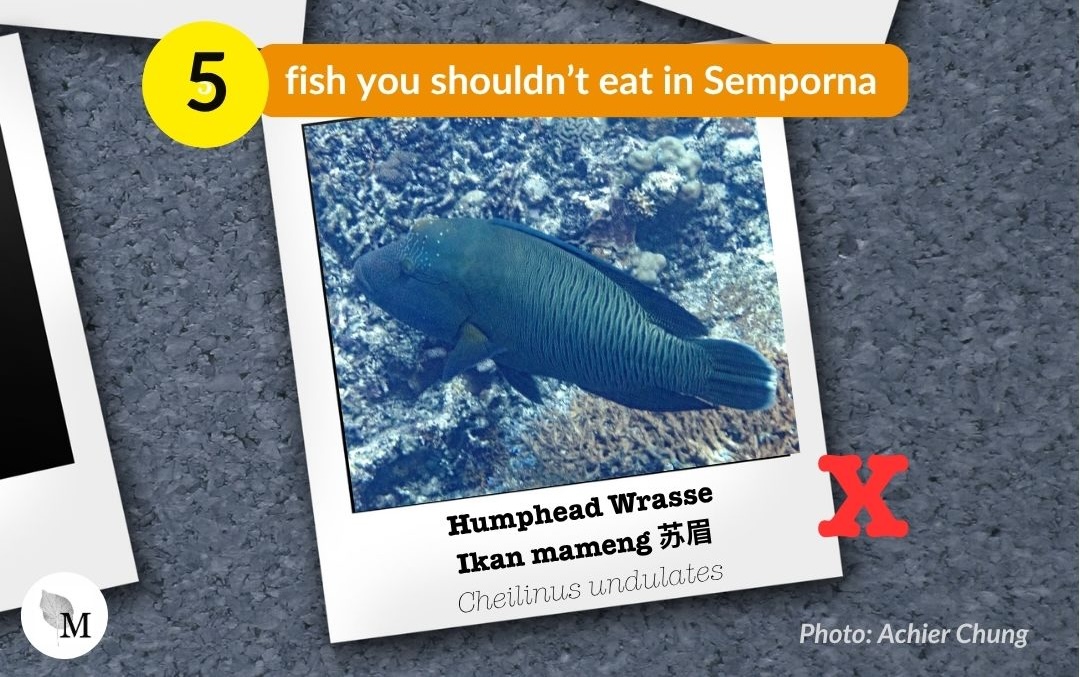
As tourists continue to demand cheap seafood, awareness and protection are urgent because wild Humphead Wrasses are particularly susceptible to extraction. According to IUCN, “Wherever it is fished, even if only moderately, density quickly declines and adults rapidly disappear.”
This was confirmed by Chung’s colleagues at the IMB who studied the fish size-to-maturity relationship of the Humpheads in Semporna. They found most of the fishes were only 3–5 years old, as they only weighed about 1 kg and were 20–30 cm long.“At that size, it is just starting to mature,” said Dr Faihana Ching Fui Fui, dean of the institute. “But unfortunately, the size that people usually eat is that particular size.”
She urged authorities and fishers to “let the fish spawn first, release all the eggs first, and then [when] .. the maturation is already passed… we can actually source them for more responsible consumption.”
The Buying Continues
Back at the live seafood market, Chung told the fish seller the Humphead in his hand was too small and walked away. The seller slid the wrasse back into the tray and continued shouting to catch the attention of the next buyer.
As the sun began to set, more Chinese tourists started streaming in. They scanned the trays, ready to bargain, with hands ready to gesture and phones on standby to record. All for cheap live seafood and a forbidden fish that Semporna is offering.
To report this story, Kwai Han first learnt how to identify a Humphead Wrasse by both its distinctive undulating body pattern and black lines around the eyes, and its various names in different languages. She also monitored Chinese social media posts about Semporna and Humpheads; studied the fish’s legal protection in Malaysia, Hong Kong, mainland China, Indonesia and the Philippines; and covered enforcement, hatchery breeding, and supply.
In Semporna, she spoke with artisanal fishers, seafood restaurant operators, dive operators, scientists, conservationists as well as government officials in town and the islands. However, attempts to interview tourists buying live Humphead Wrasses from the market were unsuccessful.
Kwai Han is grateful especially to fishers who spoke candidly about fishing practices that are rarely discussed publicly.
This piece was the result of a tip-off to Macaranga. Macaranga also attempted to investigate cross-border trade but lacked resources and time. A potential future investigation awaits.