Sekugaun village in Farwest Province was alive with celebration during Dashain, Nepal’s biggest festival. People had gathered to celebrate the Hindu festival with friends, relatives and family. But as twilight fell on October 16, 2021, dark clouds rolled in and a relentless rain began to pour.
Sher Damai, 65, lay awake as water roared just meters from his house. His family slept soundly. He could not. By midnight, floodwaters had reached their doorstep. “I knew we had to get out,” he recalled. As they scrambled uphill in the dark, the wall behind them collapsed with a deafening crash.
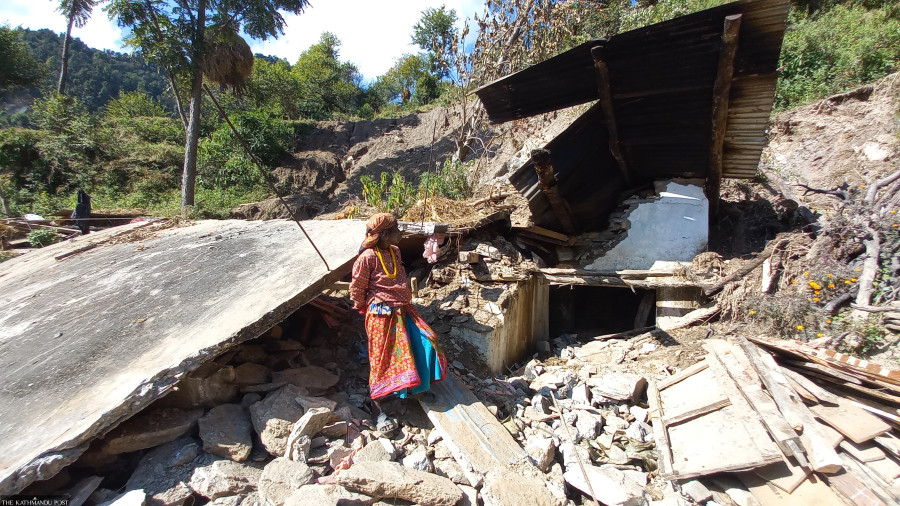
Fifteen homes in Sekugaun, most of them Dalit households, were damaged that night. Sher’s was one of hundreds across Bajhang destroyed by unseasonal monsoon floods that displaced over 1,145 families who needed complete home reconstruction. Another 854 required significant repairs. Dalits made up 463 of these affected families. The National Disaster Risk Reduction and Management Authority (NDRRMA), a government agency tasked with managing disaster risks, identified 31 families whose homes needed complete relocation because they were built in high-risk areas.
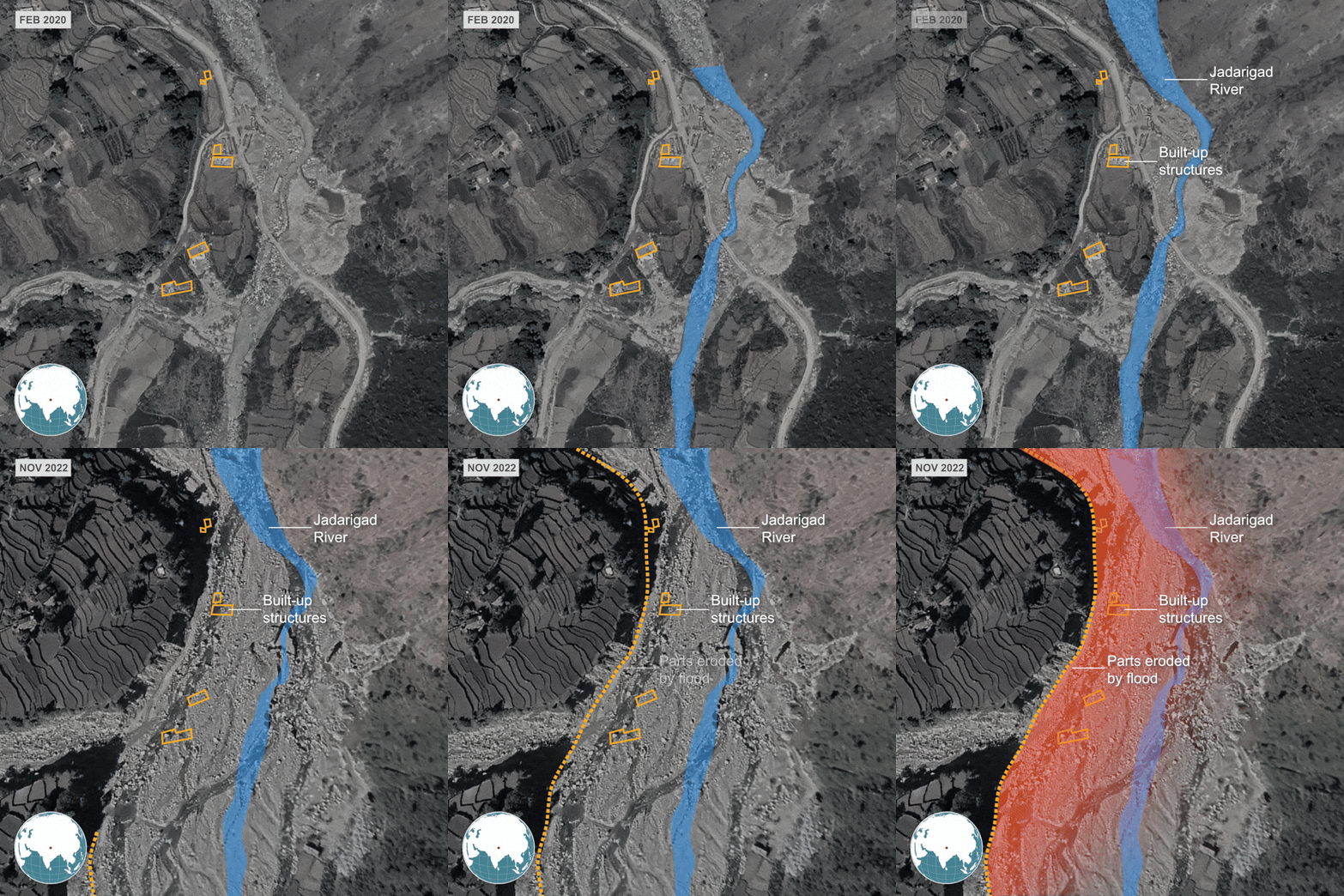
To uncover how Dalit families were excluded from the disaster reconstruction grant, Asian Dispatch analysed the government records obtained through a Right to Information (RTI) request and conducted ground-level verification across flood and landslide affected settlements in Bajhang. We cross-checked multiple beneficiary lists issued by the National Disaster Risk Reduction and Management Authority (NDRRMA) over the years and found many names had been removed or left pending. Using satellite imagery and Google Earth Engine, we also analyzed four decades of rainfall data, which confirmed the 2021 floods hit after the monsoon’s official withdrawal – adding urgency to the devastation. A visual timeline further showed how bureaucratic delays, official inaction, and structural discrimination quietly erased hundreds of Dalit families from the recovery process.

The disaster damaged 15 houses in Sekugaun, home to 85 Dalit families.
Nearly four years later, many of the worst-hit families – especially the Dalit community – have been ignored by the state, with insufficient funds to rebuild. Left off government beneficiary lists or granted partial aid at best, they remain trapped in debt or have been forced to migrate to India. The failure to deliver post-disaster support exposes deep-rooted caste discrimination that persists despite Nepal’s promises of inclusive recovery. Dalits, historically labeled as ‘untouchables,’ are among the most disadvantaged castes in Nepal–routinely excluded from land ownership, state services and political power.
In Bajhang, 125 Dalit families affected by the disaster remain abandoned, their homes marked by padlocked doors. Already among the worst hit, the Dalit community now faces a second crisis–systematic neglect by the government in both relief and reconstruction efforts.
Govinda Raj Pokharel, a former CEO of the National Reconstruction Authority, criticized the government’s failure. “The prolonged delay in rehabilitation and reconstruction work for Bajhang’s disaster victims demonstrates a fundamental weakness in governance. It has ultimately forced people to abandon their country,” said Pokharel, a former Vice Chairman of the National Planning Commission.
“After a disaster in Nepal, the government is tasked with providing immediate temporary shelter to the victims. It is followed by permanent housing within two to three years. This clearly wasn’t a priority,” he said. “Consequently, Dalit and impoverished families – who possessed nothing beyond their homes – were left without any economic safety net when their houses collapsed. These vulnerable people and communities should have received priority attention and additional support compared to others. Instead, they were rendered invisible – the state failed to see them, and they, in turn, felt abandoned by the state.”
Debt and Displacement
Despite the Dashain festival, several teams – including local officials from the rural municipality – arrived days after the landslide to assess the damage. Some brought emergency relief. Deepak Luhar, a local whose ground floor had been engulfed by mud after the landslide broke through one side of his house, followed the teams.
Deepak and his neighbor Sher Damai had narrowly escaped with their families, fleeing just in time. While their lives were spared, their homes were not. In the immediate aftermath, they were told the government would support reconstruction. “They asked us to submit applications to the ward office, saying funds would come for rebuilding,” he recalled. “It’s been four years since we applied. We haven’t received a single rupee.”
Deepak and Sher are among many Dalit families across Bajhang who submitted applications after their homes were destroyed. But most are still waiting. Some weren’t included in the beneficiary list at all. Others received only the first installment and were forced into debt trying to repair or retrofit their houses. A few homes stand shuttered, locked up by families who have since left. Some left for India with hastily built structures abandoned behind them. Others are packing to leave. One by one, Dalit settlements in the district are emptying in the wake of the disaster.
Sher managed to rebuild part of his flood-damaged house by borrowing money. But the repaired walls are already showing cracks. Stones have begun to loosen and fall.
Deepak’s family now lives in a neighbor’s home. Sher earns what little he can through grain paid twice a year in exchange for tailoring clothes for non-Dalits. Deepak relies on his blacksmithing. In their spare time, both take up day labor and borrow money just to survive.
They share a dream: to build strong, permanent homes. But that dream has come at a cost. With mounting debts and no support, their families have been forced to migrate. In April 2022, Deepak’s brother and sister-in-law left for Anarkatta in Bangalore, India, taking their infant child to work as laborers. Two years earlier, Sher’s three sons and two daughters-in-law also migrated with four young children.
“They went hoping to earn enough to rebuild what the landslide destroyed,” Sher said. “But they have to feed their families and send money back too. What little they manage to send is just enough for us to eat. I don’t know when–or if–our dream of building a proper house will come true.”
Systemic Neglect
Neither Sher’s nor Deepak’s name appears on the beneficiary list compiled by the NDRRMA for reconstruction and repair of housing for those at risk from monsoon-induced disasters. When informed of this, the two Dalit members became angry. “Those with less damage than us and even those with no damage at all are on the list, but our names have been removed,” Deepak said angrily. “The well-off receive relief even when they’re not victims, while those of us with real problems have our names cut off. What kind of justice is this?”
According to records from the NDRRMA, 46 Dalit families across all nine wards of Kedarsyun Rural Municipality were affected by the floods and landslides. Of these, NDRRMA’s survey found that 33 families required full house reconstruction, while 13 needed repairs. Yet, even after four years, not a single family–neither those on the list nor those left out–has received any government support for rebuilding or repairs.
One of the victims is 63-year-old Kaisi Od from Dundil in Kedarsyun-1. Her home, built with mud walls and a thatched roof, partially collapsed when one of its walls gave way during the disaster. For two months, her extended family of 19 lived under makeshift tents.
As the cold weather took a toll on her grandchildren’s health, they were forced to take out a loan to build a temporary shed. Repairing the wall and replacing the roof with tin sheets cost them 650,000 rupees–plunging the family into debt. Though they managed to escape the harsh conditions of tent life, they were soon overwhelmed by the financial burden. Eventually, four sons, three daughters-in-law, and nine grandchildren left for India in search of work, leaving behind Kaisi and two of her granddaughters.
“There’s so much debt and no jobs here,” Kaisi said. “They went to India hoping to pay it off. If they’d stayed, how would I feed them all? How could we repay such a huge amount?” She expressed frustration at the government’s failure to deliver on its promises. “If we had received the funds for house reconstruction, my family wouldn’t have had to leave. I wouldn’t be left alone like this in my old age.”
In Dundil village, six out of 23 Dalit families are included in the NDRRMA’s list. Kaisi and four others are categorized as needing house reconstruction and one family is marked for repair. But locals say that 13 Dalit households in the village suffered damage from the disaster.
Broken Promises
In the aftermath of the disaster, it wasn’t just local officials who arrived for an assessment. National leaders, too, descended on Bajhang–each by separate helicopter. Among them were then-Prime Minister Sher Bahadur Deuba, Home Minister Bal Krishna Khand, Far West Province Chief Minister Trilochan Bhatta, Speaker Arjun Thapa, Minister for Internal Affairs and Law Purna Joshi and Kalyani Khadka, chair of the Federal Parliament’s Development and Technology Committee.
They assured survivors that financial aid would soon arrive under the government’s “Private Housing Reconstruction, Retrofitting and Resettlement Grant Procedure 2077,” which allocates 500,000 Nepali rupees for house reconstruction, 50,000 Nepali rupees for repairs and an additional 300,000 Nepali rupees for land purchase in mountainous districts like Bajhang.
Nearly four years later, however, most victims are still waiting.
Under the procedure, local Disaster Management Committees are responsible for identifying beneficiaries and forwarding the list to the District Disaster Management Committee (DDMC). The process is based on digital entries submitted by ward offices, along with required documents like citizenship certificates, proof of land or other records confirming disaster vulnerability. The DDMC then verifies the extent of damage and finalizes the list.
But the reality on the ground tells a different story. Many Dalits–like Deepak Luhar and Sher Damai–were excluded from the initial list. Others, such as Kaisi Od of Dundil village, were listed but later neglected.
Data from the NDRRMA reveals that while the preliminary list had identified 463 Dalit families as eligible for assistance, the final list included only 97. As of now, just 33 families have received the first installment of 50,000 Nepali rupees.
Tasbir Bika, spokesperson for Kedarsyun Rural Municipality, attributes the disparity to deep-rooted structural discrimination. “We raised the issue at the municipal level,” he said. “But across the district, Dalit voices are still ignored. They’re seen as lower-caste citizens and there are no Dalits in decision-making roles. That’s why they’re deprived of services.”
This pattern repeats in Durgathali Rural Municipality, where 107 Dalit families were affected by the 2021 floods and landslides. Of them, 31 needed full reconstruction and 73 required repairs. Yet only 14 families made it to the second list of beneficiaries and none have received any financial support.
Rakail village in Durgathali–3 was among the hardest hit. A landslide severed the road below the settlement, causing several homes to collapse or crack. Five Dalit families abandoned the village three years ago. Those who remain – mostly the elderly and children – live in precarious conditions.
“We submitted petitions to both the ward and the municipality,” said Dhan Bahadur Parki. “But we got nothing. We live in crumbling homes, barely surviving. The government doesn’t care.” His son migrated to India three years ago in hopes of earning enough to rebuild.
According to the DDMC, these victims were eligible, but their names never made it through the system because the municipality failed to approve their inclusion on time.
Kailash Thakurathi, District Chief Officer and DDMC chair, said: “The beneficiary list is uploaded to the NDRRMA’s online system. It only progresses once the municipality verifies and approves it. That didn’t happen. We’ve urged them again and again, but there’s been no action.”
Local officials, for their part, deflect the blame.
“This disaster occurred under the previous leadership. It was their responsibility to ensure victims got aid,” said Ramesh Bahadur Bohara, ward chair of Durgathali–3. “I wasn’t aware people on the list hadn’t received funds. Now that I know, I’ll take action.”
Bohara said that Dalit settlements are often located in disaster-prone areas. “When generational poverty collides with natural calamities,” he said, “people are left with no choice but to leave the country.”
Locked Homes
The consequences of this cycle are starkly visible in Dikla, a village in Thalara Rural Municipality–4. On the night of October 18, 2021, a landslide struck around midnight, wiping out homes and families in an instant. Kalak Sarki lost 18 family members – his mother, wife, four children, brother, sister-in-law and several nieces and nephews. Nare Parki, his neighbor, lost five: his mother, wife, and three children. The landslide destroyed five additional homes and swept away 50 ropani (2.5 hectares) of farmland.
The municipality listed Kalak, Nare and five other families as eligible for government grants. Each was supposed to receive 500,000 Nepali rupees under the disaster assistance program. But three years on, they’ve received only the first installment: 50,000 Nepali rupees.
To rebuild, Kalak borrowed 150,000 Nepali rupees and went to India to work as a laborer, but the debt still looms. Nare, now 57, used donations from individuals and NGOs to buy a plot of land for 150,000 Nepali rupees and lay a foundation for his new house. But with no additional funds, construction stalled. He, too, has since migrated to India.
“Everyone in my family is gone,” Nare said in a phone call from Bengaluru, India. “I thought if the government helped, I could build a home and die on my own land. But fate cheated me – and so did the government.”
Two other affected families in Dikla faced the same situation. After receiving only 50,000 Nepali rupees–far short of what they needed to rebuild or buy land–they, too, left for India with their families. Some now live with relatives, while others struggle to find work abroad.
“We got the 50,000 Nepali rupees in our accounts three years after the landslide,” said Bhagwati Devi Dikli. “That’s not even enough to buy land. How are we supposed to build homes with that?” Her husband, daughter-in-law, and ten other family members have been living in India ever since.
Forgotten by the State
Among the areas hit hardest by the 2021 disaster was Khaptadchhanna Rural Municipality. Floods and landslides left 287 families homeless, including 63 Dalit households. Across Wards 1 through 7, 18 Dalit settlements bore the brunt of the destruction.
In Meltadi, a Dalit village in Ward 3 with 23 households – 20 Damai (Dalit tailors) and 3 Chadara (Dalit wooden utensil makers)–only eight homes still have their doors open. The rest have been locked up. Entire families have migrated to India, abandoning the village.
Surjan Damai said these families, who once relied on scraps of leather given by non-Dalits in exchange for labor, had little to fall back on – just small patches of land and hope. After the disaster, they took shelter in the cowsheds of non-Dalit neighbors, waiting for government relief. When it didn’t arrive, they left for India.
Further east, in Masuradi village of Ward 1, Kali Kami would soon leave for New Delhi with her children. Her husband migrated there two years ago. The family had taken a loan of 425,000 Nepali rupees to build their house, hoping to repay it with the reconstruction aid promised by the government. So far, they have received just 50,000 rupees.
“The government betrayed us,” she said. “We wouldn’t have borrowed so much if they hadn’t promised support. Who wants to leave their home behind?”
Of the 23 families in Masuradi, 12 Dalit households displaced by the landslide had already migrated two years ago. Those who remain live in constant fear, especially during heavy rains. “Our houses are like death traps,” said Prakash Sarki. “We sleep in fear. More families are getting ready to leave.”
According to the 2021 census, Khaptadchhanna has a Dalit population of 2,223. But Ram Bahadur Singh, the ward chair of Khaptadchhanna–5, said only a fraction now live in the village. “Most Dalit villages are empty,” he said. “Maybe five or six hundred Dalits remain in the entire municipality. The rest have gone to India.”
Nepal’s laws mandate that marginalized groups be prioritized in disaster response. The National Disaster Risk Reduction Policy of 2017 and the 12-year Strategic Plan (2018–2030) call for rescue and relief to focus on at-risk groups, including Dalits, the elderly, single women and people with disabilities.
But these commitments rarely translate into action, said Rup Sunar, chairperson of the Dignity Initiative, which researches issues affecting Dalit communities. “We’re good at drafting policies,” he said. “But when it comes to implementation, the deep-rooted discrimination becomes visible. The policies fade into the background.”
He said the situation isn’t unique to Bajhang. Across Far West Province, Dalit communities are among the most exposed to climate-related risks and the most neglected. “With no support, they’re forced to hand over their house keys to neighbors and leave the country,” he said. “It’s tragic that people are being pushed out of their homeland because the state can’t enforce its own promises.”
Four years on, festivals in Bajhang no longer feel the same.
“Sometimes it feels like the Dashain of 2021 brought nothing but misfortune for us,” said Harka Kami of Khaptadchhanna–1. “Since then, we’ve never had the kind of gathering we used to.”
The village is quieter now–emptied by disaster, debt and despair.