
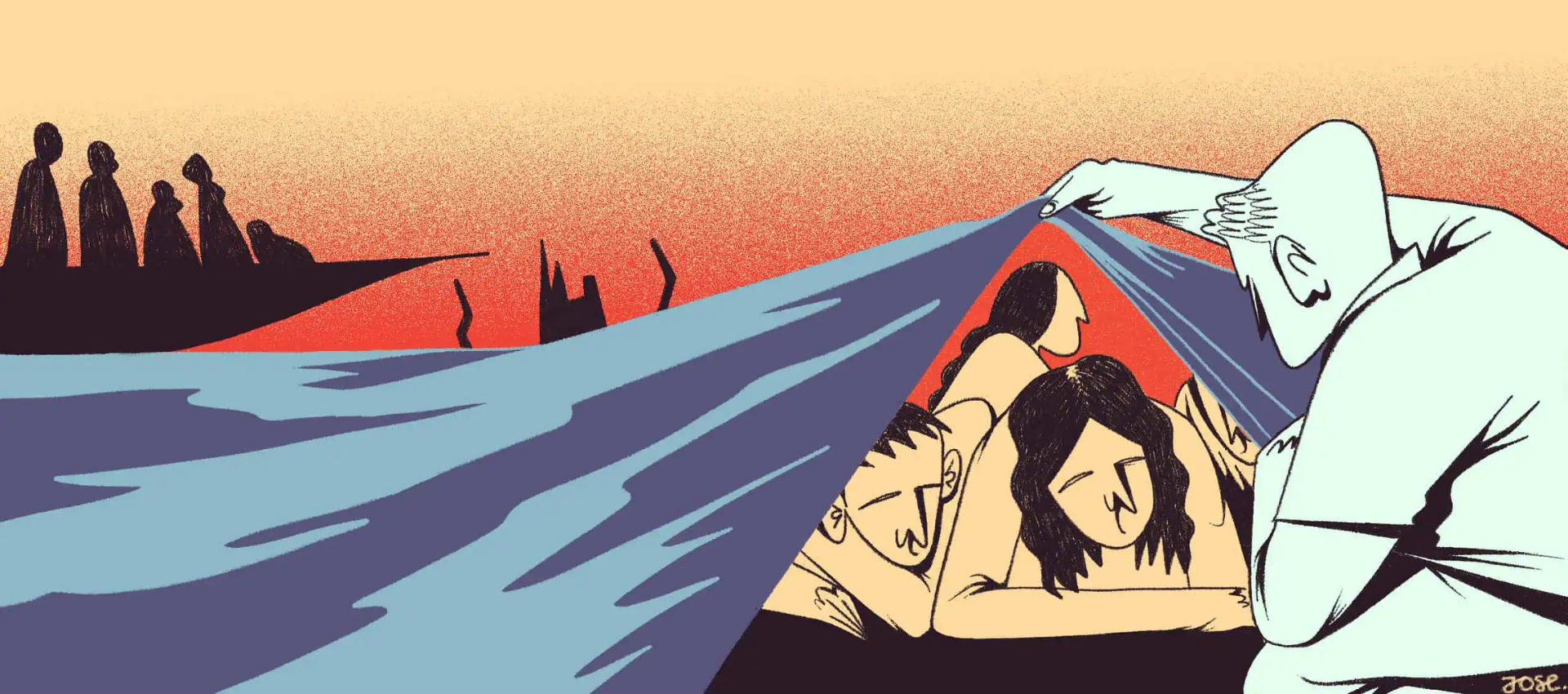
Floods are a fact of life in the northeast Indian state of Assam. But Panash Gogoi, 26, who has spent his entire life in the state, had never seen one as bad as the one that struck on July 19. That afternoon, an embankment on the Darika River broke after several days of relentless rains and water engulfed his village, Nowjan, he said.
“Water entered my home, all our homes; it was like nothing we had ever seen before,” said Panash. He recalled everyone rushing out of their homes and gathering at the nearby highway, which offered higher ground away from the overflowing river.
“I quickly started getting looks,” said Panash, a trans man who works as an actor in community theatre. “This is a time when people come together and start helping each other. I also wanted to help. But most people did not seem to want me there,” he added.
Like Panash, Priya Basfor, a 30-year-old Hijra guru, had a similar experience. She lives in a makeshift home by the train tracks in Amguri with her 12 chelas [disciples]. When the floodwaters rose, they took shelter at the nearby train station, where they felt unwelcome. “Many people were taking shelter at the station and we could tell that people didn’t want us there, but the station is our home, no one can ask us to leave here,” she said.
While both governmental and non-governmental organisations have been working to deliver aid to those in need, LGBTQIA rights organisations are finding that trans people in the worst-hit areas have been left out by the relief operations.
“A flood is something that impacts everyone equally; it doesn’t discriminate,” said Rituparna Neog, trans woman and founder of Akam Foundation, a trans and queer rights NGO based in Dibrugarh.
“However, in the past, flooding has mostly been limited to more rural areas; it is now expanding to peri-urban areas where trans people are more visible and hence more vulnerable to discrimination or being left out of relief drives.”
Rituparna Neog, Trans woman & Founder, Akam Foundation
Akam’s team called up dozens of queer and trans folks across the affected areas and identified 130 people in need of aid. They have delivered aid to 30 of them so far, and are aiming to reach 100 more this month, Rituparna said.
Mridul Yadav, District Commissioner of Sivasagar, denied that anyone was being discriminated against while distributing aid. “We have already distributed aid to about 1.5 lakh families, and we only have a list of about 100 transgenders with us. We are not distributing aid category-wise, but anyone who hasn’t gotten aid I’m sure will get it soon because we want to make sure it gets to the most disenfranchised groups first,” he said.
queerbeat has also contacted the ASDMA and will update this story when we receive a response.
Also Read
According to Rituparna and others associated with Akam, many visibly trans people living independently or in gharanas [community houses] have received no aid.
While queer and trans people living with their natal families have been able to access aid, the flood-driven crisis represents a different kind of challenge for them. “During such disasters, queer people living with natal families are often displaced and forced to live with extended relatives. Even if they may have built comfort and acceptance in their immediate surroundings and society, a move like this might force them back into a closet,” said Bhukhan Gogoi, who works with Northeast Network, a Guwahati-based women’s rights NGO.
Rituparna pointed out that the need to conceal one’s identity is particularly heightened for those forced to live in relief camps. “Many queer and trans people find alternatives, such as sheltering with friends, to avoid being forced into an unsafe environment,” she said.
Discrimination during evacuation and exclusion from aid distribution are only part of the challenge. Over 2,000 houses have been completely destroyed by the flood this month alone—all of them in Sivasagar district. Over 11,000 hectares of crop area have been affected. Once the waters recede and the immediate crisis fades, long-term rehabilitation efforts will be required. Pointing to the COVID-19 pandemic as an example, Bhukhan said that these programs often tend to leave out LGBTQIA+ people. “Historically, trans and queer people have been the last to receive aid; they’re forgotten, so rebuilding after the flood will be the biggest challenge,” he said.
‘It Came Suddenly’
On the morning of July 25, the sun was shining brightly after days of incessant rain, but the roads were still filled with water. It was a little less than a week since the floods had hit Sivasagar district. Trishan Gogoi, a community mobiliser at Akam Foundation, and his colleague were making a precarious 80 km journey by car from Dibrugarh to Sivasagar. They were carrying rice, lentils, and other essential supplies for 30 queer and trans people who had been left out of the government’s aid distribution drive.
The main roads had been rendered inaccessible due to waterlogging, so they drove on dirt tracks through dense forests, struggling to navigate without internet connectivity. “We couldn’t tell where we were even going. The people we were going to meet also couldn’t really guide us because they knew the way through roads, but we weren’t on roads,” Trishan said.
Eventually, after nearly eight hours of slow driving through dangerous terrain, Trishan made it to the first stop in the late afternoon. Trishan had arranged to meet the queer and trans folks seeking aid at the outskirts of their villages.
“We couldn’t go directly into the village because then everybody would swarm us for aid and we were there to provide aid to queer people, and also we didn’t want to out anyone…The thing is even [cishet] people who had received aid could always use more, and it might look like we are discriminating, but it’s actually the opposite; we are just trying to take care of our people.”
Trishan Gogoi, Community Mobiliser, Akam Foundation
Panash Gogoi, the trans man from Nowjan, was among the people who received aid from Trishan. He said that when the village administration was distributing aid, his family was excluded.
“I live with my natal family, but my parents are aged and couldn’t go to collect the aid. When I went, they told me they won’t give it to people who were living on rent,” Panash said. “My neighbours who also live on rent didn’t face the same problem, so I knew that it was because I look different.”
Panash said that when he tried to question the staff distributing aid about why he was being excluded, others waiting for aid told him he was holding up the queue and asked him to leave.
Beyond the immediate struggle for food and shelter after the flood, some trans folks in Assam are also battling anxieties around another form of deprivation: the threat to their legal identities and fundamental rights.
Mahek Khan, a 23-year-old trans woman from Nazira, a town in Sivasagar, was eating lunch with her family when the water burst into their home. As they rushed to evacuate, Mahek’s priority was to grab her transgender ID card.
“That’s one thing I can’t lose. I was lucky to get it before the Trans [Amendment] Act, but now, I know it would be impossible to get it again,” she said. The Transgender Persons (Protection of Rights) Act was amended earlier this year, to introduce a number of new steps in the process of securing a transgender identity card, including medical scrutiny and approval from a district magistrate.
In recent years, Assam has created a National Register of Citizens (NRC) and completed a Special Intensive Revision of its electoral rolls. Both exercises required citizens to provide the state extensive documentation to prove their legal identity. They have resulted in the disproportionate disenfranchisement of marginalised populations including Muslims, Dalits, and gender and sexual minorities who lack the resources to maintain this paper trail.
For many Muslim households like Mahek’s, keeping documents safe has become a number one priority these days.
“Especially after the NRC, we know that your Indianness can be questioned at any moment. Many people’s names were left out because of similar situations of having lost their documents in floods,” she said.
After the Flood
Mahek’s family has now returned to their home made of bamboo and mud. They had spent the last 20 days in their aunt’s house in Sonari, about 35 km away from their home in Nazira. “The water has dried now, but everything is ruined,” she said. The government has announced that it will offer financial aid to those whose homes have been destroyed, so they have to be at home to collect it.
“While many people are now coming forward to help with aid, rehabilitation will be the biggest challenge, and will cost the most money,” Rituparna said. “It’s only once the flooding stops that we’ll be able to properly assess who needs help and how we can help them,” she added.
Meanwhile, Mahek has moved to Mumbai in the hope of finding work and supporting her family. “We had bought an auto on EMI; even that got swept away in the flood, so when a trans sister of mine told me I could stay with her, I left. I knew I had to contribute [financially],” she added.
According to Rituparna, one of the biggest challenges of rebuilding after a crisis like this is addressing loss of livelihoods. The aftermath has been particularly harsh on those reliant on informal income—such as members of the Hijra community, many of whom earn their living through begging and sex work.
“We work on the trains, and so our source of livelihood is gone. It’s been almost a month that they have been shut,” said Priya, the Hijra guru. Without a source of income, she and her disciples ran out of money and food in the days following the floods. The aid they received from Trishan came at the right time, but now even that’s running out, she said.
Over the past couple of weeks, Priya has watched other people who live near the train tracks leaving to seek shelter in their relatives’ homes. “We don’t have anywhere to go; this is our home. It took us a long time to build this, gathering money over time to buy a fridge and a microwave; it’s all gone now,” she added.
Priya’s disciples are in their 20s, and for all of them this disaster will become a defining one, she said.
“We have these gharanas so that trans people have a safe place to land. I was supposed to take care of them, provide for them, but I can’t protect them from something like this,” she said.