

Over the last few weeks, courts across the UK have been busy.
On July 29, when an 18-year-old boy attacked children at a Taylor Swift-themed event and killed three young girls in the UK’s Southport city, it opened a Pandora’s box that is the long-simmering racist sentiments among some sections of its society. Violence engulfed several cities in the country led by far-right British mobs and lone individuals. Their target? Muslims and their businesses, and services like hotels used by asylum seekers.
Now, courts are doling out sentences to citizens accused of partaking or fanning violence. A total of 1,280 arrests and 796 charges later, trials include a 12 year old from Manchester, a Tory councillor’s wife in Southport and a law student in Plymouth.
The riots are widely attributed to a long-simmering anti-immigration sentiment in the UK. For many British citizens of South Asian and African descent, also known as the “Windrush generation”, last month’s events were a painful reminder of deadly racist attacks in the ’70s and ’80s. The Windrush generation were people of former colonies invited to rebuild post-World War 2 UK. A 2023 survey by the University of Oxford shows that while attitudes towards immigrants have softened over the decades, over 50 percent of people there still think immigration numbers should be reduced.
UK police have confirmed the role of not just far-right extremism but also disinformation that led to the worst violence the country has seen over a decades where hotels housing asylum seekers, migrants and Muslims were targeted. The rioters also set alight police vehicles, mosques and Asian-owned businesses.

Who created the racist hoax that fanned UK race riots?
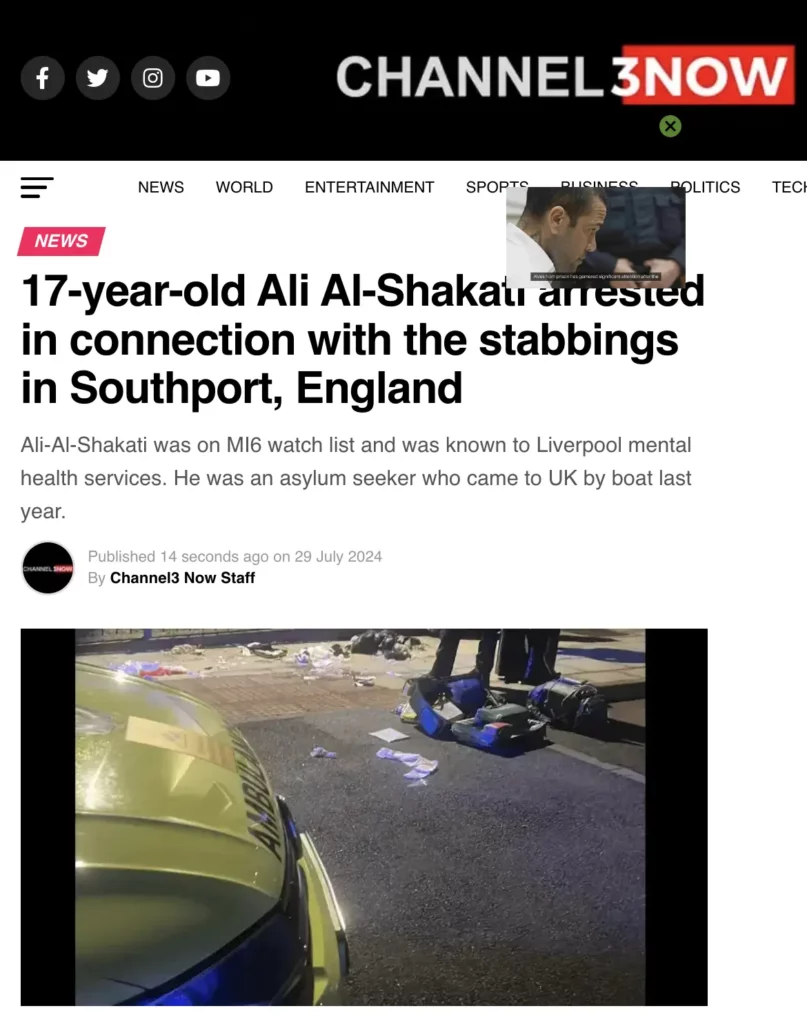
It was the social media handle of a “Channel3Now News” on X that gained conspicuous traffic shortly after the July 29 attacks.
In a now-deleted post on X detailing the identity of the attacker, this obscure website published an article and X post claiming that the attacker is an immigrant who came to the UK illegally by boat and is on a watch list related to security and mental health.
Channel3Now is a little-known website operated from Pakistan. A BBC investigation found that the website aggregates crime news from across the world to earn its revenue. Channel3Now had shared the hoax without a byline and admitted to the BBC that the fake news “shouldn’t have happened but it was an error, not intentional.”
A man called Farhan Asif, who lives in Lahore and is identified as a 32-year-old web developer, was arrested last month by Pakistani police under cyberterrorism laws, but eventually released last week after the police said they couldn’t find evidence that he posted the news. The UK police, however, say that it was Asif who shared the post and deleted it later. Asian Dispatch could not independently confirm whether the hoax was posted from Pakistan, the UK or another part of the world.
In another interview, Asif is quoted as saying: “I don’t know how such a small article or a minor Twitter account could cause widespread confusion.”
The website has since been shut down but an archived version of the hoax article shows the name “Ali-Al-Shakati” attached to the attacker on July 29 without any attribution to police statements. On Twitter, the website still has an unverified page.
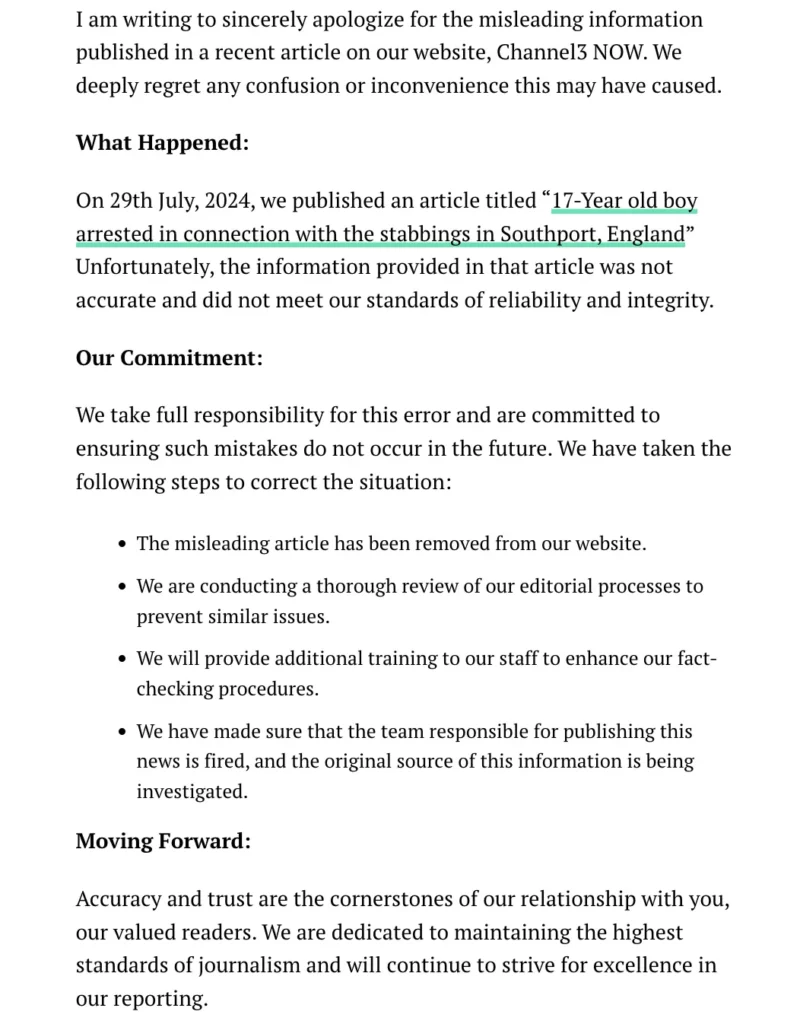
The real name of the attacker was revealed last month by the Liverpool crown court for the sake of public interest and in the light of disinformation being spread online. Axel Rudakubana, who is 18, was born to Rwandan parents in Cardiff.
How did the Western far-right influencers cash in on the hoax?
The fake news has since been debunked by media outlets and the UK police. However, the damage has been irrevocable.
By the time Channel3Now’s hoax post was deleted, it had received 1.7 million views. Far-right influencers reshared the fake news on their platforms. In his video, which is flagged for “hateful conduct” on X but still has 15.2 million views, Andrew Tate said, “The soul of the western man is so broken that when invaders slaughter your daughters, do you nothing” and warned that “they are going to keep coming.” Tate has been charged with rape and human trafficking in Romania.
Former British actor-turned-rightwing influencer Laurence Fox tweeted how “British girls have been raped by immigrant barbarians”, garnering 5 million views. Fox has previously opposed protests in support of George Floyd’s killing in the US and shared anti-vaxxer sentiments during COVID-19 pandemic.
Another rightwing influencer Stephen Yaxley-Lennon, better known as Tommy Robinson, also shared the fake news on his X account that has nearly one million followers, repeatedly linking Muslims in general to the attacks and accusing the government of “gaslighting” the public. Before his posts were deleted, it reportedly had 54 million daily views. Robinson is the founder of English Defence League, a now-defunct anti-immigrant and Islamophobic group.
Nigel Farage, who runs UK’s populist and right-wing political party called Reform, amplified the fake news too by suggesting that the UK police is withholding information about the July 19 attacks.
The violence followed soon and in tandem with these posts, first in Southport, then followed by cities of Rotherham, Tamworth, Manchester, Liverpool, Belfast in Northern Ireland, and others.
What is the role of social media platforms in all of this?
In conversations of social media platforms and threats to democratic and pluralistic values, X has been more than just culpable. Reports have shown how X is an incubator of misinformation. A Washington Post analysis found that hate speech is inherent in X’s algorithm. X’s owner Elon Musk himself has been accused of spreading hate and misinformation. In the wake of UK attacks, his now-deleted posts targeted prime minister Keir Starmer while claiming the UK was on the cusp of a “civil war” because of “unchecked immigration.”
How did the July 29 hoax contribute to existing racism in the UK?
A 2023 survey carried out by an independent UK research institute Centre on Dynamics of Ethnicity found that over a third of people from minority groups in the UK have experienced racist assaults. The report also documents varying degrees of racism across all aspects of life, from health and wellbeing to socioeconomic indicators. Last month, the UN released a report connecting the rise in racism with racist comments by the UK’s political leaders.
Surveys show that although Brexit toned down anti-immigrant sentiments, it has been seeing a rise since 2022 as reports of immigration rose. A YouGov tracker of issues that UK citizens feel strongly about, found a dip in interest in immigration and asylum issues after 2016, but there’s a sharp uptick in mid-2022. Another YouGov data found that 57 percent of surveyed people blame the role of the media in painting the immigration and asylum issue negatively.
Axel, a student at Durham University who withheld his full name for privacy reasons, explained how the far-right media has been framing the immigrants as the “other.”
“(It) frames the people of colour as the source of Britain’s plight and the enemy of the white working class,” he said. “This false narrative resonates with many who are struggling, especially those with racist sentiments, pulling them towards more entrenched far-right politics and racism.”
The UK government data shows a decline in the number of asylum seekers – 69,298 asylum applications until March 2024, which is 14 percent lower than the number of applications by March 2023.
However, another official data on illegal immigration, which shows 6,265 small boat arrivals between January 1 and April 21, 2024, compared to 5,049 in the same period last year, an increase of 24 percent.
“Anti-immigration sentiment has grown due to inadequate and poorly communicated immigration policy,” Axel said. “Both in processing immigrants and refugees justly, and in failing to provide towns and cities the resources, they need to manage demographic changes as a diverse and integrated community.”
“This has led to a rise in far-right politics, instead of an inclusive and just policy change,” he added. “Declining living standards, poverty and widening inequality associated with the cost of living crisis has left many wondering why their lives are getting harder.”
Raza Rumi, a lecturer at the City University of New York, and a graduate of London School of Economics, reiterated the role of economic stress.
“In part, the economic stress in recent years and squeeze in public services and entitlements under the larger framework of neoliberal economic policies has created a difficult situation for working people and middle classes. Homelessness, poverty including child poverty have been on the rise,” he said.
“This is a fertile environment to blame the migrants and build false narratives that they are the problem for these societies. In fact studies show that immigrants in western societies are contributing to economic development and fulfilling important needs for skilled and semi skilled workers,” he added.
Today, anti-immigration sentiment has now become a Europe-wide phenomenon. In this year’s European parliamentary elections, anti-immigrant sentiment was a key factor that enabled far-right parties in several countries, including France, Germany, and Italy, to secure more seats.